Spotting before your period: causes, patterns and when to seek assessment

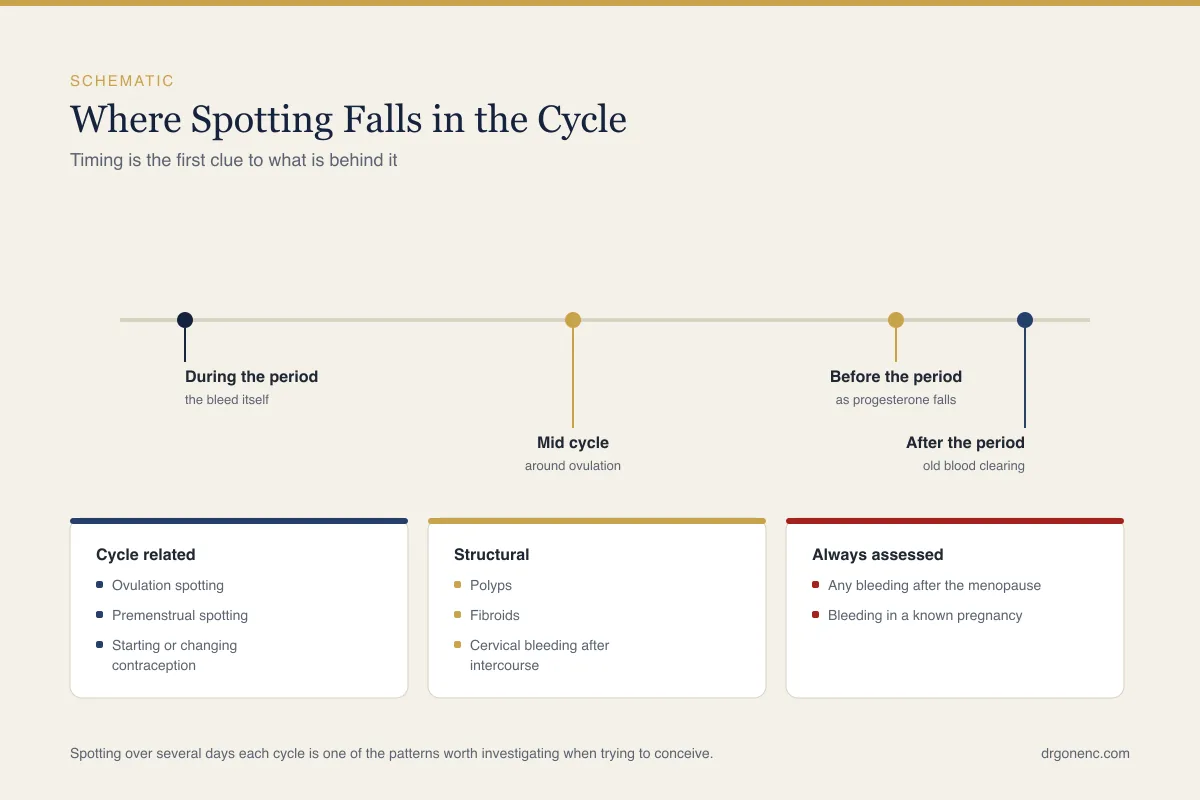
A few spots of brown or pink loss in the days before a period is one of the commonest things people notice about their own cycle, and one of the hardest to interpret, because an identical appearance can come from something entirely ordinary or from something that deserves a look. Spotting is not a diagnosis. It is a description of volume: bleeding light enough that it needs no protection at all, often seen only on wiping or as a small mark on underwear. What gives it meaning is when in the cycle it arrives, whether it is new for you, and what it arrives with.
This article works through spotting by timing, because timing is usually the most informative single piece of information: the day or two before a period as progesterone falls away, around mid cycle at ovulation, in the first months of a new or changed hormonal contraceptive, from the cervix after intercourse or a smear, and in early pregnancy, where a light short bleed is often recorded as a light period. It also covers the structural causes that need assessment rather than watching, the luteal phase question raised in people trying to conceive, and the findings that need attention the same day.
What counts as spotting, and what counts as a period
A period is bleeding that follows the shedding of the uterine lining at the end of a cycle. It arrives with some predictability, lasts a few days, and on its heavier days needs a pad, a tampon or a cup. Measured menstrual loss across a whole period averages somewhere in the region of 30 to 40 mL in healthy cycles. Spotting is a small fraction of that, often well under a millilitre across a whole day, and the practical test most clinicians use is whether any protection was needed at all.
The distinction is not pedantic, because it changes how a cycle is counted. Day one is the first day of proper bleeding, not the first day of spotting, so a day of light brown loss before the flow starts is recorded separately. Counting it as day one shortens the cycle on paper, shifts the apparent timing of ovulation, and can mistime blood tests that are dated from day one. A short written record of the last few cycles is far more useful to a doctor than an impression.
Several words describe the same observation from different angles. Intermenstrual bleeding means any bleeding between periods. Premenstrual spotting describes light loss in the days immediately before a bleed. Breakthrough bleeding is the term used while on hormonal contraception, and postcoital bleeding is bleeding after intercourse. All four are descriptions rather than diagnoses, and each one points towards a different list of causes, which is why a doctor will ask so precisely about the day it happened.
It is also worth knowing that the bodies that publish on this do not use identical definitions of a normal cycle. Patient information from the NHS and from ACOG both put usual cycle length at 21 to 35 days and a period at up to 7 days, while the classification systems used in gynaecology practice are a little wider, treating cycles of roughly 24 to 38 days and bleeding of up to 8 days as within normal limits. A cycle inside either set of limits is not abnormal on length alone, and spotting is assessed on its pattern rather than against a single agreed number.
What does spotting look like
Colour is usually the first thing noticed, and it is explained by speed rather than by anything hormonal. Blood that leaves the uterus slowly has time to oxidise on the way out, so light loss tends to look brown, rust coloured or pink rather than red. Fresh red loss has arrived faster, which is why bleeding from the cervix after intercourse often looks brighter than premenstrual spotting does. Colour on its own therefore says very little, and nothing at all about fertility.
- Brown or dark brown marks seen only on wiping, with nothing on underwear or on a liner
- Pink tinged cervical mucus, which is what mid cycle spotting most often looks like
- A single small spot of fresh red blood, lasting less than a day
- Light rust coloured loss that comes and goes over two or three days before the flow proper begins
- Loss that stops and starts rather than running continuously, and that needs no protection on any day
What the appearance cannot tell you is the cause. A polyp, a cervical ectropion, an early pregnancy and ordinary progesterone withdrawal can all produce a day of brown loss that looks the same in the bathroom. This is why the clinical questions are about timing, repetition and accompanying symptoms, and why bleeding that is heavier than spotting, or that comes with pain, fever or an unusual discharge, is treated as a different problem rather than as spotting.
Spotting that needs assessment the same day
Most spotting is not urgent. A small number of presentations are, and they are set out here rather than at the end of the article so that nobody reads their way past them. Two of them cannot wait at all: if light bleeding in someone who is or could be pregnant comes with severe tummy pain, pain in the shoulder tip, feeling sick, faint or dizzy, collapse, or bleeding that turns heavy, call an ambulance or go to an emergency department now. For everything else listed below, contact a doctor, an early pregnancy service or an emergency department the same day rather than waiting to see what the next cycle does.
- Any bleeding or spotting with pain low down on one side, in someone who could be pregnant, whether or not a test has been done, because of the possibility of an ectopic pregnancy
- Shoulder tip pain, feeling faint or dizzy, collapse, severe tummy pain, or pain on opening the bowels alongside light bleeding in a possible pregnancy. This is an emergency now, not an appointment later today.
- Bleeding that becomes heavy, soaks through protection quickly or passes large clots. Call an ambulance if you are or could be pregnant; the same day otherwise.
- Bleeding with fever, feeling unwell, or a discharge that smells offensive, which raises the question of infection in the uterus or pelvis
- Bleeding at any stage of a known pregnancy, which should always be reported the same day even when it settles
The reason for naming these separately is that the dangerous causes of light bleeding are not the dramatic ones. An ectopic pregnancy very often announces itself with spotting and one sided discomfort rather than with heavy loss, and the window in which it is straightforward to treat is measured in days. Nothing in the rest of this article should be read as a reason to wait when one of the findings above is present. One further pattern sits just outside this list: any bleeding after periods have stopped for a year or more, including a single episode of spotting, is not an emergency but always needs a cause to be identified, so book promptly with a doctor rather than waiting, as described later in this article.
The day or two before your period: progesterone falling away
After ovulation the emptied follicle becomes the corpus luteum, and its job is to produce progesterone, which holds the lining stable and secretory. If no pregnancy implants, the corpus luteum has a finite life and progesterone support falls away towards the end of the cycle. The lining then begins to break down, and the first part of it to do so can produce a small amount of dark loss a day or two before the main bleed arrives. For many women this is simply how their period starts.
Judged on its own, a day of brown loss immediately before a bleed that then behaves normally is one of the least worrying patterns in gynaecology. What matters is whether it is yours. Someone who has always seen a day of spotting before the flow has a pattern. Someone whose period used to begin abruptly and now opens with three days of intermittent brown loss has a change, and a change is the thing worth describing to a doctor, even when the explanation turns out to be benign.
Two ordinary situations lengthen this premenstrual window without indicating disease. In perimenopause, cycles become more variable and progesterone production less consistent, so spotting before and sometimes between bleeds becomes more common. In the first cycles after stopping hormonal contraception, after a birth, or while breastfeeding, the lining and the hormonal signals are re-establishing themselves and light loss at the edges of a bleed is frequent while that settles.
Spotting a week before your period, and the luteal phase
Spotting that starts roughly a week before the expected bleed falls in the middle of the luteal phase, which is the part of the cycle between ovulation and the period. This is a different pattern from a day of brown loss immediately before the flow, and it is the one that gets investigated, particularly in people trying to conceive, because it raises the question of whether the lining is being adequately supported or whether something inside the cavity is bleeding.
Here the honest answer is that the evidence is less settled than internet writing on the subject suggests. ASRM takes the position that luteal phase deficiency is not a condition that can be reliably diagnosed as a standalone cause of infertility or pregnancy loss, because no test has been validated for the purpose. Progesterone can be measured in the mid luteal phase, roughly seven days after ovulation, when levels peak. The same ASRM committee opinion holds that a luteal value above 3 ng/mL, around 10 nmol/L, is sufficient evidence that ovulation has recently happened, and that no minimum figure defines a normal ovulation; higher cut-offs such as the 30 nmol/L, in the region of 10 ng/mL, used by some UK services say more about the strength of luteal support than about whether ovulation occurred, and a substantial share of mid luteal values in women who are ovulating normally fall below 10 ng/mL. A single figure is therefore a snapshot of a hormone that is released in pulses.
So rather than labelling the luteal phase, assessment usually looks for things that can be found and treated. That means a pelvic examination, swabs if infection is possible, a transvaginal ultrasound scan to look at the lining and the cavity, consideration of thyroid function and prolactin where cycles are also irregular, and in some cases hysteroscopy to see the cavity directly. Repeated premenstrual spotting over several days should be discussed with the doctor managing your care rather than treated as a diagnosis in itself.
Mid cycle spotting around ovulation
Around ovulation, oestrogen peaks and then dips before progesterone rises, and that brief fall in oestrogen support is the usual explanation for a small amount of endometrial shedding at mid cycle. The follicle also ruptures and releases a little blood and follicular fluid into the pelvis, but that blood stays in the abdomen and is not what appears in the vagina. Because cervical mucus at this point in the cycle is clear, abundant and stretchy, the result is often described as pink tinged mucus rather than as bleeding, and it usually lasts hours rather than days. The pattern is covered in more detail in our article on ovulation bleeding and spotting.
Timing is what separates this from other explanations. Ovulatory spotting sits near the middle of the cycle, recurs in the same part of successive cycles, and is brief. Spotting that appears later, around the time implantation would be occurring, has a different set of causes. Spotting that happens at unpredictable points, or that has no relationship to the cycle at all, is the pattern that points away from ovulation and towards the cervix, the cavity or infection.
Mid cycle loss that is new in someone whose cycles never did this, that happens every cycle and is becoming heavier, or that comes with pelvic pain or an altered discharge, deserves the same assessment as any other intermenstrual bleeding. The fact that a bleed falls at mid cycle does not by itself prove it came from the ovary, and a polyp or an ectropion can bleed at any point in the month.
After starting, changing or stopping hormonal contraception
Unscheduled light bleeding is one of the commonest effects of hormonal contraception, and it is expected rather than surprising in the first months of a new method. Combined hormonal methods, progestogen only pills, the implant, the injection and the hormonal intrauterine system all thin and alter the lining, and a thin lining is a lining that sheds at unpredictable moments until it stabilises. With progestogen only methods in particular, irregular spotting is a recognised part of the early pattern.
Guidance genuinely differs on how long to persist before reviewing. FSRH advice is to give a new method around three months before judging the bleeding pattern, while NHS and ACOG patient information frames the decision around whether the bleeding is acceptable to the woman herself rather than around a fixed interval. Both approaches are reasonable. What neither supports is stopping a method abruptly without advice, since that produces its own withdrawal bleed and leaves a gap in contraceptive cover.
Two refinements are worth knowing. Missed or late pills, vomiting and diarrhoea can all cause breakthrough bleeding and can reduce contraceptive effect at the same time, so bleeding that follows a run of missed doses is a prompt to check the instructions for that method with a pharmacist or doctor. Separately, new bleeding after years of a settled pattern on the same method is not simply attributable to the method, and should be assessed in the same way as intermenstrual bleeding in anyone else.
The cervix: spotting after intercourse, after a smear, and with infection
The cervix is a frequent source of light bleeding, and it is easy to see why. Its surface is delicate, it carries a rich blood supply, and in many women the softer glandular tissue from inside the canal extends onto the outer surface, a finding called an ectropion. That tissue bleeds readily on contact. Bleeding after intercourse is therefore often cervical and often benign, but postcoital bleeding is also one of the patterns that merits an examination at least once rather than reassurance by search engine.
Cervical screening is relevant twice over. A day of light spotting after a smear is ordinary, because the sample is taken by brushing the surface of the cervix. More importantly, spotting is never a reason to postpone screening, and a doctor assessing bleeding will want to know when your last screening test was and what it showed. Screening intervals and the age at which screening starts are set differently in different countries, so follow the programme where you live rather than advice written for somewhere else.
Infection is the other cervical cause, and it can be quiet. Chlamydia and gonorrhoea can inflame the cervix with no symptom other than light bleeding or a change in discharge, and untreated infection can ascend to cause pelvic inflammatory disease. Testing is straightforward, treatment with antibiotics is prescribed by a doctor according to local resistance patterns, and recent partners need testing as well. Bleeding accompanied by pelvic pain, fever or an offensive discharge should be assessed promptly rather than watched.
Spotting in early pregnancy, mistaken for a light period
Light bleeding around the time a period was due is one of the ways early pregnancy presents, and it is a common reason for a pregnancy to be dated wrongly. The bleed is typically lighter, shorter and often browner than that person's usual period, and because it arrives roughly on schedule it gets written down as a light period. A pregnancy test taken a few days later is the quickest way to settle the question. The timing and appearance are discussed further in our article on implantation bleeding.
Once a pregnancy is known or possible, the approach changes. NHS guidance is that any vaginal bleeding in pregnancy should be reported, because although many such pregnancies continue entirely normally, bleeding is also how miscarriage and ectopic pregnancy present, and the two cannot be separated on the description alone. Assessment is usually a combination of examination, a blood test for hCG and an ultrasound scan, arranged through a doctor or an early pregnancy assessment service.
The practical consequence for anyone trying to conceive is to treat an unusually light, short or brown bleed as a possible pregnancy rather than as a confirmed period, and to test accordingly. For anyone not trying to conceive but at risk of pregnancy, the same applies. A negative test taken too early can be wrong, and repeating it after a few days is the standard advice if the period does not behave as expected.
Structural causes, and why bleeding after the menopause is different
When spotting is repeated, unrelated to the cycle or new in someone with previously regular bleeding, attention turns to the cavity itself. Endometrial and cervical polyps are soft outgrowths of lining tissue with a fragile surface and are a classic cause of intermenstrual and postcoital spotting. Fibroids that sit within or distort the cavity can do the same, as can adenomyosis. Chronic inflammation of the lining is another recognised cause, and infection must be excluded in any new bleeding pattern.
Assessment is methodical rather than elaborate: history and examination, swabs where appropriate, a transvaginal ultrasound scan that reports the lining thickness in millimetres and looks for focal lesions, and hysteroscopy where the scan is unclear or a polyp is suspected, since hysteroscopy both sees and treats. Thresholds used to interpret lining thickness differ between guidelines, with some services acting on a measurement above 4 mm after the menopause and others using 5 mm, which is one reason results are interpreted alongside the clinical picture rather than alone.
Bleeding after the menopause sits in a category of its own. Once periods have been absent for a year, there is no longer a cycle to explain light loss, so any bleeding, including a single episode of spotting, needs a cause to be identified. NICE sets out referral pathways in its suspected cancer guidance, and ACOG patient information states that bleeding after the menopause should always be evaluated; the wording differs but the destination is the same. Most causes turn out to be benign, most often thinning of the womb lining, called endometrial atrophy, or of the vaginal and vulval tissues, but that conclusion is reached after assessment and not before it.
The common patterns side by side
The table below sets out the patterns described above in the order a doctor would think about them, which is by timing. It is a way of organising a conversation, not a diagnostic tool, and a pattern that appears in the first column with a reassuring entry in the last one still deserves attention if it is new for you or if it is changing from cycle to cycle.
| Timing | Usual appearance | Common explanation | Assessment |
|---|---|---|---|
| A day or two before the flow | Dark brown, only on wiping, merging into the period | Progesterone falling as the corpus luteum ends | Usually none if this is your own steady pattern |
| Several days before the flow, cycle after cycle | Light brown or pink, stopping and starting, before a normal bleed | Luteal phase and endometrial causes, sometimes a polyp | Worth a routine appointment, especially when trying to conceive |
| Mid cycle, around ovulation | Pink tinged mucus, or one spot lasting less than a day | The brief dip in oestrogen around ovulation, before progesterone rises | Usually none if brief and cyclical; assess if new or heavier |
| First months of a new or changed hormonal method | Light red or brown, unpredictable, over several weeks | Breakthrough bleeding while the lining adjusts | Review with the prescriber if it persists or is unacceptable |
| After intercourse or after a smear | Fresh red loss, brief, usually without pain | A delicate cervix or an ectropion, sometimes infection | Examination at least once, and check screening status |
| Possible or confirmed early pregnancy | Lighter, shorter and often browner than your usual period | Several causes, some needing urgent exclusion | Pregnancy test, then contact a doctor or early pregnancy service |
| Any bleeding after a year without periods | A single episode of spotting is enough to count | Needs a cause to be identified rather than assumed | Prompt assessment, not watching |
Read across a row rather than down a column. The same brown mark on tissue paper belongs to a different row depending only on the day it appeared, which is why the single most useful thing anyone can bring to an appointment is a note of the dates. Two rows can also apply at once, since someone on a hormonal method can still develop a polyp, and the method does not excuse a new pattern from being looked at.
When to seek assessment rather than watch
The urgent findings are listed earlier in this article and are the ones that override everything else. Short of those, the useful distinction is between a single episode and a pattern. One day of light brown loss before an otherwise ordinary period, in someone whose cycles are regular and who feels well, rarely needs investigating. Spotting that repeats, that is new for you, or that comes with other changes is worth a routine appointment, and the sooner it is described accurately the shorter the process tends to be.
- Spotting between periods at all, which ACOG counts as abnormal uterine bleeding even after a single episode, and which is worth raising with a doctor rather than waiting to see whether it repeats
- Bleeding after intercourse, even once, since this merits an examination of the cervix
- Premenstrual spotting over several days in someone trying to conceive, or alongside difficulty conceiving
- Spotting with pelvic pain, an altered or offensive discharge, or pain on intercourse
- A bleeding pattern that has changed on a hormonal method you have used without problems for a long time
- Any bleeding after the menopause, which needs a prompt appointment rather than monitoring at home. Bleeding in pregnancy is not on this list because it belongs in the urgent list earlier in this article and should be reported the same day, not saved for a routine appointment.
Preparing for the appointment makes a real difference. Bring the dates of the last three or four cycles with the spotting days marked separately from the bleeding days, the name of the contraceptive method you use and when it started, the date and result of your last cervical screening test, and a note of any new medication. If pregnancy is possible, do a test beforehand, because the answer changes which assessment is appropriate on the day.
Everything here is general information about a symptom that has many causes, several of them entirely benign and a few of them time critical. It cannot substitute for an examination, a scan or the judgement of the doctor who knows your history, and where this article and your own doctor differ, follow your doctor. If you are unsure whether what you are seeing counts as spotting or as a period, that uncertainty is itself a good reason to ask.
Related Reading
- Ovulation Bleeding and Spotting: Why It Happens and How to Tell It Apart
- Implantation Bleeding: What It Looks Like, Timing, Cramps and When to Test
- The Luteal Phase: Meaning, Length, Symptoms and Progesterone
- Uterine polyps and fertility: endometrial polyps, symptoms and removal
- Why is my period so light? Causes, assessment and what it means for fertility
- Low progesterone symptoms and causes: how a result is actually read
- Implantation cramps: what they feel like and what they cannot tell you
Sources and references
This article is supported by the following independent, authoritative sources:
- ACOG, Abnormal Uterine Bleeding
- ACOG, Perimenopausal Bleeding and Bleeding After Menopause
- NHS, Postmenopausal bleeding
- NHS, Vaginal bleeding in pregnancy
- ASRM, Diagnosis and treatment of luteal phase deficiency: a committee opinion
- NICE, Suspected cancer: recognition and referral (NG12), recommendations organised by site of cancer