Why is my period so light? Causes, assessment and what it means for fertility

A period that is suddenly barely there, finished within a day, or needing nothing more than a liner, is one of the commonest reasons people start searching for reassurance about their cycle. The honest answer is that menstrual loss varies enormously between healthy women, and there is no single volume that marks the boundary between normal and abnormal. What is light for one person is ordinary for another. Doctors sometimes use the word hypomenorrhoea, or describe a scanty period, but that is an observation rather than a diagnosis.
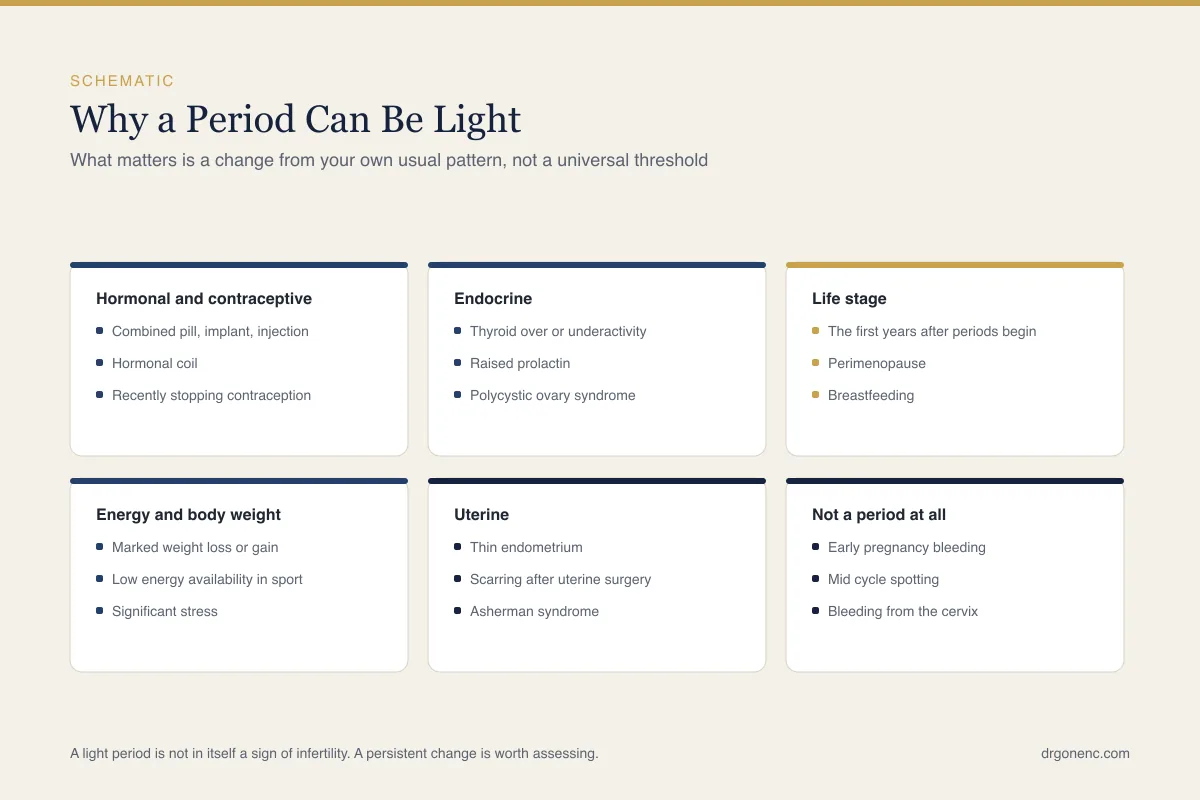
This article explains what counts as a light period, why the question that matters is whether this is a change from your own usual pattern rather than how you compare with anyone else, and the reasons a bleed becomes lighter: age at either end of reproductive life, hormonal contraception and the hormonal coil, recently stopping contraception, the months after a birth and while breastfeeding, weight change and heavy training, stress, thyroid disease, raised prolactin, polycystic ovary syndrome, perimenopause, a thin or scarred lining, and early pregnancy bleeding mistaken for a period. It also sets out which changes need assessment the same day, what assessment involves, whether a light period needs treating at all, and what it does and does not say about fertility.
What counts as a light period, and what does not
Measured menstrual blood loss across a whole period averages somewhere in the region of 30 to 40 mL in healthy cycles, and loss above about 80 mL is the figure used in research to define heavy menstrual bleeding. Nobody measures this in clinic. Collecting and weighing menstrual loss is a research technique, so in everyday practice volume is recorded as the woman describes it: light, normal or heavy for her. In practice, neither the FIGO classification of abnormal uterine bleeding nor patient guidance from bodies such as ACOG defines bleeding by a measured volume; both describe it in terms of what the woman reports and how it affects her, which is a recognition that lived experience is the measurement actually available.
Alongside volume, two other features of a period are worth separating out, because people often use the word light to mean one of them instead. Frequency is how often bleeding arrives. The FIGO classification of abnormal uterine bleeding puts the usual range at 24 to 38 days, while NHS and ACOG patient information both use 21 to 35 days; on either definition a cycle inside those limits is not abnormal on length alone. Duration is how many days it lasts, and FIGO treats up to 8 days as normal, with NHS and ACOG material quoting up to about 7. A light period is then usually described as one that is shorter than it used to be, needs fewer products, or produces only spotting on days that previously needed a pad or a tampon.
Colour is worth a word, because it is usually the first thing noticed. Blood that leaves the body slowly has time to oxidise, so a light flow is often pink, brown or rust coloured rather than red, and brown spotting at the start or end of a period is ordinary. On heavier days the loss is red because it arrives faster. Colour on its own therefore says very little about volume and nothing about fertility. The exception is a bleed that is lighter, darker, more watery or more brown than your own periods usually are in someone who could be pregnant, because that is the description that goes with an early pregnancy complication, and it is the pattern set out below.
There is deliberately no agreed millilitre threshold for a light period, and that absence is informative rather than a gap in the textbooks. Some women have bled lightly for two or three days since their teens, have regular predictable cycles, and are entirely well. Others bleed for six days and find two of those days heavy. Neither pattern is a problem by itself. A single lighter period after a stressful month, a bout of illness or a holiday is also common, and on its own it rarely means anything at all.
The question that matters: is this a change from your own pattern?
Because the normal range is so wide, comparing yourself with a friend, a forum thread or an app average answers very little. What carries information is your own baseline. A period that has always been light, in a cycle that arrives regularly, is a pattern. A period that used to need changing every few hours and now needs a liner for a day is a change, and a change is what deserves attention. Writing down the last few cycles, their length and what products were needed gives a doctor far more to work with than an impression. One practical point for anyone keeping a record: day one is the first day of proper bleeding, not the first day of spotting, so a day or two of light brown loss before the flow starts is counted as spotting rather than as the start of the cycle. Noting it separately keeps cycle lengths comparable from month to month, and it matters for timing the blood tests described later, which are dated from day one.
The timing of the change often points towards the explanation. A drop in flow that begins in the first months of a new contraceptive is almost always the contraceptive. A gradual lightening over a year or two in your forties, with cycles that also start to shift in length, fits perimenopause. An abrupt change immediately after a uterine procedure, a pregnancy loss or a delivery raises the question of the lining itself. A change alongside weight loss, a new training programme or a difficult stretch of life points towards the hypothalamus.
Some changes should be taken more seriously than a lighter bleed on its own. Some changes need a routine appointment and one needs same-day attention. Bleeding that becomes irregular, bleeding between periods or after intercourse, any bleeding after the menopause, and periods that stop altogether for three months or more should all be assessed in their own right, and bleeding after the menopause should be looked at promptly rather than watched. A light or dark bleed accompanied by pain low down on one side is different: that needs assessing the same day, whether or not a pregnancy test has been done, because of the possibility of an ectopic pregnancy, and shoulder tip pain, faintness or collapse means calling 999 or going to an emergency department now. Your own doctor is the person to interpret the pattern, because the same change in flow means different things at seventeen, at thirty five and at forty eight.
It is worth saying plainly what a light period is not. Reduced menstrual flow is not among the symptoms that prompt investigation for cancer of the womb or the cervix, and a period becoming lighter is not in itself a reason for that kind of referral. What is investigated is the opposite pattern: bleeding that happens when it should not. Bleeding between periods, bleeding after intercourse, and any bleeding at all after the menopause are the patterns that prompt examination of the cervix and, depending on age and history, assessment of the lining of the womb. They are looked at promptly because the great majority turn out to have a benign explanation, and the ones that do not are more straightforward to treat when they are found early. If a lighter period arrives with any of those, it is that accompanying bleeding, not the lighter flow, that your doctor will act on.
When a light bleed needs same-day assessment
Almost every light period described on this page has an ordinary explanation, and most need nothing more than a few cycles of watching. A small number do not, and they belong near the beginning rather than the end, because the interval between the symptom starting and being assessed is what changes the outcome. The first step for anyone who could be pregnant at all is a pregnancy test, because the most dangerous cause of a bleed that is lighter, shorter or darker than usual is an ectopic pregnancy.
- Pain in the tip of the shoulder, feeling faint or dizzy, collapsing, or severe abdominal pain alongside any bleeding: go to an emergency department or call 999 now, because these can mean an ectopic pregnancy has ruptured.
- Pain low down on one side of the abdomen with a light, dark or watery bleed: seek assessment today, whether or not you have done a pregnancy test. The NHS advises contacting a GP or calling NHS 111 if you might be pregnant and have this combination, even without a positive test.
- A positive pregnancy test with any bleeding or any abdominal pain: contact your own doctor, an early pregnancy assessment service where one is available, or an emergency department the same day.
- A negative pregnancy test does not settle it. A test can be negative very early, so if one sided pain continues with an out of character bleed, seek assessment anyway and repeat the test.
- Any bleeding after the menopause, bleeding between periods, or bleeding after intercourse: arrange assessment promptly rather than waiting for a pattern, so that the cervix and the lining of the womb can be looked at.
- A sudden and sustained drop in flow, or periods stopping, after a dilatation and curettage, a delivery or other uterine surgery. This is not an emergency, but it is a reason to arrange an appointment rather than to wait for the pattern to correct itself.
- Periods stopping for three months or more, or periods lightening and spacing out before the age of 40. Again not urgent, but assessed rather than watched for longer.
Nothing on this list means something has already gone wrong. It means the question cannot be answered from home. If any of it applies to you, do not wait to finish reading and do not wait for three cycles to see whether a pattern establishes itself: contact your own doctor or an emergency service now. Everything that follows is written for the far commoner situation of a lighter bleed in someone who is otherwise well.
Age: the early years and the years approaching menopause
The two ends of reproductive life are the commonest settings for a light period that worries nobody. In the first years after the first period, the hypothalamus, pituitary and ovary are still establishing a rhythm, and many cycles in that period do not release an egg. Without ovulation the lining is built by oestrogen alone and shed unpredictably, so bleeds can be light, irregular, occasionally heavy, and separated by long gaps. Cycles usually settle into a more regular pattern within a few years of menarche.
At the other end, the transition towards menopause changes periods long before they stop. Oestradiol swings rather than declining smoothly, FSH rises, and ovulation becomes intermittent. Cycle length is usually the first thing to shift, and flow follows: some women notice periods becoming shorter and lighter until they cease, others have unexpectedly heavy bleeds in the same years, and many have both in turn. The NHS describes this variability as typical of perimenopause, which is why a single lighter period in your forties is not a useful marker of anything on its own.
Periods becoming lighter and less frequent well before the expected age needs a different conversation. Premature ovarian insufficiency, meaning ovarian function declining before the age of 40, often announces itself through cycles that lengthen and lighten or stop, sometimes with hot flushes, night sweats or vaginal dryness. It has implications for bone and cardiovascular health as well as for fertility, so it is diagnosed properly rather than assumed from flow alone. Blood tests taken at the right point in the cycle, together with a careful history, are how that is sorted out.
Hormonal contraception, the hormonal coil and stopping contraception
Hormonal contraception is by a wide margin the commonest reason a period becomes lighter, and in most cases it is the intended effect rather than a side effect. Every progestogen containing method keeps the endometrium thin, and a thin lining has less to shed. With the combined pill, the bleed in the hormone free interval is a withdrawal bleed rather than a true period, and it is normally shorter and lighter than the periods it replaced. Many regimens now run packets together deliberately, which reduces bleeding further or removes it.
The levonorgestrel releasing intrauterine system, usually called the hormonal coil, acts mainly inside the uterus and thins the lining substantially. Bleeding commonly becomes much lighter over the first months, often reduced to spotting, and for some women periods stop altogether while the device is in place. That is also why it is used as a treatment for heavy menstrual bleeding. The progestogen only pill, the implant and the injection produce a less predictable picture: lighter or absent bleeding is common, and so is irregular spotting, particularly in the first months.
Coming off contraception is its own situation. After the combined pill or the removal of a coil, cycles usually return within a few months, and the first bleeds can be light, late or heavier than expected before a pattern re-establishes itself. After the contraceptive injection the return takes longer, and NHS information states that it can take up to a year for fertility to return to its previous level after stopping, which is worth knowing when planning a pregnancy. Light bleeds during that interval are expected rather than a sign of damage.
A light or absent bleed on a hormonal method does not mean blood is accumulating inside the uterus, and it does not mean the lining is being harmed. It is simply not being built up each month. Long term fertility after stopping is determined by your age and by any underlying condition, not by how many years a method was used. What can be affected is how quickly ovulation resumes, which is the delay described above for the injection, and that is a delay rather than a reduction. If bleeding stops on a method where that was not expected, or becomes persistently irregular and unexplained, it is still worth raising with the prescriber rather than waiting.
After a birth and while breastfeeding
The months after a birth are one of the commonest settings for a period that is barely there, and the mechanism is different from everything described above. Breastfeeding keeps prolactin high, and prolactin slows the hypothalamic pulses that drive the pituitary, so ovulation and a fully built lining are re-established gradually rather than all at once. The more frequent and the more exclusive the feeding, the longer that suppression tends to last. Periods often return late, short, light and irregular, and the first bleed may amount to a day of spotting.
That pattern is expected rather than evidence of damage. As feeds reduce in frequency, or stop, prolactin falls, cycles usually re-establish themselves over the following months, and flow returns towards what it was before the pregnancy. There is no fixed timetable, because it follows feeding rather than the calendar, and women who do not breastfeed at all generally see periods return earlier. A single scanty bleed in this period, in someone who is otherwise well, needs nothing but time.
Two things in this period are not expected and are worth raising. The first is a sudden and sustained drop in flow, or periods that do not return at all, after a dilatation and curettage carried out for retained tissue following a delivery or a miscarriage, because that is the setting in which intrauterine adhesions arise and the timing is what separates them from a breastfeeding pattern. The second is that breastfeeding is not reliable contraception, so an out of character bleed still warrants a pregnancy test, and the red flags set out earlier apply in exactly the same way. Whether a light bleed after a birth is simply lactational or something else is a judgement for your own doctor, who can take the feeding history alongside the obstetric one.
Weight, training load and stress
The hypothalamus treats the menstrual cycle as discretionary. When the body is short of available energy, whether through weight loss, restricted eating, illness or a training load that outstrips what is eaten, the pulses of gonadotrophin releasing hormone that drive the pituitary slow down. LH and FSH fall, the ovary makes less oestradiol, the lining is built less thoroughly, and periods become light, infrequent or absent. This is called functional hypothalamic amenorrhoea, and a lighter, shorter bleed is often the first stage of it rather than the last.
In athletes this is now discussed as low energy availability rather than as a consequence of being thin, because it occurs in women whose weight looks unremarkable. Endurance running, cycling, rowing, dance and gymnastics come up most often, and the sequence is familiar: training increases, eating does not keep pace, periods shorten and lighten, and eventually stop. It matters beyond the cycle, because the low oestrogen state that accompanies it affects bone density, and a stress fracture sometimes appears before anyone connects the two things.
Weight change in the other direction can also disturb periods, usually by way of insulin resistance and the hormonal picture associated with polycystic ovary syndrome, where the result is more often infrequent periods than consistently light ones. Rapid weight loss after bariatric surgery or a restrictive diet, coeliac disease, inflammatory bowel disease and poorly controlled diabetes can all reduce bleeding through a similar route of low energy availability or systemic illness. The pattern seen in polycystic ovary syndrome is covered separately.
Psychological stress works through the same pathway, which is why bereavement, exams, a job change, travel across time zones, shift work, a viral illness or an operation can all be followed by a cycle that is late, short or unusually light. One such cycle needs no investigation and usually corrects itself. A pattern that persists for several months, particularly alongside weight loss, heavy training, low mood or restricted eating, should be assessed properly rather than accepted, because of the longer term effect on the skeleton.
Thyroid disease and raised prolactin
Thyroid hormone influences the menstrual cycle at several points, and both an overactive and an underactive thyroid can change bleeding. An overactive thyroid classically makes periods lighter and less frequent, and sometimes stops them. An underactive thyroid is better known for heavy periods, but it can also cause light or absent bleeding, particularly when it also raises prolactin. Other clues are usually present: weight change without a change in eating, heat or cold intolerance, palpitations, tiredness, hair and skin changes, or a change in bowel habit.
Thyroid function is straightforward to check. TSH and free T4 are measured on a single blood sample, reported in mIU/L and pmol/L respectively, and thyroid antibodies are added where autoimmune disease is suspected. Treating the thyroid problem usually restores the previous bleeding pattern over a few cycles, although it is not immediate and the dose often needs adjusting first. Because thyroid disease is common in women of reproductive age and simple to confirm, it is one of the first things checked when periods change without an obvious explanation.
Raised prolactin suppresses the same hypothalamic pulses, so it produces light, infrequent or absent periods, sometimes with milky nipple discharge, reduced libido, or headaches and visual symptoms where a pituitary adenoma is large. Causes include pregnancy and breastfeeding, a benign pituitary tumour, an underactive thyroid, chronic kidney disease, nipple stimulation, stress, and a sample taken soon after exercise. Several medicine groups raise it, notably antipsychotics, some antidepressants, some antiemetics and some blood pressure drugs. If you take any of these, do not stop or change the dose yourself: raised prolactin caused by a medicine is managed by the doctor who prescribed it, who can weigh a change against what the medicine is treating. Raised prolactin is confirmed on a repeat sample before anything further is done.
Polycystic ovary syndrome and infrequent ovulation
Polycystic ovary syndrome, which NHS patient information now calls polyendocrine metabolic ovarian syndrome, is a common reason for periods to arrive infrequently, and when they do arrive they are often described as light. The underlying problem is that ovulation happens erratically or not at all, so the orderly sequence of oestrogen building the lining, progesterone stabilising it, and a predictable withdrawal bleed following, does not take place. Diagnosis rests on two of three features: infrequent or absent ovulation, clinical or biochemical signs of excess androgens, and the appearance of the ovaries on ultrasound. It also requires that the conditions which mimic that picture, including thyroid disease, raised prolactin and the adrenal causes described below, have been excluded first, which is why the diagnosis is made by a doctor on the whole picture rather than read off a scan report.
Guidance here has moved, and not uniformly. The 2023 international evidence based guideline accepts a raised anti-Mullerian hormone level as an alternative to ultrasound for diagnosis in adults, while other bodies still rely on the scan, and neither criterion is applied in the first years after menarche. The name is in transition too. NHS patient information now uses polyendocrine metabolic ovarian syndrome, shortened to PMOS, while the 2023 international guideline and most clinicians still say polycystic ovary syndrome; the two terms describe the same condition, so a reader may meet either. It is also worth correcting a common assumption. Because ovulation is unreliable, the lining can be exposed to oestrogen without progesterone for long stretches, so some women with this diagnosis have heavy unpredictable bleeds rather than light ones.
Other causes of infrequent ovulation produce the same light, widely spaced bleeding: the low energy availability described above, raised prolactin, thyroid disease, late onset congenital adrenal hyperplasia and, rarely, an androgen secreting tumour. They are distinguished by history, examination and a small number of blood tests rather than by how light the period was. What this group shares is that the volume of the bleed is a downstream signal, and the question a doctor is really asking is whether ovulation is happening at all.
A thin or scarred endometrium, including Asherman syndrome
Sometimes the hormones are working and the problem lies in the lining itself. The endometrium can be thin because it has little oestrogen to respond to, as in functional hypothalamic amenorrhoea, after the menopause, or on long term progestogen, and a thin lining produces a scanty bleed when it is shed. The lining can also be damaged. Scar tissue inside the cavity, known as intrauterine adhesions, replaces functioning lining with fibrous bands, and the amount of tissue available to bleed falls accordingly.
Asherman syndrome is the term used when those adhesions cause symptoms. It follows instrumentation of the uterus, most often a dilatation and curettage carried out for retained tissue after a miscarriage or a delivery, and less often surgery to remove fibroids, a caesarean section, or severe intrauterine infection including genital tuberculosis in regions where it still occurs. The giveaway is timing: a sudden and sustained drop in flow, or periods stopping, after a specific uterine procedure. Cyclical pelvic pain without bleeding can occur where blood cannot escape.
Narrowing of the cervical canal has a similar effect by a different route, and can follow treatment to the cervix, surgery, or atrophy after the menopause, with blood retained rather than reduced. Where the cavity or the canal is in question, assessment moves to imaging and direct inspection: a transvaginal scan measuring endometrial thickness in millimetres, saline infusion sonography, and hysteroscopy, which looks inside the cavity. Treatment of adhesions is surgical and specialised, and whether it is appropriate at all is a decision for the treating team.
Early pregnancy bleeding mistaken for a light period
The most important alternative explanation for a period that was lighter and shorter than usual is that it was not a period at all. Bleeding in early pregnancy is common, and because it often arrives at roughly the expected time, it is easily recorded as a light period and then forgotten. Some women reach the middle of a pregnancy convinced that their last period was simply scanty. Anyone who could be pregnant and has a bleed that is out of character should do a pregnancy test rather than assume.
The possibilities behind such a bleed differ a great deal in seriousness. Light spotting around the time of implantation is not harmful in itself and usually settles on its own, although it cannot be told apart from the other causes below without a test and, where there are symptoms, an assessment. A threatened miscarriage causes bleeding with the pregnancy continuing in many cases. A miscarriage in progress causes heavier bleeding with cramping. An ectopic pregnancy, meaning one that has implanted outside the uterine cavity, can present with a bleed that is lighter and darker than a normal period, together with one sided abdominal pain, shoulder tip pain, dizziness or pain on opening the bowels.
Home urine tests detect human chorionic gonadotrophin from concentrations of around 25 mIU/mL, which for most women means a reliable result from about the day the period was due. A test taken very early can be negative when a pregnancy is nonetheless present, so repeating it after a week is sensible if the period still has not behaved normally. One sided pain with a light bleed needs assessment the same day whether a pregnancy test is positive, negative, or has not been done, because a urine test can still be negative very early in an ectopic pregnancy, and the NHS advises contacting a GP or NHS 111 for this combination even without a positive test. Shoulder tip pain, feeling faint or dizzy, collapse, or severe abdominal pain is different again: go to an emergency department or call 999 straight away rather than waiting for an appointment or a test result, because a ruptured ectopic pregnancy is a surgical emergency.
Putting the common explanations side by side
No table can diagnose anything, because several of these explanations coexist and the same change in flow appears in more than one row. What a summary does help with is preparing for an appointment. It shows which accompanying features a doctor will ask about, and why questions on contraception, training, weight, medicines and previous uterine surgery are not idle: they are how one row is separated from another before any test is arranged.
| Explanation | What usually goes with it | What assessment usually looks at |
|---|---|---|
| Hormonal contraception or the hormonal coil | Change begins within months of starting; spotting at first; sometimes no bleeding at all | Method and start date, a bleeding diary; tests often unnecessary |
| Recently stopping contraception | Irregular or late cycles for a few months, and longer after the injection | Time since the last dose or removal, pregnancy test |
| The first years after menarche | Unpredictable cycles in a teenager who is otherwise well | History, with review rather than hormone testing in most cases |
| Perimenopause | Cycle length shifting from the forties, hot flushes, night sweats, disturbed sleep | History; FSH only in selected situations |
| Low energy availability, weight loss or heavy training | Weight change, restricted eating, hard training, stress fracture, low mood | Weight and eating history, LH, FSH, oestradiol, bone assessment if prolonged |
| Thyroid disease | Changes in weight, temperature tolerance, energy, bowel habit, palpitations | TSH and free T4, with thyroid antibodies if indicated |
| Raised prolactin | Milky nipple discharge, headache, visual change, or a relevant medicine | Prolactin on a repeat sample, pituitary imaging if confirmed |
| Polycystic ovary syndrome | Infrequent periods since the teens, acne, excess hair growth, weight gain | Androgens, LH, FSH, and ultrasound of the ovaries or an anti-Mullerian hormone level as an alternative in adults |
| Thin or scarred lining | Sudden drop in flow after a uterine procedure, cyclical pain without bleeding | Transvaginal scan, saline infusion sonography, hysteroscopy |
| Premature ovarian insufficiency | Cycles lengthening and lightening before the age of 40, hot flushes, night sweats, vaginal dryness | FSH and oestradiol on two occasions, AMH, karyotype and other genetic tests, bone assessment |
| Narrowing of the cervical canal | Flow reduced or absent with cyclical pelvic pain, after cervical treatment, surgery or the menopause | Transvaginal scan, hysteroscopy or direct inspection of the cervix |
| Early pregnancy bleeding | A bleed out of character, later, shorter or darker than usual | Pregnancy test, with urgent review if there is one sided pain |
What assessment looks like, and which tests are usually considered
Assessment begins with the story rather than with a blood test, and most of the diagnosis is made there. A doctor will want the age at which periods started, the usual pattern and what has changed, how many days the bleed now lasts and what products are used, whether cycles are still regular, any contraception and when it was started or stopped, pregnancies and any uterine procedures, current medicines, weight change, training, stress, and symptoms suggesting thyroid disease, raised prolactin, excess androgens or low oestrogen.
- A pregnancy test, which comes first whenever pregnancy is possible at all
- TSH and free T4 for thyroid function, and prolactin, repeated on a second sample if the first is raised
- FSH, LH and oestradiol, which separate a problem at the level of the hypothalamus and pituitary from one in the ovary
- Total testosterone, with SHBG and sometimes other androgens, where polycystic ovary syndrome or another cause of excess androgen is suspected
- A transvaginal ultrasound scan, which measures endometrial thickness in millimetres and describes the ovaries and the uterine cavity
- Saline infusion sonography or hysteroscopy where intrauterine adhesions, a polyp or narrowing of the cervical canal are suspected
- Anti-Mullerian hormone in selected situations, and a karyotype with other genetic tests where ovarian insufficiency is confirmed before the age of 40
- Occasionally screening for coeliac disease, another chronic illness or a disorder of eating, guided by the rest of the picture
Timing matters for several of these. FSH, LH and oestradiol are usually taken in the first few days of a cycle where one exists, and a progesterone level taken about a week before the expected period is one way of asking whether ovulation occurred. Guidance differs on how long to wait before investigating a light period with no other symptoms: a lighter bleed in someone otherwise well is often simply watched for a few cycles, while periods that have been absent for three months or more, which ACOG lists among the patterns that count as abnormal bleeding, are investigated rather than watched further, as is any abnormal bleeding pattern.
Not everyone needs tests at all. Where a new contraceptive explains the change, no investigation is usually required and the explanation is the reassurance. Where a teenager has had irregular light periods in the year since her first, review is often more useful than a hormone profile. Which of these tests applies to you, in what order, and whether a scan adds anything at all is a judgement for the doctor who has taken your history and examined you.
Does a light period need treating?
A light period is a symptom rather than a condition, and that distinction decides the answer. Where the cause is benign, there is nothing to treat, because the flow itself is not a target of treatment: no doctor sets out to make a period heavier, and a lighter bleed carries no consequence for health in its own right. What is treated, where anything is, is the cause behind it. So the question that decides whether treatment is needed is the one the earlier sections were asking, which is why the bleed changed and whether ovulation is happening, rather than how light it has become.
Where hormonal contraception is the explanation, continuing it is entirely reasonable. A lighter or absent bleed on a progestogen containing method is the expected consequence of a thin lining, it is not a build up of anything, and it does not need to be reversed. If the pattern is unwelcome, there are methods that affect bleeding differently, and that is a conversation worth having. The important point is that a method should be changed or stopped only after discussing it with the prescriber, and never unilaterally, because stopping leaves you without contraceptive cover. The same applies to thyroid medicine, to medicines that raise prolactin, and to anything else prescribed long term: the doctor who prescribed it is the person to weigh a change against what it is treating.
Where a cause is found, treating that cause is what restores the cycle, and it does so over months rather than weeks. Thyroid disease is treated and bleeding usually returns to its previous pattern over a few cycles, once the dose has settled. Raised prolactin is addressed according to its cause, whether that is a medicine, an underactive thyroid or a pituitary adenoma. In polycystic ovary syndrome, also called polyendocrine metabolic ovarian syndrome in NHS material, management is directed at the consequences of unreliable ovulation rather than at the flow, and at the metabolic picture alongside it. In each case the cycle follows the treatment rather than setting the pace, so patience is part of the plan.
Low energy availability is the one cause where the treatment is mostly not medical. Restoring energy intake and reducing training load is what allows the hypothalamic pulses to resume, usually with dietetic input and often with psychological support where eating is restricted, and it is worth doing properly rather than approximately because of the effect of prolonged low oestrogen on bone. Periods returning is a useful sign that the energy balance has been corrected, which is why it is tracked rather than overridden with a hormonal method that produces a withdrawal bleed and masks the signal. For intrauterine adhesions the treatment is surgical and specialised, and whether an operation is appropriate at all, and what it can be expected to achieve, is a decision for the treating team on the individual findings.
One thing deserves saying plainly, because it is widely sold and widely searched for: no supplement, herbal remedy, vitamin, tea or over the counter product has been shown to increase menstrual flow, and a light period is not a deficiency state to be corrected. Medicines that affect bleeding should not be started or stopped on your own initiative either. If a lighter period is accompanied by anything on the earlier list of red flags, that takes priority over any of this. Otherwise, whether anything needs treating at all, and what that would be, is a judgement for the doctor who has taken your history, examined you and seen your results.
What a light period does and does not say about fertility
This is usually the real question behind the search, so it deserves a direct answer. A light period is not in itself a sign of infertility. The volume of blood lost reflects how much lining was built and shed in that one cycle. It is not a measure of egg quality, of ovarian reserve or of the ability to conceive. Women who have always bled lightly, in cycles that arrive predictably, ovulate and conceive in the ordinary way, and no test of fertility counts millilitres.
What does carry information is regularity. A monthly, predictable bleed, even a light one, is reasonable evidence that ovulation is happening, because it is the fall in progesterone after ovulation that produces a bleed on schedule. Periods that are not only light but widely spaced, unpredictable or absent suggest that ovulation is unreliable, and that is a fertility question in its own right, whatever the flow. So the useful thing to ask is not how heavy the bleed was, but whether it came when it was expected.
The second thing that matters is whether the lining can respond when it is needed. In treatment cycles the lining is assessed by scan, measured in millimetres at a defined point before an embryo transfer, and that measurement is a far better guide than the appearance of a bleed. A persistently thin or scarred lining can affect implantation, which is why a sudden drop in flow after uterine surgery is taken seriously, while a light period that has been there since adolescence generally is not.
It is also worth being careful not to over read a single observation. A light period after stopping the pill, in the months following a birth, while breastfeeding, after a stressful year, or in a cycle that was simply late, is not a sign that something is wrong with the uterus or the ovaries. Where light bleeding is one part of a wider pattern, such as low energy availability or raised prolactin, treating the underlying cause usually restores the cycle and ovulation together.
Independently of flow, the usual advice on when to seek help still applies: after about a year of trying to conceive without success, or after about six months if you are 35 or older, or sooner if periods are irregular or absent. A light period is a reason to describe your own pattern accurately, not a reason to assume a problem. Assessment is individual, and what it means in your case, and whether any of it needs investigating, belongs to the physician treating you.
Related Reading
- Endometrial Lining and Implantation: What Matters
- Asherman Syndrome (Intrauterine Adhesions) and Fertility
- PCOS and Getting Pregnant: Symptoms, Diagnosis and Fertility Options
- Low AMH & Diminished Ovarian Reserve
- Fertility Testing: How to Know If You Are Fertile (Female and Male)
- Spotting before your period: causes, patterns and when to seek assessment
- Cramps but no period: what causes it and when it needs assessing
Sources and references
This article is supported by the following independent, authoritative sources: