Implantation cramps: what they feel like and what they cannot tell you

Implantation is a microscopic event. A blastocyst no bigger than a full stop settles against the lining of the womb and begins to attach, and it does so without stretching, tearing or distending anything that carries pain fibres. There is no reliable way to feel it happen. That is the honest starting point for this article, because the phrase implantation cramps implies a sensation you can identify, and no sensation has ever been shown to identify it.
What people notice in the second half of the cycle is nonetheless real. The twinges, the low pelvic ache and the crampy fullness are genuinely felt and are not imagined. The difficulty is that identical sensations occur in cycles that end in a period and in cycles that end in a pregnancy, so they cannot separate the two. Below is the timeline that makes sense of the idea, what is typically described, how the comparison with period cramps actually works, and which cramping needs assessing rather than waiting out. One thing first, because it does not belong at the bottom of an article. If your pain is severe, one sided and persistent, or comes with vaginal bleeding, pain at the tip of the shoulder, fever or feeling faint, stop reading and get assessed today, and call an ambulance if the pain is sudden and intense or you feel faint. That pattern is not implantation, and the section on cramping that needs assessing urgently sets out exactly what to do.
What implantation is, and why it cannot be felt
Before anything else. Cramping that is severe, sudden or one sided and persistent, cramping with vaginal bleeding, pain at the tip of the shoulder, fever, or feeling faint, dizzy or clammy is not implantation and is not something to wait out. Call your local emergency number (112 in Turkey and across the EU, 999 in the UK, 911 in the US) for sudden or intense pain, shoulder tip pain, heavy bleeding, faintness or collapse, and do not drive yourself. For the other features in that list, contact your own doctor or an early pregnancy assessment service today. They are set out in full in the section on cramping that needs assessing urgently.
After fertilisation in the fallopian tube, the fertilised egg divides as it travels towards the womb and arrives in the uterine cavity as a blastocyst several days later. Attachment to the endometrium then unfolds over about four to five days, as the cells that will become the placenta burrow into the lining and connect with maternal blood vessels. The whole structure at this point measures a fraction of a millimetre across.
Pelvic pain is generated mainly by stretching of a hollow organ, contraction of smooth muscle, a reduced blood supply, inflammation of a membrane or pressure on a nerve. Attachment at this scale does none of those things to a degree the nervous system can register. The lining of the womb is also not supplied with the kind of dense sensory innervation that would report a microscopic change in one small patch of it.
This is why cramping does not appear as a sign of implantation in patient guidance from bodies such as the NHS or ACOG. The NHS list of early pregnancy symptoms runs from a missed period and light bleeding around the time a period is due through sickness, tiredness, sore breasts, needing to pee more often and mood change, and cramping does not appear on it. ACOG discusses cramping only as a symptom to interpret in context, alongside bleeding, rather than as a marker of attachment. It is a popular description, not a clinical one.
When implantation happens, and when cramping gets attributed to it
Implantation usually begins somewhere between six and twelve days after ovulation, most often on days eight to ten, and takes a further few days to complete. Counted from the first day of the last period, in a 28 day cycle with ovulation around day 14, that falls on roughly cycle days 20 to 26, the very end of the third week and into the fourth. Counted from intercourse it is a little later and more variable, because sperm can survive in the reproductive tract for several days before an egg is released. Cycles vary, and the NHS puts the gap between ovulation and the next period at about 10 to 16 days, so these are approximations rather than dates.
That window is the whole reason sensations get attributed to implantation. Somebody trying to conceive who notices a twinge eight days after ovulation has a plausible story to attach to it. Somebody at the same point in the same cycle who is not trying to conceive attaches nothing to it and has forgotten it by the evening. The sensation is the same in both. The attention paid to it is not.
The window also explains a common disappointment. Cramping three or four days after ovulation is too early for implantation to have occurred at all, and cramping the day before a period is due falls after the implantation window has closed, which makes it far more likely to be premenstrual. For the sequence set out day by day, see how long after sex implantation happens.
What is typically described
Across the accounts people give, a fairly consistent picture emerges, and it is worth writing down so that you can recognise it without over-reading it. None of these features has been shown to predict a pregnancy, and every one of them also occurs in cycles that end with a period arriving on time.
- A mild, dull ache low in the pelvis, more often described as prickling, tingling or pulling than as cramping proper
- Sensations that come and go across a day or two rather than building steadily towards something
- Occasionally one sided, which is not meaningful: the blastocyst attaches somewhere on the lining, and which part cannot be felt from outside
- Mild enough to notice while sitting still, and usually not enough to interrupt the day
- Sometimes accompanied by light spotting that stays light and never becomes a flow
What is not typical is severe pain, pain that keeps building, pain that wakes you at night, pain with fever, or pain with heavy bleeding. Those descriptions belong to the section below on cramping that needs assessing urgently, and they should never be filed under implantation while you wait for a test to become positive.
Implantation cramping or period cramps? A practical comparison
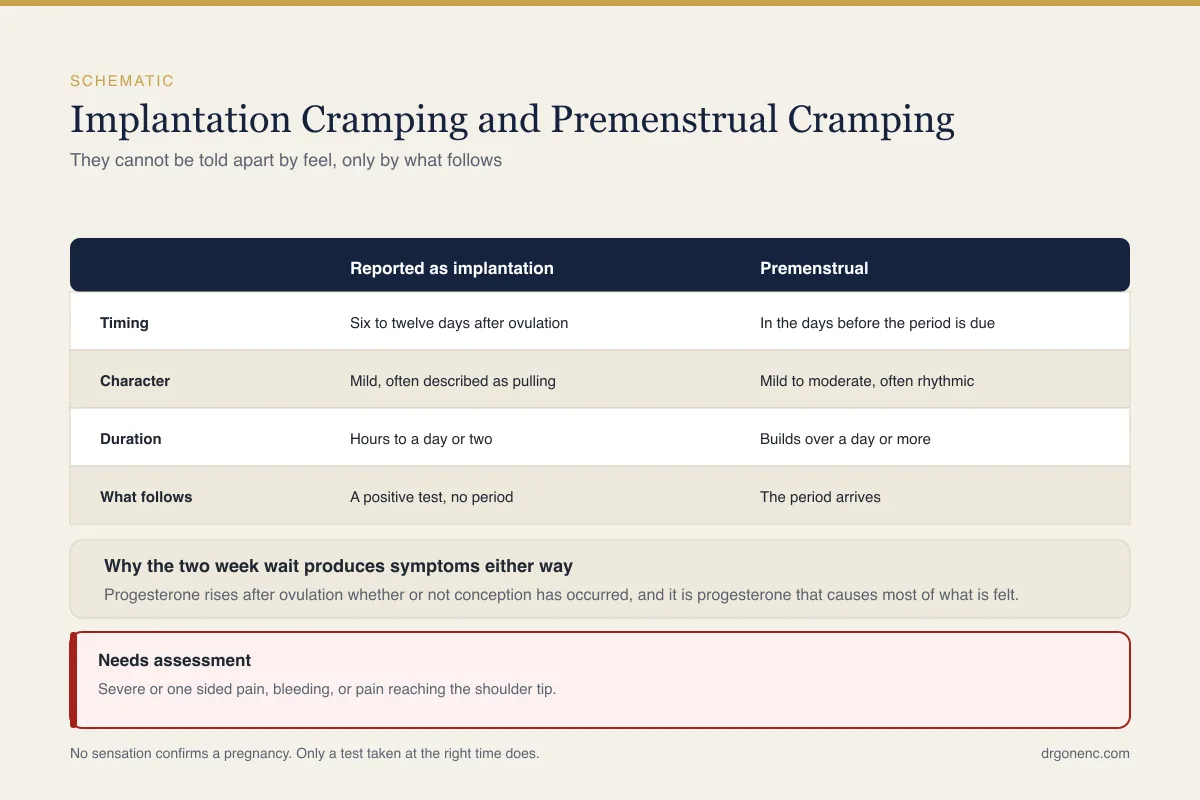
The comparison below is the one almost everybody wants, and it should be read with its limitation in mind. It describes tendencies across many accounts, not a test you can apply to your own cycle this month. Every row has exceptions in both directions, and the final row is the one that actually matters.
| Feature | Described as implantation cramping | Premenstrual and period cramping |
|---|---|---|
| Timing in the cycle | Reported around six to twelve days after ovulation, most often days eight to ten, so from the middle of the luteal phase towards its end | Usually the day or two before the bleed and the first days of it, so at the end of the luteal phase |
| Character | Described as dull, prickling, tingling or pulling, low in the pelvis | Described as cramping waves, a dragging ache or spasm across the lower abdomen, often with low back ache |
| Intensity | Usually mild enough to be noticed rather than to interrupt the day | Varies widely, from barely noticed to pain that needs treatment and time away from work |
| Duration | Reported as coming and going across a day or two | Builds over hours and usually settles after the heaviest days of the bleed |
| Side | Sometimes one sided, which carries no information | Usually central and low, sometimes spreading into the thighs |
| What tends to come with it | Little else, or light spotting that stays light | Breast tenderness, bloating and mood change, then a bleed that builds in volume |
| What follows | No period arrives and a test taken after the missed period is positive | A period arrives close to schedule |
| Can it be told apart at the time? | No. It sits in the same part of the cycle and feels the same | No. Only what happens next separates the two |
Read the two columns against each other and the problem becomes visible. Every feature overlaps. The only entry that genuinely separates them is what happens next, which is another way of saying that the question answers itself within a week or so and cannot honestly be answered today. Anyone who tells you otherwise is describing a cycle whose outcome they already knew.
Why the two week wait produces symptoms either way
After ovulation the collapsed follicle becomes the corpus luteum and starts producing progesterone. That rise happens whether or not an egg was fertilised, and it is the engine behind most of what is noticed in the second half of the cycle. Progesterone slows gut transit, which produces bloating and a full, crampy abdomen. It lifts basal temperature slightly, acts on breast tissue to produce tenderness, and affects mood and sleep in many people. This is ordinary luteal physiology: the NHS describes the second half of the cycle as the half in which progesterone prepares the womb for the implantation of an embryo.
If conception has not occurred, the corpus luteum fades after roughly a fortnight, progesterone falls and a period follows. If conception has occurred, hCG from the developing pregnancy keeps the corpus luteum working and progesterone stays up. The crucial point is that the symptoms of the first scenario and the second are produced by the same hormone, so for the first two weeks they feel alike, and no amount of attention paid to them will separate the two.
The womb also has a baseline level of activity that does not switch off between periods. Gentle contractions, mostly unfelt, continue throughout the cycle, and their pattern shifts with the hormonal background. On some days they are noticed and on others they are not, without anything having changed about whether a pregnancy is present. Noticing them is a fact about attention as much as about the uterus.
Cramping with spotting: what the combination does and does not mean
Light bleeding in the middle of the luteal phase, sometimes with cramping alongside it, is one of the commonest reasons people start searching. It happens in cycles that go on to be pregnancies and in cycles that do not. Breakthrough spotting while progesterone is at its height, spotting from a cervical cause brought on by intercourse, and spotting from a lining that is thin or irregular all look much the same from the outside.
Where there is a pregnancy, light bleeding in the early weeks is common and most such pregnancies continue. ACOG is nonetheless clear that bleeding in pregnancy should be reported rather than interpreted at home, because the same appearance can accompany a miscarriage or an ectopic pregnancy. The pattern is covered in full in the article on implantation bleeding.
The practical rule is short. Spotting with mild cramping that settles, in somebody who is otherwise well and whose pregnancy test is negative after a missed period, can reasonably be mentioned at the next appointment. If a pregnancy is possible or already confirmed, take a test and tell your own doctor about the bleeding rather than waiting, because ACOG advises contacting your doctor about any bleeding at any point in pregnancy. Bleeding heavier than a light period, bleeding with pain that is more than mild, or any bleeding after a positive test needs discussing with your own doctor the same day rather than researching further.
Cramping after embryo transfer
After an embryo transfer the picture differs in one important respect: medication is now part of the explanation. Luteal support is prescribed in most transfer cycles, and progesterone given as a medicine produces the same bloating, abdominal fullness and crampy sensation as progesterone from a corpus luteum, sometimes more noticeably. Which active substance, which route and how long it continues are decisions for the treating team, and are not something to adjust on the basis of how the cramping feels.
The procedure itself contributes as well. A speculum, a fine catheter passed through the cervix and a full bladder held for the transfer all leave a residual crampy awareness that can last a day or two and says nothing at all about whether the embryo has attached. In a fresh cycle the ovaries are also still enlarged after stimulation, and enlarged ovaries ache for days to weeks afterwards.
This is why symptom watching after a transfer is particularly unrewarding. People with strong cramping and people with none appear in both outcome groups, and the same is true of breast tenderness, nausea and spotting. The article on symptoms after embryo transfer goes through this at length. Anything that worries you belongs with the clinic looking after you rather than with accounts written by strangers.
Cramping that needs assessing urgently
Call an ambulance now (112 in Turkey and across the EU, 999 in the UK, 911 in the US), or go straight to the nearest emergency department, if you have sudden, severe or intense pain low in the abdomen, pain at the tip of the shoulder, heavy vaginal bleeding, or if you feel very dizzy or faint, look very pale, turn clammy or breathless, notice a racing pulse, or collapse. Those features can mean a ruptured ectopic pregnancy, which is life threatening and needs surgery as soon as possible. Do not wait for a pregnancy test, a repeat test, a call back or a planned appointment, and do not drive yourself.
Most cramping in the second half of the cycle is benign. A small number of presentations are not, and because they arise in exactly the window people are attributing sensations to implantation, they are dangerously easy to explain away. Contact your own doctor, your clinic or an early pregnancy assessment service today, rather than waiting for a test result or a planned appointment, if any of the following applies to you.
- Severe pain, or pain that is steadily worsening rather than coming and going
- Pain concentrated on one side of the lower abdomen that persists instead of passing within minutes
- Pain together with vaginal bleeding, particularly after a positive pregnancy test or a missed period
- Pain at the tip of the shoulder, which can be referred pain from blood irritating the diaphragm
- Pain on passing urine or opening the bowels, or a sudden painful urge to open the bowels
- Fever, feeling generally unwell, or an offensive vaginal discharge
- Persistent vomiting, or an abdomen that is swelling with breathlessness after a stimulated cycle
Shoulder tip pain, and one sided pain with bleeding, are the combinations that concern doctors most, because they fit an ectopic pregnancy, where a pregnancy has implanted outside the cavity of the womb and most often in a fallopian tube. NHS, RCOG and NICE guidance all treat these findings as grounds for urgent assessment, and NICE sets out the pathway through an early pregnancy assessment service with a scan and blood tests. An ectopic pregnancy is far more straightforward to manage when it is found early, and becomes an emergency when it is not.
If you are in any doubt, be assessed. No doctor minds seeing somebody whose pain turns out to be ordinary luteal cramping, and the consequence of waiting with the alternative is far too serious. Outside normal hours this means an emergency department rather than an appointment in a few days, and it means going now rather than after one more test.
Other explanations for cramping in the second half of the cycle
Before attributing mid luteal cramping to a pregnancy it helps to know what else produces it, because most of the time one of these is the answer. Ovulation pain, mittelschmerz, is felt around the release of the egg rather than a week later, and is covered in the article on ovulation pain. A functional ovarian cyst can ache for days. Constipation and trapped wind, both of which progesterone makes more likely, mimic pelvic cramping closely.
Endometriosis and adenomyosis cause pain that is often worst before and during a period but can be present across the whole cycle. Fibroids produce pressure and cramping. Pelvic inflammatory disease gives pain with discharge and frequently fever. Urinary infection and irritable bowel symptoms are both common and both get mistaken for gynaecological pain. Recent intercourse, a hard training session or a long drive can leave a muscular ache in the same region.
None of this can be sorted out from a description alone, which is the recurring theme of this article. An examination, and often a urine test, a swab or a scan, is what separates these possibilities, and that work belongs with your own doctor rather than with a symptom checker or a forum thread.
What a pregnancy test can and cannot settle
The only thing that answers the question is a pregnancy test, and the timing of that test is governed by hCG rather than by sensation. hCG only reaches the maternal bloodstream in measurable amounts once implantation has begun, and it then rises steadily, so a test taken before implantation has started cannot be positive however convincing the cramping has been. For the first day or two after it starts, the level is usually still too low for a home urine test to pick up. Sensation runs ahead of chemistry, which is precisely why it misleads.
A urine test taken from the first day of a missed period is reliable for most people. Tests taken earlier are sometimes positive and sometimes falsely reassuring, and a negative result several days before a period is due carries almost no information. If you test early and get a negative, the sensible next step is to repeat it once the period is actually missed, not to reinterpret your symptoms in the meantime.
Blood tests measuring hCG in mIU/mL are used in fertility treatment and in early pregnancy assessment, where a value and its change across about 48 hours are interpreted together with a scan and the clinical picture. They are requested and read by a clinician for that reason. A single figure, read on its own and compared with figures posted online, tells you very little and worries most people unnecessarily.
How to think about cramping while you wait
The two week wait is uncomfortable partly because the body generates a steady stream of data that cannot be interpreted. The most workable stance is to treat the sensations as information about the luteal phase rather than about the outcome, and to let the test do the work of answering. That is not resignation. It is an accurate reading of what the signals can carry.
A few things genuinely help. Keep a simple note of what you feel and on which day after ovulation, which is more useful to a doctor than a recollection weeks later. Treat mild cramping as you would at any other point in the month, with warmth and with simple measures agreed with your own doctor or pharmacist, bearing in mind that some pain relief is avoided when a pregnancy is possible. And decide in advance which day you will test, so that the decision is not remade every morning.
Finally, resist the comparison. The accounts you will read were written by people who already knew how their cycle ended, which makes remembered symptoms look far more predictive than they were at the time. Your own cycle is not interpretable from the inside, and that is a limitation of the biology rather than a failure of attention on your part.
Related Reading
- Implantation Bleeding: What It Looks Like, Timing, Cramps and When to Test
- After Embryo Transfer: Implantation Symptoms and What to Expect
- How long after sex does implantation occur, and what happens in between
- The Luteal Phase: Meaning, Length, Symptoms and Progesterone
- Ovulation Pain (Mittelschmerz): Why Cramping During Ovulation Happens and When It Matters
Sources and references
This article is supported by the following independent, authoritative sources:
- NHS (United Kingdom), fertility in the menstrual cycle
- NHS (United Kingdom), signs and symptoms that might mean you are pregnant
- ACOG (United States), bleeding during pregnancy
- NHS (United Kingdom), ectopic pregnancy
- RCOG (United Kingdom), ectopic pregnancy
- NICE (United Kingdom), ectopic pregnancy and miscarriage: diagnosis and initial management