Low progesterone symptoms and causes: how a result is actually read

Most people who look up low progesterone symptoms arrive holding one of two things: a list of complaints that something they read has pinned on this hormone, or a blood result with a single figure on it. Progesterone is the hormone released after ovulation, and it genuinely matters. It turns the lining of the uterus into tissue an embryo can implant into, and it keeps that lining in place until either a pregnancy takes over hormone production or the level falls and a period follows. What it is not is a hormone that can be judged from one number taken on an unknown day of the cycle.
This article sets out when progesterone rises, what a mid-luteal measurement can and cannot establish, reference ranges in both ng/mL and nmol/L, and the causes that usually sit behind a low reading: cycles without ovulation, polycystic ovary syndrome, thyroid disease, raised prolactin, perimenopause and low energy availability. It is also honest about where the evidence is unsettled, particularly around early pregnancy loss. Some findings cannot wait for a test result: pain low down on one side with a positive pregnancy test or a late period, bleeding in early pregnancy with pain, heavy bleeding, or feeling faint all need same day assessment, and they have their own section further down. Everything here is general information. Your own result belongs with the doctor who requested it, who can see your cycle, your history and the rest of your tests.
What progesterone does, and when in the cycle it rises
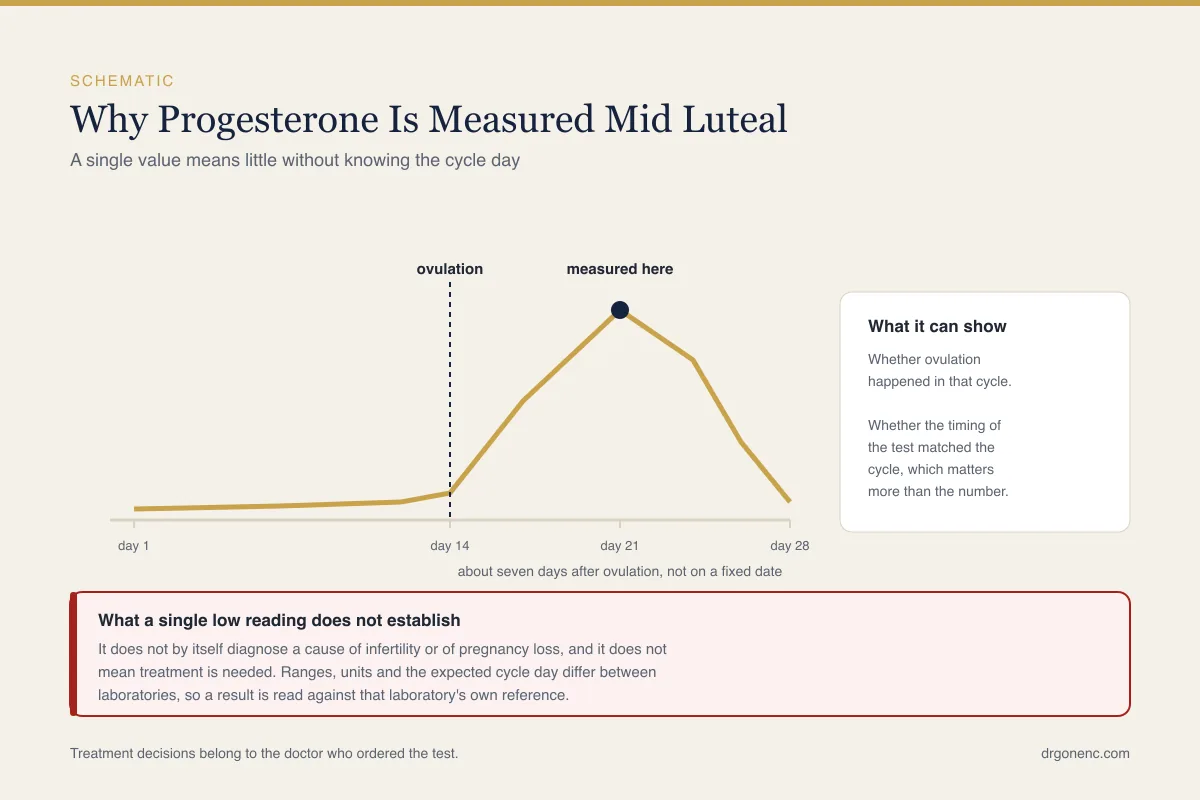
Progesterone is made mainly by the corpus luteum, the structure left behind in the ovary once a follicle has released an egg. Before ovulation the ovary produces very little of it: the first half of the cycle belongs to oestrogen, which thickens the lining of the uterus. After ovulation progesterone converts that thickened lining into a secretory layer, suppresses contractions of the uterus and prompts the lining to produce the proteins an implanting embryo depends on. Levels usually peak about six to eight days after the egg is released.
If no pregnancy follows, the corpus luteum fades after roughly twelve to fourteen days, progesterone falls, and the lining breaks down as a period. If an embryo implants, the hormone it produces, human chorionic gonadotrophin, signals the corpus luteum to keep working, so progesterone continues to climb until the placenta becomes able to make enough on its own. This is why a figure that would be unremarkable in the second half of a cycle looks very different in a confirmed pregnancy.
Two consequences follow for anyone reading a result. The first is that progesterone is supposed to be low before ovulation in every healthy cycle, so a low value on its own carries almost no information without the cycle day. The second is that the luteal phase, the stretch between ovulation and the next period, is relatively fixed at around twelve to fourteen days and ranges from about eleven to seventeen, while the first half of the cycle varies widely. A long cycle usually means ovulation came late, as the luteal phase article explains in more detail.
Why one progesterone reading on its own means very little
Progesterone is not released steadily. The corpus luteum secretes it in pulses that follow pulses of luteinising hormone from the pituitary gland, and those pulses become more pronounced in the middle and later part of the luteal phase. In women who are ovulating entirely normally, values measured over short intervals swing between roughly 5 ng/mL and 40 ng/mL, which is about 16 to 127 nmol/L, and a level can change by as much as eightfold within ninety minutes. Two samples taken the same morning can therefore disagree without either being wrong.
The second problem is the calendar. Cycle days are counted from the first day of proper bleeding, not from the first day of spotting, and the day of ovulation is unknown unless it has been tracked with urine tests, scans or a careful record. The familiar day twenty one test assumes a twenty eight day cycle and ovulation around day fourteen. In a thirty five day cycle ovulation happens closer to day twenty one or twenty two, so that same sample lands at or just before the rise rather than at its peak, and a low figure there is expected rather than abnormal. The correctly timed sample in that cycle would be around day twenty eight.
Assays add a further layer. Different laboratories use different methods, report in different units and print different reference intervals, and some report to one decimal place while others round. A figure quoted in an article, a forum post or a direct to consumer test report is not a threshold you can hold your own result against. The only sensible comparison is with the range printed on your own report, read by the clinician who knows when in your cycle the blood was taken.
What a mid-luteal measurement is actually used for
A mid-luteal progesterone is timed to land about seven days after ovulation, which is day twenty one in a twenty eight day cycle and later in longer cycles. The usual instruction is to count back about seven days from the expected start of the next period rather than forward from the last one. Where cycles are irregular, the sample is often repeated in a later week, or paired with urine tests for the luteinising hormone surge, because a single mistimed sample is the commonest reason a result looks falsely low.
What the test establishes is narrow and useful: whether ovulation has happened. A luteal value above about 3 ng/mL, roughly 10 nmol/L, is taken as presumptive evidence that an egg was released in that cycle. Some United Kingdom laboratories print a higher mid-luteal figure, often around 30 nmol/L, close to 9 ng/mL, as their own cut-off for a result that is clearly consistent with ovulation, and treat values below it as a reason to repeat the test in another cycle rather than as a diagnosis. That is a local laboratory convention rather than an internationally agreed threshold, which is one reason the same number can be described differently in different countries.
What the test does not do is grade how fertile someone is. The ASRM committee opinion on luteal phase deficiency states plainly that no minimum serum progesterone concentration defines normal or fertile luteal function, and that none of the proposed tests, including serial measurements and endometrial biopsy, reliably separates fertile from infertile women. A mid-luteal progesterone is a yes or no answer about ovulation, not a score. Whether yours needs repeating, and what it means alongside your other results, is a judgement for your own doctor.
Progesterone reference ranges in ng/mL and nmol/L
Results arrive in one of two unit systems, which is why the same sample can be described as 10 or as 32. Nanograms per millilitre, ng/mL, is used widely in the United States and in Turkey, while nanomoles per litre, nmol/L, is standard in the United Kingdom and much of Europe. To convert, multiply the ng/mL figure by about 3.2; to go the other way, divide by the same number. A mid-luteal result of 12 ng/mL and one of 38 nmol/L are the same measurement reported twice.
| Point in the cycle | Usual serum progesterone (ng/mL) | The same figures (nmol/L) |
|---|---|---|
| Follicular phase, before ovulation | Under about 1 to 2 ng/mL | Under about 3 to 6 nmol/L |
| Around ovulation, as the level starts to rise | About 2 to 5 ng/mL | About 6 to 16 nmol/L |
| Mid-luteal, about a week after ovulation | Commonly about 5 to 20 ng/mL, but can swing anywhere between about 5 and 40 ng/mL within the same day | Commonly about 16 to 64 nmol/L, with the same-day swing reaching about 127 nmol/L |
| Figure usually taken as evidence that ovulation has happened | Above about 3 ng/mL | Above about 10 nmol/L |
| Higher cut-off used by some United Kingdom laboratories (local convention, not an agreed standard) | Above about 9 ng/mL | Above about 30 nmol/L |
| After the menopause | Below about 0.5 ng/mL | Below about 1.6 nmol/L |
| First trimester of pregnancy | Can reach about 90 ng/mL | Can reach about 285 nmol/L |
Treat that table as orientation only. Reference intervals differ between laboratories, as does the cycle day each one assumes when it prints a luteal range, and some laboratories quote ranges for medicated cycles separately because treatment changes the figures entirely. Your report will carry its own range, and that is the one your result should be read against. A figure that sits just under a printed range is a prompt for a conversation and often for a repeat test, not a diagnosis in itself.
The symptoms attributed to low progesterone, and what they really tell you
The complaints people bring to this subject are consistent, and many of them appear on patient information pages, including the Cleveland Clinic page on low progesterone. They are worth setting out in full, because seeing them together makes the central difficulty obvious: almost none of them belongs to this hormone alone.
- Irregular, unpredictable or absent periods.
- Spotting in the days before a period starts.
- A short interval between ovulation and bleeding, or cycles shorter than about twenty one days.
- Difficulty conceiving, or very early pregnancy loss.
- Low mood, anxiety or mood swings in the second half of the cycle.
- Broken sleep or difficulty getting to sleep.
- Headaches.
- Breast tenderness.
- Bloating or weight change.
- Hot flushes and night sweats.
Only the first group tells you much. Changes in the pattern of bleeding, a shortening of the interval between ovulation and the period, and periods that stop altogether are the symptoms that genuinely track what progesterone is doing, because they reflect whether ovulation is happening at all. The rest are reported constantly by people whose progesterone is entirely ordinary, and they are equally common in thyroid disease, iron deficiency, perimenopause, disturbed sleep, pain conditions, depression and a stressful few months.
That does not mean the symptoms are imaginary or unimportant. It means the list cannot be used as a diagnostic test, and that treating a symptom list as a hormone result leads people towards the wrong investigations. What actually moves an assessment forward is a record of the last few cycles: the date each period started, how long it lasted, how heavy it was, and any spotting in between. That record tells a doctor more in thirty seconds than a symptom checklist does.
Cycles without ovulation: the commonest explanation
The usual reason a mid-luteal progesterone comes back low is that the cycle in question did not produce an egg. Without ovulation there is no corpus luteum, and without a corpus luteum there is no progesterone rise. Oestrogen continues to act on the lining unopposed, so the lining thickens without ever being converted into a secretory layer, and bleeding becomes unpredictable, sometimes heavier than usual, sometimes very light and sometimes absent for months.
A few patterns point that way before any blood is taken. Cycles consistently shorter than twenty one days or longer than thirty five days, cycle lengths that vary by more than a week from month to month, periods that disappear for three months or more, and the absence of any of the mid-cycle changes people often notice all raise the question. Cycles can also alternate, which is why a low result one month and a normal one the next is a common and unremarkable sequence.
Because anovulation is a symptom rather than a diagnosis, the useful question is what is interrupting ovulation. That is why progesterone is almost never requested alone: thyroid function, prolactin and, where periods are absent, the pituitary hormones are usually checked alongside it, with a pregnancy test first. Which of those tests you need, and in what order, is a decision for your own doctor once your cycle history has been reviewed.
PCOS, thyroid disease and raised prolactin
Polycystic ovary syndrome is the commonest endocrine reason for infrequent ovulation in the reproductive years. Progesterone is low in these cycles not because the ovary cannot make it, but because luteal phases happen rarely, so most samples are drawn from a cycle in which no egg was released. One naming point is worth knowing, because it causes confusion when people compare sources: the current ASRM committee opinion on luteal phase deficiency uses the term polyendocrine metabolic ovarian syndrome for what it notes was previously known as polycystic ovary syndrome, while ACOG, the NHS and the main patient information services still use polycystic ovary syndrome. The condition is the same, and the PCOS and conceiving article covers it in detail.
An underactive thyroid affects the cycle through the hypothalamus and pituitary gland, and it also tends to raise prolactin, because the releasing hormone that drives thyroid stimulating hormone also stimulates prolactin production. The result can be a shortened luteal phase, cycles that stop altogether, or simply irregularity. Thyroid disease is also one of the great mimics of hormone symptoms in general: tiredness, weight change, low mood, heavy periods and poor sleep all overlap with what people attribute to progesterone.
Raised prolactin acts more directly, dampening the pulsatile signal that drives the ovary and producing shorter luteal phases with lower progesterone, or no ovulation at all. Causes include some medicines, particularly those that block dopamine such as certain antipsychotics and anti-sickness drugs, an underactive thyroid, nipple stimulation, breastfeeding and benign pituitary tumours, and a single raised reading is often repeated before anything else is done. Each of these three conditions is treated on its own terms, and in each case the progesterone figure tends to settle once the underlying problem is addressed.
Perimenopause, heavy training and low energy availability
In the years before the menopause, ovulation becomes intermittent. Cycles shorten, then lengthen and become unpredictable, and a mid-luteal sample drawn in a cycle without ovulation reads low. This is expected rather than abnormal. It is also the reason progesterone is not used to diagnose perimenopause. NHS patient information describes a change in the pattern of periods as one of the first signs of this phase, and that pattern over several cycles carries far more weight than a hormone figure, because levels fluctuate too much from cycle to cycle to settle the question. A single reading in your forties describes that cycle, not the transition as a whole.
Low energy availability is the cause most often missed, and it is the one most likely to be reversible. When intake does not match what training and daily life demand, whether through deliberate restriction, rapid weight loss, disordered eating or simply a heavy training block, the hypothalamus reduces the pulse frequency that drives the ovary. Short luteal phases and absent ovulation follow. The ASRM committee opinion lists hypothalamic amenorrhoea, eating disorders, excessive exercise, significant weight loss and stress among the conditions associated with a disturbed luteal phase.
Illness, travel, shift work, poor sleep and a genuinely difficult stretch of life can all delay or skip an ovulation, and one unusual cycle in that setting rarely means anything at all. Age also plays a part independently: luteal progesterone production tends to decline in the later reproductive years. Whether a low reading in any of these situations needs repeating, investigating or simply noting is a judgement that depends on your age, your plans and the rest of your history, which is why it belongs with your own doctor.
What low progesterone does and does not mean for fertility
Where a low mid-luteal progesterone reflects absent ovulation, it matters a great deal, because conception cannot happen in a cycle with no egg. In that situation the figure is a signpost, and treatment is directed at the reason ovulation is not happening rather than at the number itself. Restoring ovulation, whether by treating thyroid disease or raised prolactin, addressing energy availability, or using medication that induces ovulation under specialist supervision, raises progesterone as a side effect of fixing the cycle.
Where ovulation is clearly happening, the picture is far less certain than the internet suggests. Luteal phase deficiency, the idea that an inadequate luteal phase is itself a cause of infertility or recurrent loss, has not been established as an independent condition. Short luteal phases are found in a substantial minority of ovulatory cycles in women who are not infertile, and in a series reported in the ASRM committee opinion and followed over a year, women with a short luteal phase were less likely to conceive in the following month but no less likely to conceive over the whole year. Describing a borderline figure as a cause of infertility overstates what is known.
Treated cycles are a different matter, and the distinction causes a lot of confusion. In IVF and frozen embryo transfer the corpus luteum is either disturbed by the stimulation and egg collection or absent altogether, so luteal support is given as a routine part of the protocol rather than because anyone has diagnosed a deficiency. The article on luteal support in IVF explains why that is standard practice in treatment and not a conclusion about natural cycles.
Progesterone and early pregnancy loss: an unsettled area
This is the part of the subject most often oversimplified, and it deserves care. In early pregnancy, progesterone from the corpus luteum depends on the rise in human chorionic gonadotrophin from the pregnancy itself. If a pregnancy is not developing, that signal does not rise as expected and progesterone falls with it. A low level in that setting is therefore often a consequence of what is already happening rather than its cause, which is why a single progesterone result is not used on its own to decide whether a pregnancy is viable.
Progesterone is nonetheless used in some early pregnancy situations, and here guidance genuinely differs between bodies. NICE guidance on ectopic pregnancy and miscarriage recommends offering progesterone given vaginally, not merely considering it, for women who have bleeding, an intrauterine pregnancy confirmed on scan, and a previous miscarriage, and it sets out both how long treatment continues where a heartbeat is seen and that it stops if a loss is confirmed. Other national bodies set the threshold for offering it differently, and for unexplained recurrent loss without bleeding the evidence is weaker still. Doses, preparations and timing are decisions for the doctor looking after the pregnancy, and they are deliberately not set out here.
The practical implication is narrow. Starting progesterone on your own, after a home result or an article, is not a substitute for finding out where a pregnancy is and whether it is developing, and it can delay an assessment that matters more. If you have had repeated losses, the recurrent miscarriage article sets out the investigations usually offered, and your own doctor can say which of them apply to you.
Findings that need same day assessment
Most questions about progesterone are not urgent and can wait for a routine appointment. A small number of situations cannot, and they matter here because people who are tracking hormones sometimes wait for a blood result when they should be seeking help. If any of the following applies, go to an emergency department or your nearest maternity or gynaecology unit the same day rather than waiting for a test, a scan appointment or a call back.
- Pain low down on one side, constant or coming in waves, with a positive pregnancy test or a late period, whether or not there is any bleeding.
- Sudden, severe pain on one side of the lower abdomen, often with nausea or vomiting, whether or not you could be pregnant. Pain of this kind can mean an ovary has twisted or a cyst has bled or burst, and it needs assessment within hours, not a blood test.
- Bleeding in early pregnancy together with pain, bleeding heavy enough to soak a pad in an hour or less, or passing clots.
- Pain at the tip of the shoulder, pain on opening the bowels, feeling faint, dizziness or collapse, with a positive test or a late period.
- Heavy bleeding outside pregnancy that soaks through a pad or tampon in an hour or less, or bleeding with breathlessness, palpitations or feeling faint.
- Fever with pain low in the abdomen and offensive vaginal discharge.
The reason for being firm about this is that a hormone level cannot tell you where a pregnancy has implanted, and ectopic pregnancy and heavy bleeding are both situations in which time matters. A progesterone result, however low or reassuring, does not change any of the advice above. If you are already under the care of a fertility unit or a maternity service, their own emergency number takes priority over a routine appointment. One further finding is urgent without being an emergency: any vaginal bleeding after the menopause should be reported to your doctor straight away, even a single episode that settles on its own, because it needs assessment on an urgent referral pathway rather than at an emergency department.
How low progesterone is assessed, and what treatment means in practice
Assessment starts with the cycle rather than the hormone. A doctor will usually want the dates of recent periods, how long cycles run and how much they vary, whether bleeding has changed in volume or pattern, how long you have been trying to conceive if that is the question, your weight history and training load, and the medicines and supplements you take. Only then does the timing of a blood test make sense, because a sample taken on the wrong day answers nothing.
- A pregnancy test first, where a period is late.
- A mid-luteal progesterone timed about a week before the next period is expected, repeated in another cycle where the first result is borderline or the timing was uncertain.
- Thyroid function and prolactin, as the two commonest treatable endocrine contributors.
- Pituitary and ovarian hormones where periods are absent or very infrequent.
- Pelvic ultrasound where there is bleeding, pain or a suspicion of a structural cause.
- A review of medicines, including hormonal contraception, which changes what a progesterone result means.
Treatment follows the cause rather than the figure. Where ovulation is not happening, the work is to treat what is interrupting it or to induce ovulation under supervision. Progesterone itself is prescribed in defined situations: as luteal support in assisted conception, as part of menopausal hormone therapy alongside oestrogen to protect the lining, and in selected early pregnancy circumstances. Treatment is also used to bring order to the lining and the bleeding pattern in cycles without ovulation, although there the drug given is usually a synthetic progestogen rather than progesterone itself. It can be given by mouth, as a vaginal preparation or by injection. Which form, when and for how long are prescribing decisions, and they are made by the doctor who has assessed you.
People searching for how to increase progesterone deserve a straight answer: if you are not ovulating, nothing you eat will produce a corpus luteum, and no food or supplement substitutes for finding out why ovulation has stopped. What does help, indirectly, is restoring energy availability if intake has been low, treating thyroid disease or raised prolactin where present, attending to sleep and alcohol, and giving any change a few cycles before judging it. Creams and extracts sold for hormone balance are not equivalent to prescribed treatment, are not regulated in the same way, and can distort a blood result, so tell your doctor if you use one.
Related Reading
- Progesterone and Luteal Phase Support in IVF
- The Luteal Phase: Meaning, Length, Symptoms and Progesterone
- PCOS and Getting Pregnant: Symptoms, Diagnosis and Fertility Options
- Recurrent Miscarriage and Implantation Failure: Causes and What Can Help
- Fertility Testing: How to Know If You Are Fertile (Female and Male)
- Spotting before your period: causes, patterns and when to seek assessment
Sources and references
This article is supported by the following independent, authoritative sources:
- MedlinePlus, Progesterone test
- Cleveland Clinic, Low progesterone
- ASRM, Diagnosis and treatment of luteal phase deficiency: a committee opinion (Fertil Steril 2026;126:633-9)
- ACOG, Polycystic ovary syndrome (PCOS)
- NICE, Ectopic pregnancy and miscarriage: diagnosis and initial management (NG126)
- NHS, Symptoms of menopause and perimenopause