What is menopause? The stages, symptoms and age range explained

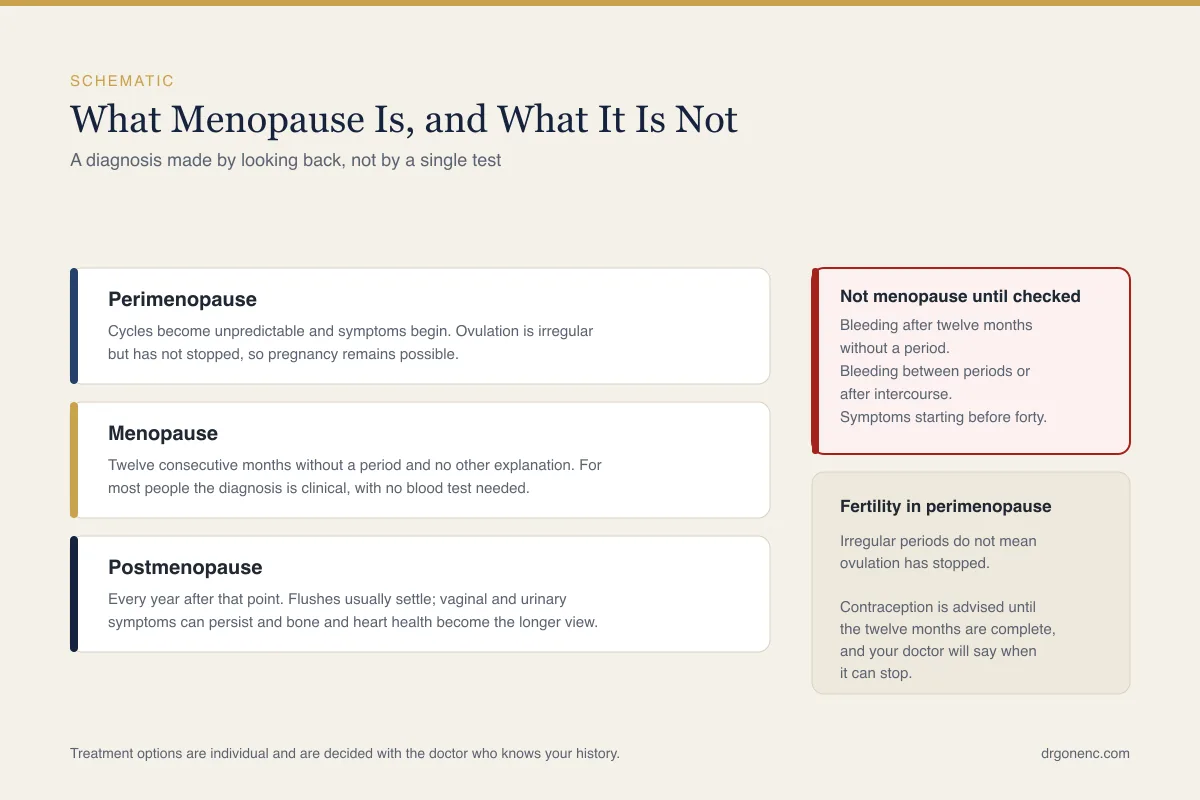
Menopause is a single point in time rather than a phase. It is the date of the final menstrual period, and it can only be identified looking backwards, once twelve consecutive months have passed without another one. Everything up to that date is perimenopause, and everything from that date onwards is postmenopause, though neither label can be applied with confidence until the twelve months have gone by. Most people who look up what menopause is are somewhere in the middle of all this, with cycles that have changed and symptoms that do not yet have a name, which is part of why the subject is so hard to pin down.
This article sets out how menopause is defined and diagnosed, the three stages and what separates them, the usual age range and what counts as early, the symptoms that most often prompt an appointment and why they vary so widely from one person to the next, what changes for bone and cardiovascular health in the longer term, when hormone blood tests add something and when they do not, and which symptoms should always be investigated rather than put down to menopause. There is a separate section on fertility during perimenopause, because unpredictable periods are not the same thing as no longer being able to conceive.
What is menopause, and how is it defined?
Before anything else. Some symptoms in midlife should never be put down to menopause. Contact your doctor without delay if you have any vaginal bleeding after twelve months without a period, bleeding after sex, bleeding between periods, bleeding heavy enough to cause flooding or large clots, or a new breast lump or nipple change. Seek same-day medical help for urinary symptoms with pain, fever or visible blood, or for a new severe headache with visual, speech or limb symptoms. If you have thoughts of harming yourself, contact your doctor or your local emergency number today, or go to your nearest emergency department. The full list is in symptoms that should not simply be put down to menopause.
Menopause is defined as the permanent end of menstruation that follows the loss of ovarian follicular activity. In clinical practice it is identified after twelve consecutive months without a period, when there is no other explanation such as pregnancy, a hormonal treatment or a medical condition. Because the definition depends on a full year of silence, the diagnosis is always made in retrospect: the date of menopause is the date of the final period, and that date is only recognised for what it was once the year has passed.
That backwards looking definition explains much of the confusion around the word. Someone who has not had a period for nine months cannot yet be told she is postmenopausal, even though she may have every symptom described on this page, and if no period follows she will later turn out to have been postmenopausal all along. Someone whose periods stopped thirteen months ago is postmenopausal, even if she feels entirely well. The label describes where the cycle has reached, not how a person feels, and decisions about treatment are made on the symptoms rather than on the label.
Menopause can also be induced rather than spontaneous. Removal of both ovaries, some chemotherapy regimens, pelvic radiotherapy and certain medicines that suppress ovarian function can bring it about at any age, often abruptly, with symptoms arriving over days instead of years. A hysterectomy that leaves the ovaries in place is a different situation again. Periods stop immediately, but the ovaries usually keep working for a time, so the twelve month rule cannot be applied and the transition has to be judged on symptoms and age.
The World Health Organization describes menopause as a normal part of ageing rather than a disease, and that framing is useful as long as it is not read as a reason to tolerate symptoms. A natural process can still cause problems that are worth treating. Both things are true at once, and the balance between them is individual.
The three stages: perimenopause, menopause and postmenopause
Perimenopause, sometimes called the menopausal transition, is the stretch of time in which ovarian function becomes erratic. For most women it begins in the mid-forties, although the first cycle changes can appear in the late thirties or early forties, and it can start later. Because it is defined by a change from your own previous pattern rather than by an age, two women of the same age can be at opposite ends of it. It usually begins with a change in cycle length rather than with symptoms, although hot flushes, broken sleep and mood changes can appear while periods are still arriving more or less on time. Estimates of its length vary with how it is measured, and the US National Institute on Aging puts the span of menopause related symptoms at roughly two to eight years. By convention it is counted as running until twelve months after the final period, which is also the point at which it can be confirmed to have ended, so the first postmenopausal year and the last perimenopausal year are the same twelve months looked at from different ends.
Menopause itself is one day, the final menstrual period. Postmenopause is everything afterwards, and it is not a uniform state. The early postmenopausal years are when symptoms are often still active and when bone loss is at its quickest. The later years are when the longer term consequences of low oestrogen matter more than day to day symptoms do. Vasomotor symptoms commonly continue for several years after the last period, and for a substantial minority of women they carry on considerably longer.
| Stage | What defines it | What periods do | Usual length | What tends to matter most |
|---|---|---|---|---|
| Perimenopause | Erratic ovarian function, with fluctuating oestradiol and rising FSH | Cycle length changes first, then cycles are skipped; bleeding may be heavier or lighter | Commonly a few years up to about eight, sometimes shorter and sometimes longer | Symptom control, assessment of abnormal bleeding, and contraception, since pregnancy is still possible |
| Menopause | The final menstrual period, identified only after twelve months with no further bleeding | The last one; the date is recognised in hindsight | A single point in time | Making sure other causes of absent periods have been excluded |
| Postmenopause | Follicular activity has ended; oestradiol low, FSH and LH persistently raised | None; any bleeding at all needs investigation | The rest of life | Continuing symptoms, genitourinary changes, and bone and cardiovascular health |
Stage names are useful shorthand rather than a schedule. Cycles can settle back into a regular pattern for months before stopping for good, periods can return after a gap of several months, and symptoms do not reliably track the stage a person is in. Research staging systems describe the transition in finer detail, but in a consultation the practical questions are simpler: what the cycle is doing, what the symptoms are, what else could explain them, and what the person wants to do about them.
When does menopause start, and what falls outside the usual range?
For most women the final period falls between the ages of 45 and 55, with the average in the UK and in many comparable countries sitting in the early fifties. Both ends of that window are ordinary. Stopping at 46 and stopping at 54 are equally within the usual range, and neither needs an explanation. Outside that window two separate terms are used, and the distinction matters because the assessment and the follow up are different.
Menopause before the age of 45 is described as early menopause. When ovarian function is lost before 40, the term used is premature ovarian insufficiency, and it is not simply menopause arriving sooner. It warrants a search for a cause, a discussion about long term bone and cardiovascular protection, and a separate conversation about fertility, because ovarian activity in premature ovarian insufficiency can be intermittent rather than finished. A separate article on low AMH and diminished ovarian reserve explains what those particular results do and do not predict.
Several things shift the timing. Smoking is consistently associated with an earlier menopause. Family history matters, and a mother's or sister's age at her final period is a rough guide rather than a forecast. Chemotherapy, pelvic radiotherapy, ovarian surgery and some autoimmune and genetic conditions can bring it forward. Combined hormonal contraception does not delay menopause, although it conceals the cycle changes that would otherwise signal it, so some women only find out where they are after stopping the method.
What is happening in the ovary and to the hormones
The ovary contains a finite number of follicles from before birth, and that pool falls steadily with age while the quality of the remaining eggs declines alongside the number. As the pool shrinks, the ovary produces less inhibin B and less anti-Mullerian hormone, and the pituitary responds by raising follicle stimulating hormone in an attempt to recruit follicles that no longer respond as readily. This is why FSH begins to rise long before periods stop, and why it cannot by itself say when they will.
Oestradiol does not fall away smoothly. Through perimenopause it swings, sometimes to levels higher than those of a standard cycle and sometimes to very low ones, occasionally within the same few weeks. Those swings, rather than a simple steady deficiency, account for symptoms appearing while periods are still present, and for how changeable those symptoms can be from one month to the next. Once follicular activity has ended, oestradiol settles at a low level and both FSH and luteinising hormone remain persistently raised.
Laboratory reports use different units, and the numbers are easy to misread at home. FSH is reported in IU/L or mIU/mL, oestradiol in pg/mL or pmol/L, and anti-Mullerian hormone in ng/mL or pmol/L. A single measurement taken during perimenopause describes one moment in a fluctuating system and little more than that. What FSH levels actually mean depends on when in the cycle the sample was drawn and on what else is going on, which is why interpretation belongs to the doctor who requested the test.
How periods change through perimenopause
The earliest dependable sign of perimenopause is a change in cycle length. A persistent difference of seven days or more between consecutive cycles, compared with what was normal for that person, marks the early transition. Later on, cycles are skipped, and a gap of sixty days or more between periods indicates the late transition, which usually means the final period is somewhere within the next few years. Both patterns are common, and both can be interrupted by stretches of apparently normal cycles.
Flow changes as well. Periods can become heavier or lighter, longer or shorter, with clots or with spotting in between. Heavier bleeding in the forties is common and frequently hormonal, because cycles without ovulation leave the lining to build up unopposed. It is also how fibroids, polyps, adenomyosis, thyroid disorders and problems with the lining itself present, so it should be assessed rather than assumed to be the transition. Bleeding between periods, bleeding after sex and cycles consistently shorter than 21 days all need looking at.
Hormonal contraception removes the signpost altogether. The combined pill produces a withdrawal bleed that says nothing about ovarian activity, and progestogen only methods and the hormonal intrauterine system often stop bleeding completely. In those situations the cycle cannot be used to track the transition at all, so age, symptoms and occasionally blood tests have to be used instead, with the timing of any test planned together with the prescriber.
The symptoms that bring people in
Hot flushes and night sweats, together called vasomotor symptoms, are the reason most women first raise menopause with a doctor. A flush is a sudden sensation of heat spreading over the chest, neck and face, often with sweating, reddening of the skin, palpitations and then a chill as it passes. At night the same event wakes people and soaks nightclothes. Alcohol, hot drinks, spicy food, warm rooms and stress are common triggers, and for most women the symptom eases within a few years of the final period, although in large long term studies the median total duration of frequent flushes is closer to seven years, and for some women it is longer still.
- Vasomotor: hot flushes, night sweats, and the daytime fatigue that follows broken nights
- Sleep: difficulty falling asleep, early waking, and sleep fragmented by sweats
- Mood and thinking: low mood, anxiety, irritability, poor concentration, forgetfulness and word finding difficulty
- Genitourinary: vaginal dryness and soreness, discomfort during sex, urinary urgency and frequency, and repeated urinary infections
- Musculoskeletal: aching joints and muscles, morning stiffness, and new pain in the shoulders, hips or hands
- Skin, hair and mucous membranes: dry or itchy skin, thinning scalp hair, dry eyes and a dry mouth
- Headaches: new headaches, or a change in an established pattern of migraine
- Palpitations: an awareness of the heart racing or pounding, often with a flush
- Sexual function: reduced interest in sex, which may be hormonal, situational or both
- Weight and body shape: a tendency to gain weight and for fat to settle around the abdomen rather than the hips and thighs, often with no change in diet or activity
The genitourinary symptoms deserve separate mention because they behave differently from flushes. Thinning and drying of the vaginal and urethral tissue tends to persist or progress over time rather than settle, it responds to treatment that is largely local, and it is frequently never mentioned in appointments. Discomfort during sex, recurrent urinary infections and urgency in the fifties and sixties are often put down to age when they are in fact treatable. Raising them is worthwhile even when nothing else is troubling.
Weight and body shape come up in almost every appointment. Some of the change is ageing rather than menopause, since muscle mass and resting metabolic rate fall through midlife in men too, but the redistribution of fat towards the abdomen does track the fall in oestrogen, and broken sleep makes appetite regulation harder. The practical consequences are that resistance exercise and protein intake matter more than they did, and that the change is not a failure of willpower. Weight gain is also not, in itself, a red flag. Unintended weight loss is, and so is weight change alongside marked fatigue, hair loss or cold intolerance, which can point to thyroid disease.
Mood and cognitive symptoms are real and are commonly underestimated. Losing a train of thought, struggling for a familiar word and a general feeling of mental fog are described often enough to be accepted as part of the transition, and they usually improve afterwards. What they are not is an automatic explanation for everything. Depressive illness, thyroid disease, anaemia, chronic sleep deprivation and significant life stress look very similar and are managed quite differently, so an assessment is a better starting point than an assumption.
Why symptoms vary so much from one person to another
Two women of the same age with similar hormone levels can have entirely different experiences. Some pass through the transition with little more than a change in their cycle, while others have symptoms that interfere with work, sleep and relationships for years. Part of that difference appears to be genetic, part of it is how quickly hormone levels change, and part of it is everything else that happens to be going on in a person's life and body at the same time.
Speed seems to matter. A menopause induced by removal of both ovaries, where oestrogen falls within hours rather than over years, tends to produce more intense symptoms than a gradual natural transition does, which is one reason hormone therapy is discussed differently in that situation. Body weight, smoking, physical activity and alcohol intake all show some association with symptom severity, as do untreated sleep disorders, which amplify very nearly everything else.
Reported experience also differs between populations and between healthcare settings, for reasons that include genuine biological variation, differences in what people consider worth mentioning, and differences in what clinicians ask about. The practical consequence is that symptom lists are better read as a menu of possibilities than as a checklist to match. Not having a given symptom does not mean the transition is not under way, and having several of them does not on its own confirm that it is.
Fertility in perimenopause, and when contraception can be stopped
Unpredictable periods are not the same as the end of fertility. Through perimenopause ovulation becomes irregular, with some cycles ovulatory and some not, and there is no way to know in advance which will be which. Spontaneous pregnancy remains possible until menopause is established, and a meaningful share of pregnancies after 40 are unplanned. A long gap between periods is not evidence that ovulation has stopped for good, because cycles can resume after several months of absence.
At the same time, the chance of conceiving in any given cycle falls substantially through the forties, and the risk of miscarriage and of chromosomal abnormality rises as eggs age. Those two facts sit together uncomfortably, and both are true: pregnancy becomes much less likely and remains possible. For anyone hoping to conceive during this period, the useful response is early assessment rather than waiting to see what happens, and trying to conceive after 40 covers that ground in more detail.
For anyone who does not want to conceive, contraception needs to continue past the point at which the cycle appears to have finished, and that point arrives later than most people expect. The criteria depend on age rather than on symptoms, because a year without bleeding means something different at 48 than it does at 53. NHS guidance and UK contraception guidance set out how long to carry on for, and the rules are short enough to remember:
- Aged 40 to 49, continue contraception for two years after the last period
- Aged 50 or over, continue for one year after the last period
- UK contraception guidance allows most people to stop all contraception at the age of 55, by which point spontaneous conception is very unlikely even if some bleeding is still occurring
- If a hormonal method has stopped the bleeding altogether, the date of the last natural period cannot be established, so when to stop should be decided with the prescriber
- Hormone replacement therapy is not a contraceptive, and a separate method is still needed alongside it until the criteria above have been met
That final point is worth repeating, because it is a common misunderstanding with real consequences. Hormone therapy is prescribed to treat symptoms, not to prevent pregnancy, and the doses used do not suppress ovulation dependably. Which method suits a particular woman in her late forties depends on blood pressure, migraine history, smoking, bleeding pattern and what else the method is being asked to do, so it is a conversation for your own doctor or contraception service rather than a decision to take from an article.
One question follows naturally from all of this and is worth answering plainly. After menopause, spontaneous pregnancy is no longer possible, because there are no eggs left to release. The World Health Organization puts it the same way, noting that pregnancy after menopause occurs only in the rare cases where specialised fertility treatment is used. What such treatment involves, and whether it is lawful at all, differs from one country to another. Treatment using donated eggs is not permitted in Turkey and is therefore not offered here, and where it is available elsewhere the limiting factors become general health, cardiovascular and obstetric risk and formal assessment rather than ovarian function. None of that can be settled by an article, and anyone considering it should discuss it with a fertility specialist and take advice on the law where they live. For women approaching this stage who want to keep the option of using their own eggs, the decision has to be made considerably earlier, and a separate article on egg freezing sets out the timing.
Bone and cardiovascular health in the longer term
Oestrogen helps maintain bone, and its withdrawal accelerates bone loss. The quickest loss occurs in the years immediately around and after the final period, and it then continues more slowly, which over time can lead to osteoporosis and to fractures of the wrist, spine and hip after relatively minor injuries. Bone density can be measured with a DXA scan where there are risk factors such as early menopause, long term steroid use, a low body weight, smoking or a family history of fracture.
What helps bone is unglamorous and well established: weight bearing activity and resistance exercise, adequate dietary calcium, attention to vitamin D, stopping smoking, keeping alcohol within recommended limits, and avoiding being underweight. Where bone loss is already significant, specific medical treatment may be considered, and that is a prescribing decision for a doctor. For women with premature ovarian insufficiency the bone question is more pressing, simply because the number of years spent with low oestrogen is greater.
Cardiovascular risk also changes. Lipid profiles tend to shift unfavourably, fat distribution moves towards the abdomen, and blood pressure often rises. Age contributes to all of this and the transition contributes something of its own. An earlier menopause, and particularly premature ovarian insufficiency, is associated with greater cardiovascular and bone risk over a lifetime. Blood pressure, lipid and glucose checks at the intervals your own healthcare system recommends are a sensible part of ordinary care in these years.
Whether hormone therapy has any role in protecting bone or the heart, and if so for whom, is an area where the guidance has changed over the years and where national bodies still differ in emphasis. It is not a question that can be settled in general terms. The answer depends on age, on how long ago the final period was, on personal and family history, and on what is actually being treated, so it belongs in a discussion with a doctor who knows the whole history.
When blood tests help, and when they do not
In women over 45 with typical symptoms, menopause and perimenopause are diagnosed clinically, without a blood test. NICE guidance is explicit that perimenopause and menopause should be identified without laboratory tests in otherwise healthy people aged 45 or over, and that a follicle stimulating hormone level should be considered only between 40 and 45 where symptoms and a change in cycle raise the question, or under 40 where menopause is suspected. Being on hormonal contraception does not make a test more useful: NICE says separately not to use an FSH blood test at all in anyone taking combined oestrogen and progestogen contraception or high-dose progestogen, because the method itself alters the result. The reason for all of this is straightforward: hormone levels fluctuate so widely through the transition that a single result can be unremarkable one week and clearly raised the next. ACOG's patient information likewise puts the emphasis on the pattern of symptoms and the change in cycle rather than on a test, noting that the average age of menopause is 51 and that the oestrogen produced by the ovaries begins to fluctuate in the thirties and forties.
Tests are genuinely useful in narrower situations. They are used when menopause is suspected under the age of 40, where premature ovarian insufficiency is diagnosed on two raised FSH samples taken four to six weeks apart alongside absent or infrequent periods. They are used between 40 and 45, where symptoms and cycle change together raise the question. They are used after a hysterectomy that leaves the ovaries in place in women under 45, where no cycle can be followed and age alone does not settle the question, although over 45 NICE still advises identifying menopause from the pattern of symptoms rather than from a test. And they are used when something else might explain the picture.
It is worth knowing that NICE sets no numerical FSH cut off at all. Its menopause guideline asks only for an elevated FSH on two samples taken four to six weeks apart where premature ovarian insufficiency is suspected, without naming a figure. Where numbers do get quoted they come from elsewhere, and they answer different questions: the European criteria for premature ovarian insufficiency use a level above 25 IU/L on two samples taken more than four weeks apart, while UK contraception guidance uses two levels above 30 IU/L taken six weeks apart to help decide when contraception can be stopped where a hormonal method has masked the bleeding pattern. Comparing those figures as though they answered the same question is one of the easier ways to confuse yourself with a laboratory report, and a figure quoted on one website may not be the figure your own laboratory is working to. Anti-Mullerian hormone is a measure of ovarian reserve and is not a test for menopause, so it cannot date a final period. Combined hormonal contraception makes an FSH result unreliable, which is why NICE advises against using the test in that situation rather than trying to time it.
Where symptoms are not clearly menopausal, the more valuable tests are often those looking for something else altogether: thyroid function, a full blood count with ferritin, a pregnancy test where relevant, prolactin where periods have stopped unexpectedly early, and glucose. Which of these apply is a judgement for the clinician assessing the person in front of them, and every result needs reading alongside the history rather than in isolation.
Symptoms that should not simply be put down to menopause
The practical risk of a menopause label is that it starts to explain everything, and separate problems get absorbed into it. Fatigue, low mood, changes in bleeding and aching joints are all common in the forties and fifties and all have other possible causes. The symptoms below should be assessed on their own merits rather than attributed to the transition, and the first item on the list carries more weight than anything else on this page.
- Any vaginal bleeding after twelve months without periods. Postmenopausal bleeding always needs investigation, however light it is and however briefly it occurs, and it should be reported to your doctor without delay rather than at your next routine appointment, because UK guidance is for urgent referral to exclude cancer of the lining of the uterus
- Bleeding after sex, or bleeding between periods, at any stage of the transition
- Bleeding heavy enough to cause flooding, large clots or symptoms of anaemia, or cycles consistently closer together than 21 days
- A new breast lump, a change in the skin or shape of the breast, or nipple discharge
- Unintended weight loss, persistent bloating, a change in bowel habit, or feeling full after small amounts of food
- Severe or persistent low mood, loss of interest in everything, or any thought of harming yourself. This needs help today rather than a hormonal explanation: contact your doctor, your local emergency number or your nearest emergency department rather than waiting for a routine appointment
- Marked fatigue with hair loss, cold intolerance, palpitations or weight change, which can point to thyroid disease or anaemia
- New, severe or changed headaches, particularly with visual or other neurological symptoms
- Urinary symptoms accompanied by pain, fever or visible blood
Equally, symptoms that have already been put down to menopause but are not improving deserve a second look. A treatment trial that has not helped after a reasonable interval, symptoms that are worsening rather than settling, or a pattern that never quite fitted in the first place are all good reasons to go back rather than to accept the original explanation. Revisiting a diagnosis is normal practice and not an imposition on anyone's time.
Treatment in general terms, and who decides
Treatment is worth describing only in outline here, because every specific decision is individual. The options fall into groups. Hormone replacement therapy uses oestrogen, combined with a progestogen when the uterus is present, given by tablet, skin patch, gel or spray. Local vaginal oestrogen treats genitourinary symptoms with very little absorption into the bloodstream, and can be used alongside or instead of systemic treatment. There are non-hormonal prescription options too, and the picture here has changed. A newer class of medicine acting on the brain pathway that triggers flushes, whose active substance fezolinetant is the one currently recommended in the UK, is an option for moderate to severe hot flushes and night sweats where hormone therapy is unsuitable. Certain antidepressant classes and clonidine are sometimes used for flushes, but NICE does not recommend them routinely as a first choice for flushes alone. Where low sexual desire persists on hormone therapy, testosterone is sometimes added. And cognitive behavioural therapy, including menopause specific cognitive behavioural therapy, has evidence for flushes, sleep and mood, and is recommended as an option in its own right.
General measures matter alongside any of these: regular physical activity, attention to sleep, limiting alcohol and caffeine where they trigger flushes, stopping smoking, keeping rooms and bedding cool, and treating the things that make symptoms worse, such as untreated sleep apnoea or iron deficiency. None of that is a substitute for medical treatment where symptoms are severe, and none of it is a reason to put off asking for help if daily life is being affected.
Which of these is appropriate, and whether any treatment is appropriate at all, depends on the symptoms, on age, on how long ago the final period was, on personal and family history including breast cancer, venous thromboembolism, cardiovascular disease and migraine, and on what the person herself wants. Guidance from the various national bodies agrees on the broad principles and differs in emphasis on some of the details, which is a further reason the discussion has to be an individual one.
Evaluation is individual, and decisions about investigation and treatment belong to the doctor who examines you and knows your history. This article is background reading for that conversation rather than a substitute for it, and nothing here should be used to start, stop or change any treatment on your own.
Related Reading
- Low AMH & Diminished Ovarian Reserve
- Getting Pregnant After 40: Real Chances, Risks and Your Options
- FSH levels and fertility: what the test shows and what it does not
- Egg Freezing: A Complete Guide, Who It's For, How It Works, FAQs
- Fertility Testing: How to Know If You Are Fertile (Female and Male)
- Low progesterone symptoms and causes: how a result is actually read
- Cramps but no period: what causes it and when it needs assessing
Sources and references
This article is supported by the following independent, authoritative sources: