Cramps but no period: what causes it and when it needs assessing

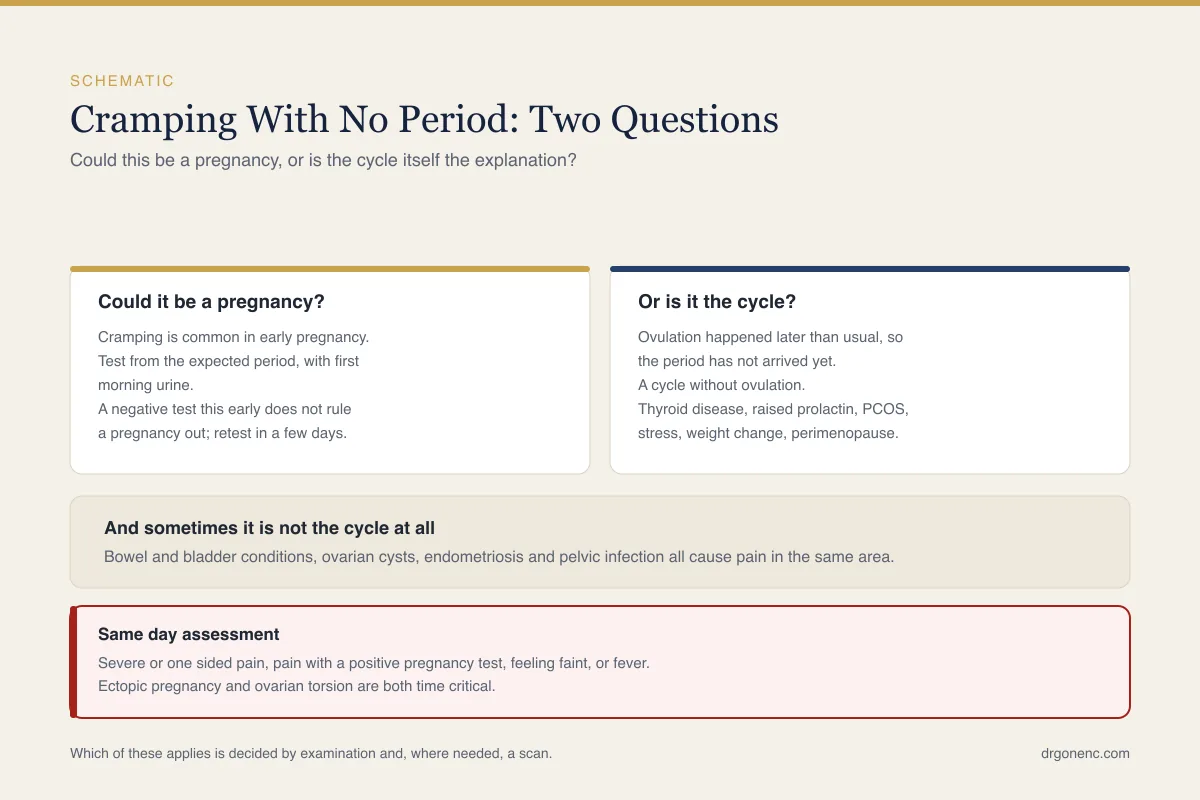
Cramping that feels exactly like a period, arriving with no bleeding at all, is one of the most unsettling things a cycle can do. Almost everyone who searches for an explanation is really asking one of two questions. The first is whether this is early pregnancy. The second is whether something is wrong. Both are reasonable questions, and they are answered in different ways: the first by a test and a date, the second by the pattern of the pain and by what comes with it. The explanation is usually ordinary, but a small number of causes need looking at today rather than next week.
This article works through them in order. It begins with the pain that needs assessing the same day, because that part cannot wait until the end of a long page. It then covers early pregnancy and what a negative test does and does not settle, the cycle explanations in which the period has simply not arrived yet, the hormonal conditions behind cycles that do not ovulate, perimenopause and the months after stopping hormonal contraception, and finally the causes that have nothing to do with the cycle at all. Throughout, the person who interprets your own pattern is your own doctor.
The two questions behind cramping with no bleed
Separating the two questions early saves a great deal of worry. If pregnancy is possible at all, the first step is a urine pregnancy test, because the answer changes what everything else means. A positive test turns cramping into something that needs its location confirmed. A negative test, taken at the right moment, moves the question towards the cycle and towards the organs that sit beside the womb. The test is quick and available without an appointment, and doing it first is more useful than reading any list of causes.
It helps to know where period type cramping actually comes from. The muscular wall of the womb contracts under the influence of locally produced chemicals called prostaglandins, briefly squeezing its own blood supply, and that is the ache described as period pain. The same nerves serve the bowel, the bladder, the ovaries and the pelvic floor, so pain from any of them is felt in roughly the same place and described in roughly the same words. Cramping that feels menstrual is therefore not proof that it is coming from the womb.
Timing is the other piece of information worth gathering before anything else. Where in the cycle the pain sits, how many days the period is now overdue, whether recent cycles have been regular or drifting, and whether anything has changed about contraception, weight, training or sleep: these few facts narrow the list more than the character of the pain does. A note on a phone is enough, and it is the single most useful thing to bring to an appointment.
Cramping that needs assessment the same day
Most cramping without a bleed is harmless and settles. A small group of causes behave differently, because the interval between the pain starting and being assessed is what changes the outcome. These belong near the beginning of the page rather than buried at the end. If any of the following applies, arrange to be seen today rather than waiting for a period to arrive or for a test to turn positive.
- Feeling faint, dizzy, grey, sweaty or breathless, collapsing, or pain in the tip of the shoulder along with abdominal pain: call your local emergency number (112 in Turkey and across the EU, 999 in the UK, 911 in the US) and do not drive yourself.
- Severe pain that came on suddenly, usually on one side, often with sickness and vomiting, and often enough to stop you walking: one of the causes of this pattern is a twisted ovary, called ovarian torsion. Go to an emergency department now rather than waiting for an appointment, because an ovary that stays twisted can lose its blood supply within hours.
- Any pain at all in someone with a positive pregnancy test, and particularly one sided pain, or pain with light, dark or watery bleeding: the location of the pregnancy has to be confirmed, because an ectopic pregnancy sits outside the womb and can bleed internally.
- Fever, shivering, a change in vaginal discharge, or pain during intercourse together with pelvic pain: this can be pelvic infection, which is treated more easily the sooner it is found.
- Pain with persistent vomiting, a swollen or rigid abdomen, or being unable to pass urine or open your bowels.
Two points about this list are worth stating plainly. The first is that a negative pregnancy test does not remove the need to be seen when the pain is severe or one sided, because torsion, a cyst accident, appendicitis and infection are not pregnancy problems and will not show on a pregnancy test. The second is that severe pain is itself the reason to go, independent of any theory about the cause. Nobody will think you have wasted their time.
On pregnancy of uncertain location, NICE guideline NG126 is explicit about the pathway. It requires immediate referral to an early pregnancy assessment service, or to an out of hours gynaecology service, for anyone with a positive pregnancy test who has pain with abdominal, pelvic or cervical tenderness on examination, and referral for anyone with pain alongside other symptoms or signs of an early pregnancy complication, with the urgency judged on the clinical picture. NHS patient material gives the same advice in plainer words. Whichever service you reach first, the point is that the location of the pregnancy is confirmed rather than assumed.
Early pregnancy, and the cramping that comes before a period that never arrives
Early pregnancy commonly causes cramping, and it can do so before any test turns positive. The sensations are usually mild, central and low down, sometimes described as a pulling or a tightening rather than a true cramp, and they frequently come with no bleeding whatsoever. They tend to appear in the second half of the cycle, from roughly a week after ovulation onwards, which is exactly when a period would also be building. That overlap is the reason the symptom is so hard to read from the inside.
There are several mechanical reasons a new pregnancy aches. Progesterone from the corpus luteum slows the bowel, which produces wind and constipation that are easily mistaken for menstrual cramping. The womb begins to grow and its supporting ligaments stretch. The lining becomes richer in blood vessels. None of these produces a sensation distinctive enough to diagnose anything, which is why the question is settled by a pregnancy test rather than by the sensation itself.
On timing, a home urine test is reliable from the first day of a missed period, and if you cannot date your period, from about three weeks after the sex in question. Most home urine tests are labelled to detect human chorionic gonadotrophin at around 20 to 25 mIU/mL, and early result versions at about 10 mIU/mL; those levels are typically reached a few days after implantation, and the exact figure is printed on the pack. Testing earlier than that is the commonest reason for a negative result in someone who is in fact pregnant. Early morning urine is more concentrated and gives the test a fairer chance of reading correctly.
It is also worth separating cramping from bleeding in early pregnancy, because the two are often confused in search terms. Light bleeding around the time a period was due can happen in an ongoing pregnancy, and a separate article on bleeding that is mistaken for a period during pregnancy sets out how that differs from a true period. Cramping on its own, with no bleeding, is not a sign that anything has gone wrong, and it is not a sign that anything has gone right either.
What a negative test does and does not rule out
A negative urine test taken on or after the day the period was due is reasonably dependable, provided the date it is being measured against is correct. The difficulty is that the date often is not. Ovulation is the variable part of the cycle, and if it happened later than usual then the period is not yet genuinely late and the pregnancy, if there is one, is not yet old enough to be detected. This is why a repeat test about a week later, if no period has come, is standard advice rather than excessive caution.
Several ordinary things flatten a result: testing too early, drinking a lot of fluid beforehand, reading the window after the time stated in the instructions, or using a test that has been stored badly or is out of date. A faint line is a positive line. If a repeat test is also negative and the period still has not arrived three weeks after the date it was due, the question stops being about pregnancy and becomes a question about the cycle, which is the subject of the next few sections.
One qualification matters more than all the others. A negative test is not a reason to stay at home with severe or one sided pain. In a pregnancy that is developing in the wrong place, hormone levels are sometimes lower than expected for the dates, so a faint or even negative result can occur alongside a genuine problem, and the causes unrelated to pregnancy do not register on the test at all. Pain severe enough to frighten you is assessed on the pain, not on the test strip.
Late ovulation, when the period has simply not arrived yet
The commonest innocent explanation for cramping with no bleed in someone who is not pregnant is a cycle that is running behind. The second half of the cycle, from ovulation to the bleed, is fairly consistent at around 10 to 16 days in most people. The first half is not consistent at all. Anything that delays the release of an egg pushes the period back by the same number of days, so a cycle that is normally 28 days can quietly run to 35 days or beyond in that one month. A single long cycle like that is usually nothing; a run of them sits outside the ranges described below and is worth raising with your doctor.
Illness, a course of antibiotics for something else, travel across time zones, night shifts, a sharp change in training load, a stressful stretch at work or a bereavement can all delay ovulation in a single cycle. The cramping during that wait is real. The lining has been building under oestrogen, the womb is mildly irritable, and ovulation itself can ache. Then the period eventually arrives, often heavier or later than expected, and the whole episode makes sense only in retrospect.
Ovulation pain deserves its own mention here, because it is frequently misread as period pain in the wrong week. It is typically one sided, lasts hours to a day or two, and sits midway through the cycle rather than at its end. A separate article covers ovulation pain and how it is distinguished from other pelvic pain. One sided pain that is severe, rather than a familiar twinge, still belongs in the same day list above.
It is also worth knowing that the expert bodies do not agree exactly on where normal cycle length ends. The FIGO classification of abnormal uterine bleeding puts the usual range at 24 to 38 days, while NHS patient information quotes 21 to 35 days. On either of those definitions, a cycle a few days longer than your own average is not in itself abnormal. Your doctor will weigh a change against your own previous pattern rather than against a published number.
Cycles that do not ovulate, and the conditions behind them
If no egg is released, no corpus luteum forms, and the progesterone that normally rises and then falls away never does either. It is that fall which triggers an organised, predictable bleed. Without it the lining keeps thickening under oestrogen alone and sheds unpredictably, so cycles become long, bleeding becomes erratic or absent, and cramping can continue in the absence of any bleed at all. This is called an anovulatory cycle, and an isolated one is common at any age.
When it keeps happening, the usual explanation is polycystic ovary syndrome, the commonest hormonal reason for long gaps between periods. The typical picture combines irregular or infrequent cycles with features of raised androgens such as acne or unwanted hair growth, and with a characteristic appearance of the ovaries on ultrasound. Diagnosis rests on a combination of findings rather than any single test, and the condition is managed rather than cured. A companion article on polycystic ovary syndrome and conception goes into the detail.
A small point of vocabulary, because it causes confusion when people compare sources. Current NHS patient material has renamed this condition polyendocrine metabolic ovarian syndrome, noting that it was previously called polycystic ovary syndrome, while most international bodies and the research literature continue to use polycystic ovary syndrome and the abbreviation PCOS. The condition described is the same one. If your own notes or a leaflet use a term you have not seen before, it is worth asking your doctor which name they are using.
Thyroid disease, raised prolactin, stress and weight change
The thyroid sets the pace of a great deal of the body, including the reproductive axis, and both an underactive and an overactive gland disturb cycles. An underactive thyroid tends to lengthen cycles and make bleeding heavier; an overactive one tends to make periods light or absent. Both are screened for with a blood test measuring thyroid stimulating hormone, usually with free thyroxine, and both are treatable with medication that only a doctor who has seen your results can prescribe appropriately.
Prolactin is the hormone of breastfeeding, and when it is raised outside breastfeeding it suppresses ovulation, which can leave the sensation of cramping without any bleed. Causes include a small benign pituitary growth, an underactive thyroid, several prescribed medicines, nipple stimulation, and sometimes nothing more than the stress of having blood taken, which is why a mildly raised result is normally repeated before anything is concluded. Levels are reported in ng/mL or in mIU/L depending on the laboratory. Treatment exists and is prescribed, and what is appropriate is decided by the doctor interpreting your own result.
Finally, the hypothalamus switches cycles down when it reads the body as being short of fuel. Marked weight loss, a low body weight, eating too little for the training being done, a heavy new exercise programme, or a sustained period of psychological strain can all stop ovulation while leaving the sensation of cramping intact. Weight gain can disturb cycles in the opposite direction through insulin resistance. Neither pattern is a moral failing, and both are reversible more often than people expect.
Perimenopause and the months after stopping hormonal contraception
In the years before periods stop altogether, ovulation becomes intermittent. Cycles shorten, then lengthen, then skip entirely, and cramping often continues through the skipped months because the lining is still responding to a fluctuating oestrogen level. This usually starts somewhere in the forties, although the range is wide, and it tends to be accompanied by hot flushes, disturbed sleep, mood change or vaginal dryness. Periods that stop before the age of 40 are a different matter and should always be assessed rather than assumed to be an early menopause.
Stopping hormonal contraception is the other frequent explanation. The combined pill produces a withdrawal bleed rather than a true period, so when it is stopped the underlying cycle has to re establish itself, and that can take a few months during which cramping arrives without a bleed. The contraceptive injection can take considerably longer to wear off. The hormonal coil thins the lining, so many users have only minimal bleeding or none while still feeling occasional cramps, which is expected. Cramping that is new, one sided or worsening in a coil user is worth checking, because the device can shift position, and a pregnancy with a coil in place needs its location confirmed in the same way as any other.
Across all of these, the honest answer is that time is often the test. A doctor will usually be content to watch two or three cycles when there is nothing worrying alongside the cramping, and will investigate sooner if periods have been absent for three months or more, if cycles were previously regular and have changed abruptly, if there is bleeding between periods or after intercourse, or if you are trying to conceive. Any bleeding after the menopause is assessed promptly and separately.
How the common patterns differ
The table below is a way of organising the patterns described on this page, not a way of diagnosing yourself. It is included because people often find it easier to recognise their own situation in a row than in a paragraph. Read it alongside the same day list above, which always takes priority. Where a row and your instinct disagree, trust the instinct and ask to be seen.
| Pattern | What it often points to | Usual next step |
|---|---|---|
| Mild central cramping, period a few days overdue, pregnancy possible | Early pregnancy, or a cycle in which ovulation was late | Urine pregnancy test now, repeat after about a week if negative and still no period |
| Any cramping with a positive pregnancy test, especially one sided | Pregnancy whose location is not yet known, including ectopic pregnancy | Same day assessment, with a scan and blood tests |
| Sudden severe one sided pain with sickness and vomiting | Ovarian torsion, or bleeding into or rupture of a cyst | Emergency department now, not a routine appointment |
| Pelvic cramping with fever, shivering or a change in discharge | Pelvic infection | Same day assessment, examination and swabs |
| Long gaps between periods over many months, cramping on and off | Cycles that are not ovulating, including polycystic ovary syndrome, thyroid disease or raised prolactin | Routine appointment; blood tests timed from the start of a bleed if periods are still coming, or taken at any point if they are absent |
| Cramping that eases or worsens with eating, wind or opening the bowels | A bowel cause rather than the womb | Routine appointment, bowel history and basic tests |
| Cramping with urinary urgency, frequency or stinging | A bladder cause | Urine test, treated accordingly |
| Cramping that has worsened over years, severe with periods, painful intercourse | Endometriosis or adenomyosis | Routine referral, with a scan and specialist review |
Notice that several rows end in the same place: a routine appointment with a history, an examination and a small number of tests. That is not an evasion. Pelvic pain is one of the areas of medicine where the pattern over time carries more information than any single scan, and a doctor who sees you twice a few weeks apart often learns more than one who orders every test at a first visit.
When the cramp is not coming from the womb at all
The bowel is the most frequent impostor. Irritable bowel syndrome produces cramping low in the abdomen that is often worse before a period, because prostaglandins affect gut muscle as well as the womb, and that cyclical pattern convinces many people the cause is gynaecological. Constipation alone can cramp severely. Coeliac disease and inflammatory bowel disease present with cramping too, usually with a change in bowel habit, blood in the stool, weight loss or persistent tiredness that should be mentioned to a doctor rather than filed under periods.
The bladder is the next candidate. A urinary infection cramps low down and may do so before any stinging appears, particularly in older women, where confusion or simply feeling unwell can be the first sign. Interstitial cystitis, also called bladder pain syndrome, produces pressure and cramping that worsens as the bladder fills and eases after passing urine. The abdominal wall itself can be the source after a strain, a cough or surgery, in which case the pain is reproducible by pressing one small spot.
- Pain that changes clearly with eating, wind or opening the bowels, rather than with the cycle, points away from the womb.
- Pain that eases immediately after passing urine, or comes with urgency and frequency, points towards the bladder.
- Pain reproduced exactly by pressing a single tender spot on the abdominal wall is usually muscular.
- Pain that has always arrived in the middle of the cycle and lasted a day or so is more likely to be ovulation.
- Pain with a positive pregnancy test, with fever, or of sudden severity belongs in the same day list regardless of any of the above.
Ovarian cysts, endometriosis and pelvic infection
Functional ovarian cysts are part of normal ovarian activity. A follicle that does not release its egg, or a corpus luteum that fills with fluid or blood, can reach 30 to 50 mm or more and stretch the ovarian surface, which aches like a deep cramp and can be strictly one sided. The great majority settle over one or two cycles and need nothing but a repeat scan. A fuller discussion of ovarian pain and the point at which it needs assessing is available separately on this site.
Endometriosis is the diagnosis most often missed in this presentation, because its pain characteristically builds in the days before a bleed, which is precisely the pattern someone with long or absent cycles describes as cramping with no period. Pain during or after intercourse, pain on opening the bowels around a period, and cramping that has worsened year on year are the features that raise it. NICE guideline NG73 advises not excluding endometriosis when the abdominal or pelvic examination and ultrasound scan are normal, and recognises that referral may still be necessary even with a normal scan, so a reassuring scan is not the end of the question.
Pelvic inflammatory disease is infection reaching the womb, tubes and ovaries, most often from a sexually transmitted infection that caused no symptoms at the time. It can present as a dull constant pelvic cramp with a change in discharge, pain on intercourse, or pain alone, and fever is not always present. It is treated with a prescribed course of antibiotics chosen by the doctor who assesses you, and partners need testing too. Finding it early matters, because untreated infection can damage the tubes.
What assessment involves, and what to write down
An appointment for this complaint is mostly conversation. The history does the heavy lifting: where the pain is, what it does over a day and over a month, what makes it better or worse, what else has changed. Examination may include feeling the abdomen and, with your consent, an internal examination. Common tests are a pregnancy test, a urine dipstick, swabs if infection is possible, blood tests timed from the first day of a bleed, and a pelvic ultrasound, which sees more through a vaginal probe than through the abdomen.
- The first day of your last proper bleed, counting the first day of real flow rather than the first spotting.
- The length of your last three to six cycles, and whether they used to be more regular than they are now.
- Where the pain sits, whether it is one sided, and how long each episode lasts.
- Anything that reliably changes it: food, bowels, passing urine, intercourse, exercise, painkillers.
- Current contraception, any recent change to it, and all medicines and supplements you take.
- Pregnancy test dates and results, and any previous pregnancy or pelvic surgery.
A last word on fertility, because it is the worry underneath many of these searches. Cramping without a bleed is not in itself a sign of reduced fertility. What matters is whether ovulation is happening, and that is a question about the regularity of cycles rather than about the cramps. If periods are absent or very infrequent and you are hoping to conceive, that is a good reason to be assessed rather than to wait, and the decision about what, if anything, to investigate belongs to your own doctor, who can see your history alongside your results.
Related Reading
- Ovarian pain: what causes it, and when it needs urgent assessment
- PCOS and Getting Pregnant: Symptoms, Diagnosis and Fertility Options
- Why is my period so light? Causes, assessment and what it means for fertility
- Ovulation Pain (Mittelschmerz): Why Cramping During Ovulation Happens and When It Matters
- Can you have a period while pregnant? What bleeding in early pregnancy really means
Sources and references
This article is supported by the following independent, authoritative sources: