Can you have a period while pregnant? What bleeding in early pregnancy really means

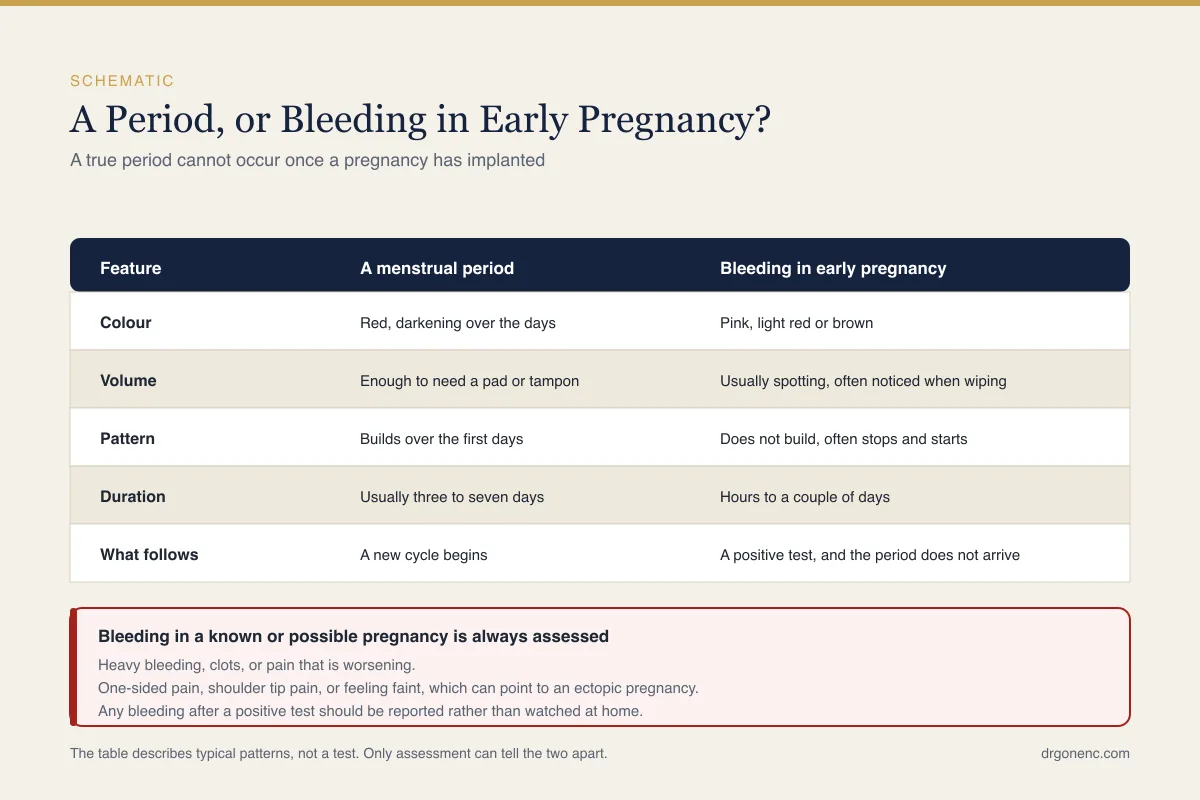
The short answer is no, and it is worth being precise about why. A menstrual period is the shedding of the uterine lining that follows a fall in progesterone when no pregnancy has implanted. Once an embryo has implanted and begun producing hCG, that fall does not happen, the lining is maintained rather than shed, and a true period becomes impossible. What is entirely possible, and common, is bleeding in early pregnancy that looks and feels enough like a light period to be mistaken for one. The distinction is not word play. It changes what the bleeding might mean and what should be done about it.
So the useful question is not whether you can be pregnant and still have a period, but what else bleeding at that point in a cycle can be. This article works through the realistic explanations, from implantation bleeding and a sensitive cervix to a subchorionic haematoma and bleeding around the date the period was due, alongside the two causes that always need assessment, which are miscarriage and ectopic pregnancy. It gives a practical way to tell a period from early pregnancy bleeding, sets out what warrants emergency help and what warrants being seen the same day, and explains why the picture is clearer after fertility treatment, where the dates are known.
If you are bleeding now, read this first. Call your local emergency number (999 in the UK, 112 in Turkey and across the EU, 911 in the US) if you feel faint or dizzy, your heart is racing, you have collapsed, you have severe or sudden abdominal pain or pain at the tip of your shoulder, or you are soaking through a pad in an hour or less. Arrange to be seen today if you have pain on one side of your lower abdomen, if you have had a previous ectopic pregnancy or tubal surgery or a positive test after fertility treatment, or if nobody yet knows where the pregnancy is. Everything below explains the rest.
One scoping point first. This article is about bleeding in the first twelve weeks, which is where the question of a period while pregnant almost always arises. Bleeding after that point is a different situation with different causes, including problems with the position of the placenta or its separation from the wall of the uterus, and it is assessed more urgently. If you are past twelve weeks and bleeding, contact your maternity unit or your own doctor straight away rather than working through this page, and call your local emergency number if the bleeding is heavy or you have constant abdominal pain.
Can you have a period while pregnant, or not?
Menstruation has a definition, and it is mechanical rather than symbolic. Through the second half of the cycle, progesterone from the corpus luteum holds the uterine lining in a stable, secretory state. If no embryo implants, the corpus luteum fades, progesterone falls, the vessels supplying the lining constrict, and the tissue breaks down and is shed. That shedding is a period. It is incompatible with an implanted pregnancy, because the pregnancy is embedded in the very tissue that would have to come away. So no, a period and an ongoing pregnancy cannot coexist.
What people describe when they say they had a period while pregnant is almost always one of two things. Either the bleed was real but was not menstruation, or the bleed came before implantation was established, in the cycle in which conception later occurred. Both are ordinary. Neither means the body somehow managed a period and a pregnancy at the same time. The confusion is understandable, because a bleed that arrives on schedule, lasts two days and needs a pad feels like nothing other than a period.
The reason to insist on the distinction is practical rather than academic. If you file the bleeding under period, you stop asking questions, you may not test, and a pregnancy can go unrecognised for weeks. If you file it under bleeding in early pregnancy, the sensible next steps follow: a test, an idea of dates, and assessment if there is pain or heavy loss. The label changes behaviour, which is why it is worth getting right.
Why the lining is not shed once a pregnancy has implanted
Implantation changes the hormonal picture within days. The outer cell layer of the embryo, the trophoblast, begins secreting human chorionic gonadotrophin, measured in blood as beta hCG in mIU/mL. That signal reaches the corpus luteum in the ovary and keeps it working instead of letting it wind down. Progesterone therefore stays high rather than falling, and without progesterone withdrawal there is no trigger for the lining to break down. In plain terms, the pregnancy sends a message that cancels the period before it can start.
Under that continued progesterone the lining does not simply persist, it transforms. The cells enlarge, the blood supply reorganises, and the tissue becomes decidua, the specialised layer that supports the developing placenta. Decidua is built to hold on rather than to come away. The timing is tight, because implantation generally begins around six to ten days after fertilisation and is complete a few days later, well inside the two weeks before a period would be expected, so the rescue of the corpus luteum happens just in time.
This is also why a bleed and a positive test are not contradictory. Bleeding can come from the edge of the implantation site, from the cervix, or from a small collection of blood beside the sac, while the decidua as a whole stays in place and hCG continues to rise. The lining is not being shed; something within or around it is bleeding. Those are different events with different implications, and only assessment, not appearance, separates them.
What bleeding in early pregnancy can actually be
Bleeding in the first twelve weeks is common, affecting a substantial minority of all pregnancies rather than a rare few, which is why early pregnancy services exist largely to assess it. It ranges from a brown smear noticed once to fresh red loss with clots. Volume alone is a poor guide, because a small bleed can come from a serious cause and a brisk one can come from a fragile cervix. What helps is to hold the realistic list in mind, then let timing, pain and a scan narrow it down.
- Implantation bleeding, light pink or brown spotting around the time the embryo embeds, usually brief and not building in intensity
- Cervical bleeding, from an ectropion, a polyp or infection, often noticed after intercourse, a smear or a vaginal examination
- A subchorionic haematoma, a collection of blood between the membranes around the pregnancy and the wall of the uterus, identified on ultrasound
- Bleeding around the date the period was due, sometimes called decidual bleeding, frequently with no cause identified at all
- Miscarriage, including threatened miscarriage, where the pregnancy is continuing and the bleeding settles
- Ectopic pregnancy, where the pregnancy has implanted outside the uterine cavity and bleeding is usually accompanied by pain
- A molar pregnancy, uncommon, where the pregnancy tissue develops abnormally rather than into an embryo, and which can present with bleeding, a larger than expected uterus, marked nausea and an unusually high hCG, diagnosed on scan and needing specific follow up
- Causes unrelated to the pregnancy, such as infection, haemorrhoids, or bleeding from the urinary tract mistaken for vaginal loss
Two of those entries, miscarriage and ectopic pregnancy, are the reason that bleeding in early pregnancy is never simply observed from a distance. Both can present with modest bleeding, and an ectopic pregnancy in particular can look unremarkable for a day or two before it does not. That is why guidance from NICE and from ACOG converges on the same practical rule: bleeding in a known or possible pregnancy deserves contact with a clinician rather than an evening of reading.
Implantation bleeding, and bleeding when the period was due
Implantation bleeding, when it happens, is light. Typically a few spots of pink, rust or dark brown on paper or underwear, sometimes mixed with mucus, lasting hours to about two days and not building hour by hour. It falls in the week or so before the expected period, typically around eight to twelve days after ovulation, once implantation is under way, and that overlap is the whole problem. Most pregnancies produce no visible implantation bleeding at all, so its absence tells you nothing, and its presence says nothing about how the pregnancy will progress. Our detailed piece on implantation bleeding covers the timing and appearance.
A separate pattern is bleeding at or just after the date the period was due, in a pregnancy that is already established. Older texts called this the placental sign, and decidual bleeding is a label still used informally, though it is not a diagnosis you will find in current guidance. No mechanism has been established; the usual suggestion is that a small area of lining at the edge of the implantation site breaks down while the rest of the decidua remains intact. In many cases no cause is found, which is an honest answer rather than an evasive one.
What matters clinically is the trajectory. Early pregnancy bleeding from a benign cause tends to be light, to stay the same or fade, and to settle within a day or two. Bleeding that increases, turns from brown to fresh red with clots, or arrives with cramping that builds has a different meaning and needs assessment the same day. None of this can be judged from memory alone, which is one reason your own doctor will ask for the date your last bleed started and exactly what it was like.
A sensitive cervix, including bleeding after intercourse or a smear
The cervix changes in pregnancy under the influence of oestrogen. Its blood supply increases and the softer lining of the canal often extends onto the outer surface, a normal finding called an ectropion. That tissue is fragile and bleeds on contact. The practical consequence is bleeding after intercourse, after a cervical screening test, after a vaginal examination, or after inserting a pessary. It is characteristically small in volume, bright or pink, noticed once and then over, and not accompanied by cramping.
A cervical polyp behaves similarly, as can an infection of the cervix, which is why a clinician may take swabs while assessing a bleed. None of this can be concluded from the history alone. Examination is what distinguishes bleeding arising from a visible cervical surface from bleeding coming through the cervical canal out of the uterine cavity, and a scan then addresses the second question. Bleeding after intercourse in pregnancy is common and usually benign, yet a first episode still warrants a call, because the same story occasionally accompanies something else.
Two further points are worth knowing. Cervical screening is generally deferred in pregnancy unless there is a specific reason to proceed, and your own clinician will advise on timing. And a bleed after intercourse does not mean that intercourse harmed the pregnancy. Whether to avoid intercourse while you are bleeding is a sensible question to put to the doctor following your pregnancy, who knows what the scan has shown.
Subchorionic haematoma, a collection of blood seen on the scan
A subchorionic haematoma is a collection of blood between the chorionic membrane around the pregnancy and the wall of the uterus. It is a scan diagnosis, reported with a size in millimetres and a position relative to the sac. Many are found incidentally in women who have had no bleeding at all. When they do bleed, the pattern is often prolonged and intermittent: brown or dark red loss appearing and settling over days or weeks as old blood tracks out through the cervix, tiresome to live with and frequently unaccompanied by pain.
Most small haematomas resorb without any intervention, and a pregnancy with a visible heartbeat alongside one commonly continues. Larger collections, and those accompanied by substantial bleeding, are followed more closely. Beyond that, the honest position is that the evidence base is thin. There is no treatment of established benefit, bed rest has never been shown to change the course, and advice on activity differs between units and between national bodies rather than following one agreed protocol. What your own clinician recommends will reflect the size, the site and your history.
Practically, this means two things. A haematoma that is releasing old brown blood over a fortnight is being watched rather than ignored. And a change in the character of the loss, to fresh red, heavier or painful bleeding, is a reason to be reassessed rather than to assume the same haematoma is behaving as before. Scans are repeated when the clinical picture changes, and the interval between them is a judgement for the doctor following you.
Telling a period and early pregnancy bleeding apart
Patients are often told to compare their bleed with a period, so it is worth setting out what that comparison actually involves. No single feature settles it, and the source of a bleed cannot be read off its appearance alone, by you or by an experienced gynaecologist; that is what examination and a scan are for. The value of the comparison lies in the pattern over time. A period has a recognisable arc: it starts, builds, peaks and tapers across several days, then stops. Most early pregnancy bleeding does not follow that arc.
| Feature | A menstrual period | Bleeding in early pregnancy |
|---|---|---|
| Colour | Often pink or brown at the start, fresh red for a day or two, then darkening | Commonly pink, rust or brown throughout; fresh red is possible and is taken more seriously |
| Volume | Enough for pads or tampons, heaviest in the first two days | Usually spotting or light loss; a liner is often sufficient |
| Pattern over time | Builds to a peak, then tapers predictably | Intermittent or unchanging; comes and goes, or appears once and stops |
| Duration | Commonly three to seven days | Hours to a couple of days, or intermittent over longer where a haematoma is present |
| Clots and tissue | Small clots are usual | Clots or tissue are not expected and should be reported |
| Pain | Familiar cramping, central, often easing as the flow continues | None or mild central tightening; severe, constant or one sided pain is a warning sign |
| What follows | The cycle continues and a later pregnancy test is negative | A pregnancy test is positive; dating, and usually a scan, follow |
Read the table as a guide to probability, not as a decision tool. Two traps are worth naming. A bleed can be light and still arise from an ectopic pregnancy, so lightness is not reassurance when there is one sided pain. And a bleed can be heavy with clots and still be followed by an ongoing pregnancy, so heaviness is not a verdict either. The only way to know which situation you are in is a test, a date, and where indicated a scan.
Bleeding that may mean miscarriage
Miscarriage is the commonest reason for bleeding in early pregnancy to be investigated, and it needs saying plainly that bleeding does not equal miscarriage. Threatened miscarriage describes bleeding with a closed cervix and a pregnancy that is continuing, and many such pregnancies go on without further trouble. The features that raise concern are cramping that builds and becomes rhythmic, bleeding that becomes heavier rather than lighter, the passage of clots or tissue, and loss of pregnancy symptoms, although symptoms are an unreliable guide on their own.
There is one treatment with evidence behind it, and it is worth knowing about so that you can ask. Where a scan has confirmed a pregnancy inside the uterus, there is vaginal bleeding, and there has been a previous miscarriage, NICE recommends vaginal micronised progesterone, 400 mg twice daily, continued to sixteen completed weeks if a heartbeat is confirmed. It is not recommended where there has been no previous miscarriage, and it is never started before a scan has located the pregnancy, because that would risk treating an ectopic pregnancy. That recommendation is NICE guidance and not every national body advises progesterone in this situation, so practice differs between countries and between units, and whether it applies to you is a decision for the doctor assessing you. Alongside it, the standard safety net is simple: if the bleeding gets worse, or carries on beyond two weeks, go back to be reassessed rather than waiting it out.
Assessment follows a standard path. An ultrasound scan, usually transvaginal, locates the pregnancy and measures it. NICE guidance on ectopic pregnancy and miscarriage sets specific thresholds for diagnosis, including a crown rump length of 7.0 mm or more with no visible heartbeat, or a mean gestational sac diameter of 25.0 mm or more with no visible embryo, each confirmed by a repeat scan or a second opinion. Earlier than that, a scan may simply be too early to interpret, and the answer comes from repeating it after an interval rather than from a single image.
Where a scan cannot yet locate or date the pregnancy, serial beta hCG measurements taken 48 hours apart are used alongside it, and those numbers are read as a trend from the starting value over that interval rather than against a single target figure. A pregnancy loss can also be found with no bleeding at all, on a routine scan, which is covered in our piece on missed miscarriage. The management options, which are expectant waiting, medical treatment, or a procedure to empty the uterus, are weighed individually with the doctor assessing you. Medical treatment differs by situation: for a missed miscarriage NICE recommends mifepristone followed by misoprostol forty eight hours later, while for an incomplete miscarriage misoprostol is used on its own. Your own preference carries real weight in that conversation.
Ectopic pregnancy, where bleeding and pain travel together
An ectopic pregnancy is one that has implanted outside the uterine cavity, most often in a fallopian tube. It is the reason that bleeding in early pregnancy is treated as urgent rather than interesting. The classic combination is bleeding that is lighter than a period and often dark, watery and brown, together with pain on one side of the lower abdomen that persists rather than coming and going. That bleeding can be mistaken for a late, light period, which is precisely how an ectopic pregnancy reaches an advanced stage without being recognised.
Other features mean emergency help rather than an appointment: pain at the tip of the shoulder, pain on opening the bowels or a sudden urge to do so, dizziness, feeling faint, or collapse. Those last three can reflect bleeding into the abdomen from a tube that has ruptured, so they are a reason to call your local emergency number rather than to arrange a visit. Ectopic pregnancy is seen more often after previous tubal surgery or pelvic infection, with a previous ectopic pregnancy, with an intrauterine device in place, and after fertility treatment, but it also occurs with none of those, so the absence of a risk factor is not reassurance. Diagnosis combines a scan, hCG measurements and, where the scan is inconclusive, close follow up in a dedicated service.
Treatment depends on the findings and on how stable you are: observation in selected cases, medical treatment with methotrexate, or surgery. Those decisions belong to the team assessing you in person, and they are time sensitive. If you are bleeding in early pregnancy and have one sided pain, the correct action is to be seen today rather than to wait and see whether tomorrow feels better.
When to seek care urgently
This section is deliberately separate, because it is the part worth remembering. Most early pregnancy bleeding turns out to have a benign explanation, but the features below cannot be assessed from home. Two levels matter here. Some features mean emergency help now, by ambulance: call your local emergency number (999 in the UK, 112 in Turkey and across the EU, 911 in the US) and do not drive yourself. Others mean being seen the same day, in person, by someone who can examine you and scan you: contact your own doctor or an early pregnancy assessment service where one is available.
Emergency help now, by ambulance, for any of the following:
- Feeling faint, dizzy or light-headed, a racing heartbeat, clammy pale skin, or collapse
- Heavy bleeding, for example soaking through a pad in an hour or less, or passing clots or tissue
- Severe or sudden abdominal pain, or pain at the tip of the shoulder
Seen the same day, in person, for any of the following:
- Pain on one side of the lower abdomen, or pain that is getting worse
- Pain on opening the bowels
- Fever, discharge with an offensive smell, or feeling generally unwell alongside the bleeding
- Any bleeding at all if you have had a previous ectopic pregnancy, tubal surgery, or a positive test after fertility treatment
- Bleeding when nobody yet knows where the pregnancy is, because a scan has not been done or was inconclusive
One administrative detail is easy to overlook. If your blood group is rhesus D negative, say so when you are assessed. Bleeding in pregnancy can be a sensitising event, and anti-D immunoglobulin is given in defined circumstances. The thresholds differ between national guidelines, particularly for bleeding in the first twelve weeks, so this is decided by the clinician in front of you rather than by one rule that applies everywhere. Bring any record of your blood group if you have it with you.
Why someone can reach several weeks still believing they have had periods
This happens more often than people expect, and it is rarely due to anything exotic. It usually needs only two ingredients: bleeding light enough to pass as a period, and a reason not to question it. Irregular cycles supply the second ingredient readily. If your cycles vary by weeks, a bleed arriving late, light and short is unremarkable, and a missed bleed the following month is equally unremarkable. Nothing feels out of place until a symptom, a test or a scan intervenes.
- Irregular or infrequent cycles, including with polycystic ovary syndrome, where a late light bleed means little
- Bleeding while using hormonal contraception, taken for a withdrawal or breakthrough bleed rather than a pregnancy bleed
- The first months after stopping a hormonal method, when almost any pattern seems plausible
- Breastfeeding, where cycles return unpredictably and nausea or fatigue are easily attributed to something else
- A home test done too early, read long after the stated time, or taken on dilute urine, giving a negative result that is then trusted
- Few or no symptoms at all, which is entirely possible, so nothing prompts a test in the first place
The consequence is usually about dates rather than danger. Pregnancy dating from the first day of the last menstrual period assumes that bleed really was a period. If it was not, the calculated dates can be wrong by weeks, which is why an ultrasound measurement is used to date a pregnancy when the history is uncertain. Expect detailed questions about recent bleeds, their timing and their character. Those questions are not scepticism; they are how a reliable date is reconstructed when the calendar cannot be trusted.
If you are in this position now, the practical steps are simple. Do a test, note the date your last bleed started and what it was like, and arrange an appointment. If there is pain, or the bleeding is heavy, do not wait for that appointment. Light bleeding in a cycle in which you were not expecting a pregnancy has other explanations as well, including bleeding around ovulation, which is a separate question with a separate answer, discussed in our article on ovulation bleeding and spotting.
Bleeding after IVF, where the dates are known
Fertility treatment removes most of the ambiguity. The date of the transfer is recorded, the age of the embryo is known, and the pregnancy test is scheduled rather than guessed at, so a bleed can be placed precisely in the sequence instead of being compared with a remembered period. Light spotting on the day of transfer or the day after is common and relates to the catheter passing through the cervix. Vaginal progesterone preparations can also irritate the vaginal walls and produce small amounts of blood that have nothing to do with the uterus.
The more important difference is hormonal. In a medicated frozen transfer cycle there is no corpus luteum, so all the progesterone supporting the lining comes from the prescribed supplementation. That is why instructions on timing and route are followed exactly, and why bleeding is reported rather than treated as a signal to stop. Stopping luteal support by yourself because of a bleed removes the only progesterone the lining has. Our article on progesterone and luteal support explains the reasoning, and your own clinic will say when support continues and when it is withdrawn.
One situation is particular to treatment where more than one embryo has implanted. If an early scan has shown two sacs, bleeding can represent the loss of one of them while the other continues, something sometimes called a vanishing twin. It is recognised on a repeat scan rather than guessed at from the bleeding, and it is one more reason that a bleed after transfer is reported and scanned rather than interpreted at home.
Bleeding before or around the scheduled blood test in a treatment cycle does not reliably predict the result, and the test is still taken on the planned day unless the clinic advises otherwise. Beta hCG is reported in mIU/mL and interpreted alongside the day of transfer and the stage of the embryo, which is why a single figure means little in isolation. Whether a bleed needs a scan, a repeat measurement, or simply a note in the record is a judgement that depends on the whole picture.
Bleeding in early pregnancy is a symptom with a wide range of explanations, and the assessment is individual. Your history, your dates, your blood group, your examination and your scan together decide what the bleeding most likely represents and what should happen next. That evaluation belongs to the physician looking after you. This article is intended to help you describe accurately what you have noticed, not to replace that conversation.
Related Reading
- Implantation Bleeding: What It Looks Like, Timing, Cramps and When to Test
- hCG Levels in Early Pregnancy and After IVF: What the Numbers Mean
- Missed (Silent) Miscarriage: Diagnosis, Symptoms, Causes and Management
- Ovulation Bleeding and Spotting: Why It Happens and How to Tell It Apart
- How long after sex does implantation occur, and what happens in between
- How soon can you take a pregnancy test? The timeline, day by day
- Spotting before your period: causes, patterns and when to seek assessment
Sources and references
This article is supported by the following independent, authoritative sources: