How long after sex does implantation occur, and what happens in between

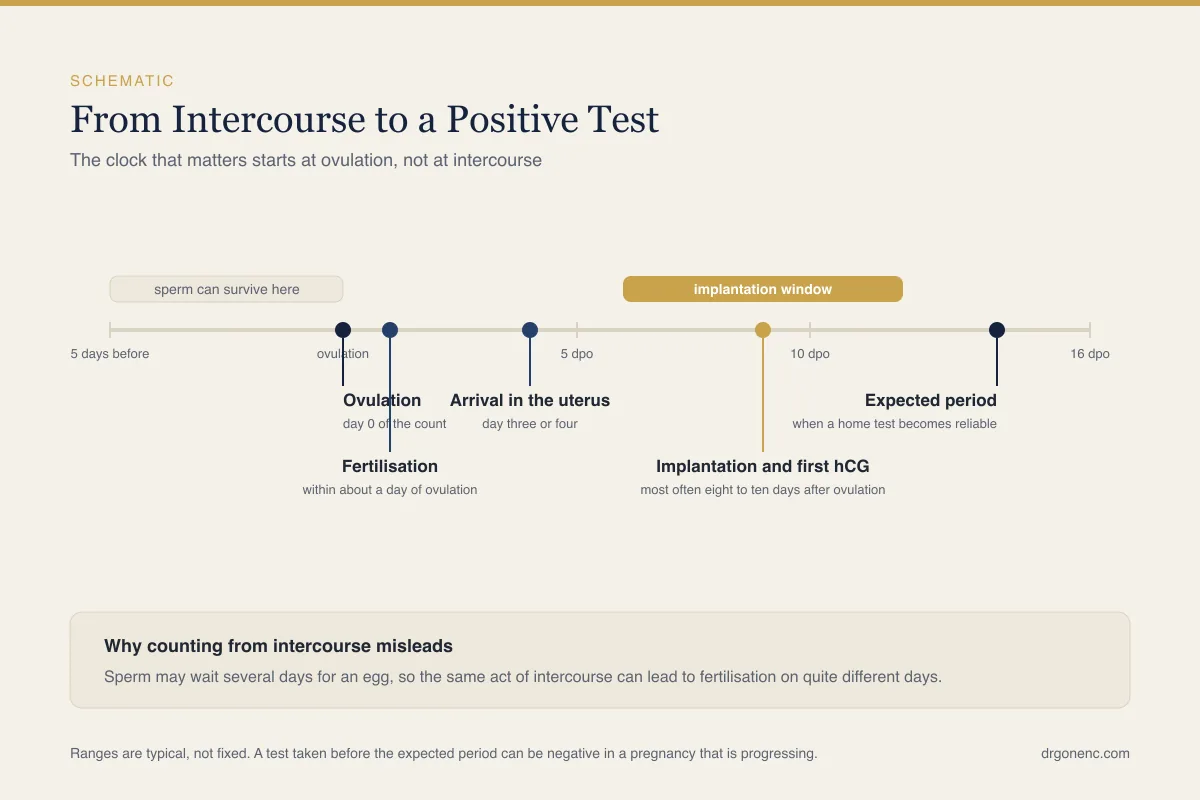
The question is asked in exactly this form, and the honest answer is that the clock being used does not quite fit the biology. Implantation does not happen a fixed number of days after intercourse. It happens a reasonably predictable number of days after ovulation, and ovulation may have followed the sex you are counting from by anything up to several days, or may have come and gone before it. Between the two events sits a sequence that cannot be hurried, cannot be felt, and cannot be tested for until near its end.
This article sets out that sequence in order: how long sperm can survive while they wait, why fertilisation can only follow the release of an egg, the three to four days the fertilised egg spends travelling to the uterus and the day or two it then floats free there, the window in which it can attach, and the point at which the hormone a pregnancy test looks for first becomes detectable. It also explains why a test taken too soon tends to disappoint, what the sensations of this fortnight do and do not mean, and how the timing changes after IVF, where the dates are known rather than estimated.
Why counting from the day of sex is the wrong anchor
The short answer, before the detail: implantation happens six to twelve days after ovulation, most often eight to ten. Because ovulation can follow the sex by up to five days, or precede it by about one, that works out at roughly five to seventeen days after intercourse. A home pregnancy test becomes reliable from the first day of a missed period, or twenty one days after the sex if you cannot date your period.
The reason people count from intercourse is sound enough: it is the one event in the whole process that has a date attached to it. Ovulation usually does not. But conception is tethered to the egg, not to the sex, and the interval between the two is variable. One act of intercourse can be followed by fertilisation within a few hours, or by fertilisation five days later, depending entirely on when the ovary releases an egg. Any answer given in days after sex has to carry that spread inside it.
That is why two women can both say they had sex on a Monday, both conceive, and have implantation occur four days apart. The first ovulated on the Tuesday, the second not until the following Saturday. Nothing about the sex differed. What differed was the cycle. An answer framed as a single number of days after intercourse quietly assumes a fact nobody has checked, which is the date the egg was released.
Two anchors do work. The first is the day of ovulation itself, from which everything afterwards is counted in days past ovulation, written DPO. The second is the date the next period is due, which is useful because, as ACOG notes, the number of days between ovulation and the start of the period is the most consistent part of the menstrual cycle. If you are unsure how your own fertile days are identified, our guide to ovulation and the fertile window covers the methods. One caveat before the timeline: if you are asking because you do not want to be pregnant, do not read the implantation window as time in hand. Emergency contraception works mainly by delaying or preventing ovulation, so it is most effective the sooner it is taken; speak to a pharmacist or your doctor straight away.
How long sperm can survive while they wait
Sperm deposited in the vagina must pass the cervix, cross the uterine cavity and reach the fallopian tube, where fertilisation takes place. Most never get there. Those that do are helped by the change in cervical mucus that oestrogen produces in the days before ovulation, when the mucus becomes clear, stretchy and permeable rather than thick and hostile. That is the practical mechanism behind mucus tracking, discussed further in our article on cervical mucus and fertility.
How long they then survive is a point on which respected bodies genuinely differ, and it is worth knowing rather than glossing over. ACOG states that sperm can survive inside the body for about three days, and sometimes up to five, after intercourse. The NHS puts the figure higher, saying sperm can survive in the fallopian tubes for up to seven days after sex. Both are describing an outer limit rather than a typical lifespan, and both lead to the same practical conclusion.
That conclusion is that sex happening several days before ovulation can still result in pregnancy, because the sperm are already in position when the egg appears. The egg has no such latitude. ACOG gives its survival in the fallopian tube as about twenty four hours after ovulation. The window therefore opens slowly, as sperm accumulate, and closes abruptly, within a day of the egg being released.
Fertilisation can only follow ovulation
This is the single fact that reorganises the whole question. No amount of intercourse produces a pregnancy in a cycle in which no egg is released, and nothing that happens before ovulation counts as conception. The ASRM committee opinion on optimising natural fertility describes the fertile window, for counselling purposes, as the six day interval ending on the day of ovulation, and reports that conception is most likely when intercourse occurs within the two days before the egg is released.
Read the other way round, that means intercourse a day or two after ovulation has usually arrived too late for that cycle, while intercourse the better part of a week earlier may be perfectly timed. So the interval you are asking about, from sex to implantation, is really two intervals joined end to end: an unknown wait for ovulation, followed by a fairly fixed sequence afterwards. Only the second half can be described with any precision.
- Sperm transport. Through the cervix and uterine cavity into the fallopian tube, taking from minutes to hours for the first arrivals, with sperm continuing to reach the tube over the following days.
- Ovulation. The release of a mature egg, which then has roughly a day in which it can be fertilised.
- Fertilisation. In the outer part of the fallopian tube, forming a single cell called a zygote.
- Cleavage and transport. Repeated cell divisions while the tube moves the embryo towards the uterus over several days.
- Blastocyst formation and hatching. The embryo becomes a fluid filled sphere and sheds its outer shell, which it must do before it can touch the lining.
- Attachment and invasion. The embryo settles on the endometrium and burrows into it, which is what implantation actually means.
Every one of those steps can fail, silently and without any sign, and in a given cycle most attempts do not end in a continuing pregnancy even when everything is timed well. That is ordinary reproductive biology rather than a sign that something is wrong, and it is one reason a single well timed month without a positive test carries very little information. The ASRM committee opinion gives the background rate plainly: most couples conceive within the first six months of trying, and the monthly chance of conceiving is highest in the first three months. So the realistic answer to how long conception takes is usually a matter of months rather than of one well timed cycle.
From fertilisation to the first chance to attach: about five to six days
Fertilisation happens in the fallopian tube, not in the uterus, which surprises many people. The NHS account of the cycle puts it simply: the egg travels down the fallopian tube, and the womb is where a fertilised egg implants. It does not travel as a single cell. It divides as it goes, moved along by the beating of microscopic hairs lining the tube and by gentle muscular contractions of the tube wall, a journey measured in days rather than hours.
By roughly the third day after fertilisation the embryo is a compact ball of cells, and it reaches the uterine cavity around the third or fourth day. By the fifth it has usually become a blastocyst, a hollow sphere with an inner cluster that will form the fetus and an outer layer that will form the placenta, and it floats free in the cavity for a day or two before it can attach at all. So the earliest moment at which implantation can even begin is around five to six days after the egg was fertilised.
Nothing about this stage can be accelerated, and nothing about it registers in the body. The embryo is microscopic, is not yet connected to your circulation, and is producing no hormone that reaches the blood in measurable quantity. Bed rest does not help it and ordinary activity does not hinder it. This is the part of the fortnight in which there is genuinely nothing to look for, which is precisely why it feels so long.
The implantation window: roughly six to twelve days after ovulation
The endometrium is not permanently receptive. Under the influence of progesterone released after ovulation it becomes able to accept an embryo for a limited period, and then loses that capacity again. This is the implantation window. NICHD states it directly: the embryo first attaches to the wall of the uterus around five or six days after ovulation, and becomes more firmly implanted between six and twelve days after ovulation. The cohort study behind those figures, published in the New England Journal of Medicine in 1999, followed 189 pregnancies and found that among those that continued, the hormone first appeared on day eight, nine or ten past ovulation in the large majority of cases.
Implantation is also not an instant. It proceeds in stages: the blastocyst comes to rest against the lining, adheres to it, and then the outer cell layer invades the tissue beneath and begins to establish a blood supply. That process unfolds over days rather than minutes. It is during the invasive stage that the outer layer starts to release human chorionic gonadotrophin, the hormone that a pregnancy test is designed to find, which is why hormone and attachment are so closely linked in the timeline below.
| Days past ovulation | What is happening | What a test would show |
|---|---|---|
| Day 0 | The egg is released. If sperm are already waiting in the fallopian tube, fertilisation can occur within hours; the egg remains fertilisable for roughly a day. | Nothing to detect. A test now reflects only a previous cycle or a hormone injection, if one was given. |
| 1 to 2 | The single fertilised cell divides repeatedly while the tube moves it towards the uterus. | Nothing to detect. |
| 3 to 4 | A compact ball of cells approaches, and may enter, the uterine cavity. | Nothing to detect. |
| 5 to 6 | The blastocyst forms, sheds its outer shell and lies free in the cavity. Attachment becomes possible towards the end of this period. | Nothing to detect. Any symptoms now come from progesterone, not from pregnancy. |
| 7 to 9 | Attachment and invasion of the lining begin. Day eight to ten is the commonest time, and the outer cell layer starts producing hCG, which enters the maternal circulation. | A blood test may begin to detect hCG towards the end of this period. Urine tests usually still read negative. |
| 10 to 12 | Attachment completes, or begins in the later cases. hCG is climbing, nearly doubling about every three days. | A sensitive urine test may turn positive, often faintly. A negative result here is not conclusive. |
| 13 to 15 | The period is due if there is no pregnancy. In pregnancy, hCG is usually well above the detection limit of home tests. | A urine test from the first day of a missed period is generally informative. |
| Beyond 15 | In a continuing pregnancy hCG keeps rising. A period that does not arrive needs explanation either way. | Repeat the urine test, or ask your doctor about a blood hCG measurement. |
One finding from that same study deserves stating plainly, because it explains a pattern patients often notice. The risk of early loss rose steadily the later attachment happened: it was lowest among pregnancies that had implanted by the ninth day past ovulation, roughly twice as common when attachment occurred on the tenth day, higher again on the eleventh, and commonest of all beyond the eleventh day, where most such pregnancies ended early. That is one reason a test turning positive unusually late, or a faint result that fades, is watched carefully by clinicians rather than treated as settled good news.
When hCG first becomes detectable
Human chorionic gonadotrophin is made by the outer cell layer of the implanting embryo, which goes on to become the placenta. MedlinePlus puts it directly: the placenta starts making hCG after a fertilised egg attaches to the inside wall of the uterus. The NHS adds the timing, noting that the hormone all pregnancy tests detect starts to be produced around six days after fertilisation. Both statements point to the same thing. There is no hCG in your blood or urine in detectable quantity before attachment begins, however early you test.
Once production starts the rise is steep. MedlinePlus describes levels climbing for about ten weeks and almost doubling every three days. A blood test, which measures hCG in milli international units per millilitre, can find very small amounts and may show a result before a period has been missed; most laboratories use a cut off of around 5 mIU/mL, below which a result is reported as not indicating pregnancy, although the exact figure varies between laboratories and assays, with borderline results repeated rather than interpreted. Our separate article on hCG levels in early pregnancy and after IVF goes into how those numbers are read.
A urine test is a blunter instrument than a blood test, and needs more hormone to produce a line. Putting the two facts together gives the realistic answer to how soon a home test can work: at the very earliest a couple of days before the period is due, for many women on or after the day it is due, and for some a few days later still. None of that is a fault in the test. It is the hormone simply not being there yet.
Why testing early disappoints so reliably
The whole difficulty sits in the gap between hCG existing and hCG being detectable in a sample of dilute urine. Tests marketed for use before a missed period are not dishonest, but they are being asked to work at the edge of what is chemically possible, on a day when a good number of pregnancies have not yet begun producing the hormone at all. A negative result on such a day tells you almost nothing, which is exactly the information people least want.
- You tested before implantation. At six or seven days past ovulation, many pregnancies have not yet attached, so there is no hormone to find.
- You ovulated later than you think. A cycle that ovulates on day nineteen rather than day fourteen puts you several days earlier in the sequence than your calendar suggests.
- Your urine was dilute. Drinking heavily before testing lowers the concentration. The NHS notes that a sample from any time of day can be used, but MedlinePlus advises using the first urine of the morning, which usually contains more hCG, and a very dilute sample works against a faint result.
- The instructions were not followed. Reading the window too early or too late, or using an expired test, will all produce misleading results.
- Your cycles are irregular. If you cannot date the expected period, you cannot judge whether the test is early.
- The pregnancy ended very early. A faint positive that fades and is followed by a period represents a loss so early it would have passed unnoticed before home tests existed.
The NHS guidance is unusually practical here, and worth following literally. Most tests can be used from the first day of a missed period. If you do not know when your next period is due, do the test at least twenty one days after the last time you had unprotected sex. A positive result is almost certainly correct, while a negative result is less reliable, so if you still think you may be pregnant, wait a few days and test again.
What can and cannot be felt during this fortnight
Progesterone rises after ovulation in every ovulatory cycle, whether or not an egg was fertilised. It is progesterone that makes breasts tender and heavy, slows the bowel so that bloating appears, lifts the resting temperature slightly and produces the flattened, tired mood many women recognise. Those sensations are therefore indistinguishable between a cycle that ends in a pregnancy and one that ends in a period, which is why the second half of the cycle feels much the same whichever way it is going to end.
Light spotting around the time the period is expected is reported by a minority of women and often called implantation bleeding, but it cannot confirm anything on its own, and most women who conceive never see it. Equally, its absence means nothing. Our article on implantation bleeding sets out how it differs from an early period and when bleeding needs to be assessed rather than interpreted.
The attachment itself is microscopic and involves tissue without the kind of sensory supply that could report it, so a twinge at seven days past ovulation cannot honestly be attributed to implantation, however strongly it feels like something. What does warrant a call rather than interpretation is bleeding heavier than spotting, pain concentrated on one side, shoulder tip pain or feeling faint, particularly once a test has been positive. Those are questions for your own doctor the same day.
How to count, in practice
The first anchor is ovulation itself. Call the day of ovulation day zero and count forwards in days past ovulation; everything in the table above then applies directly. Ovulation is estimated from urine tests detecting the luteinising hormone surge, which precedes the release of the egg by roughly one to two days and which the ASRM notes can give a false positive in a small but not negligible proportion of cycles, from the change in cervical mucus, from a sustained small rise in waking temperature, which confirms it only in retrospect, or from ultrasound monitoring arranged by a clinic.
The second anchor is the expected period, and for most people it is the easier one. The NHS puts ovulation at around ten to sixteen days before the next period, which is another way of saying that the interval from the release of the egg to the start of a period is around ten to sixteen days. Because that second half of the cycle is comparatively stable even when the first half is not, counting backwards from the date your period is due is often more dependable than counting forwards from day one.
If your cycles are irregular, both anchors soften, and that is exactly when the twenty one day rule earns its place: test at least three weeks after the last unprotected intercourse, because by then any pregnancy resulting from it will have had time to implant and to produce detectable hormone. Persistently unpredictable cycles are themselves worth raising with your doctor, since they often indicate that ovulation is irregular or absent.
How the timeline differs after IVF
In IVF the vague half of the timeline disappears. Fertilisation happens in the laboratory on a known day, so there is no waiting to see whether and when ovulation occurred. Embryos are then allowed to develop for between two and six days after fertilisation before one is transferred to the uterus, which means the embryo arrives already part way along the sequence described above rather than at the beginning of it.
The arithmetic follows from the embryo's age at transfer. A blastocyst transferred on day five is at the stage a naturally conceived embryo would reach around five days after fertilisation, so it is close to the point at which attachment can begin, usually within a day or two of the transfer. An embryo transferred on day three has a little further to go. This is why clinics date the wait from the day of transfer and add the embryo's age to it when judging whether a test result is early.
Two things complicate early testing after treatment. Progesterone is usually given as luteal support, which can soften or delay the bleed that would otherwise tell you a cycle has failed. And if hCG was used in the cycle as part of triggering ovulation, it can remain in the body long enough to produce a positive urine test that reflects the injection rather than a pregnancy. This is why your clinic sets a test date and advises against testing before it, because of exactly this kind of false result.
When the question belongs to your own doctor
A timeline is a map, not an assessment. It can tell you that a test at eight days past ovulation is likely to be uninformative, or that intercourse two days after ovulation was probably outside the window, but it cannot tell you why a particular month did not work, and it cannot be used to date a pregnancy, to judge whether implantation succeeded or to decide whether investigation is warranted. Those judgements rest on your history, your cycles and your examination.
- Twelve months of trying without conceiving, or six months if you are thirty five or over, which is the threshold at which ASRM considers earlier assessment warranted.
- Cycles that are irregular, very long, very short or absent, since these raise the question of whether ovulation is occurring at all.
- A positive test followed by pain, one sided discomfort or bleeding, which needs same day assessment to exclude an ectopic pregnancy.
- Two or more early losses, or repeated faint positives that do not progress.
- A known condition affecting the tubes, the uterus or the lining, or a previous pelvic infection or operation.
Everything in this article describes what is usual rather than what will happen in your case. The interpretation of your own dates, your own test results and your own cycle is individual, and belongs with the physician who is looking after you, who can see the whole picture rather than a single interval on a calendar. Bring your dates, including the day of the last unprotected intercourse and the date of the last period, to that conversation.
Related Reading
- Implantation Bleeding: What It Looks Like, Timing, Cramps and When to Test
- Ovulation Explained: When It Happens and How to Find Your Fertile Window
- hCG Levels in Early Pregnancy and After IVF: What the Numbers Mean
- Cervical Mucus and Fertility: How It Changes Across Your Cycle
- The Luteal Phase: Meaning, Length, Symptoms and Progesterone
Sources and references
This article is supported by the following independent, authoritative sources:
- NHS (UK), Periods and fertility in the menstrual cycle
- NHS (UK), Doing a pregnancy test
- ACOG, Fertility awareness-based methods of family planning
- ASRM, Optimizing natural fertility: a committee opinion
- MedlinePlus (US National Library of Medicine), Pregnancy test
- NICHD (US National Institute of Child Health and Human Development), Menstruation