How soon can you take a pregnancy test? The timeline, day by day

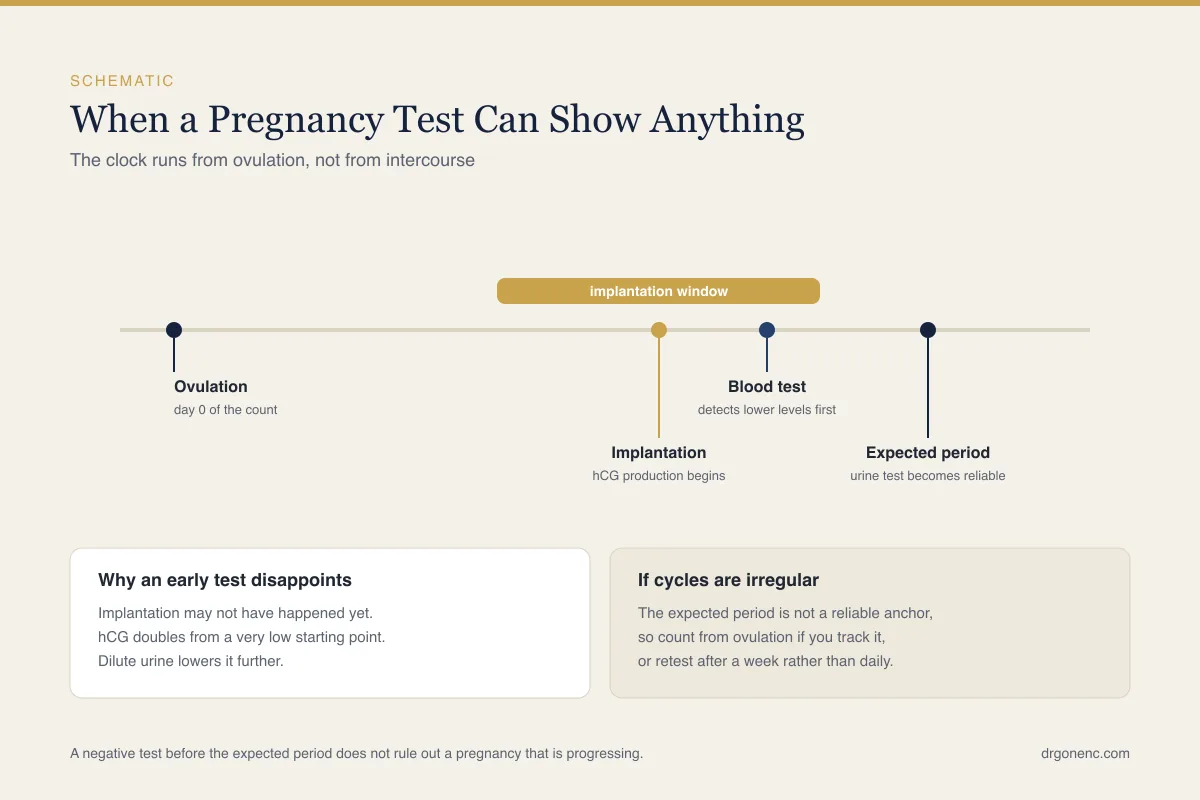
The short answer is around fourteen days after ovulation, which is the first day of a missed period, or at least twenty one days after unprotected sex if you do not know when you ovulated. The reason that is the answer, and not an earlier date, is worth understanding. A pregnancy test does not detect intercourse, and it does not detect fertilisation. It detects human chorionic gonadotrophin, a hormone that is only released once an embryo has attached to the lining of the uterus. That means the clock that matters starts at ovulation, not on the night you are counting back to. Sperm can survive for several days inside the reproductive tract, so the date of intercourse tells you very little about when a test could turn positive.
This article sets out that timeline honestly. What implantation does to the hormone, what a laboratory blood test can see and when, what a home urine test can see and when, and why a test taken before the expected period is often negative in a pregnancy that is developing perfectly well. It also covers early detection tests and what their sensitivity figures actually mean, irregular cycles where a missed period is not a usable anchor, testing after IVF where a trigger injection can still be in the system, and what to do when the test is negative and the period still does not arrive.
The short answer, and the clock it actually runs on
For someone with reasonably regular cycles, a home urine test is at its most reliable from the first day of a missed period, which in most cycles falls around fourteen days after ovulation. Some tests are designed to be used a few days before that, and a laboratory blood test can usually find the hormone a little earlier still. None of them can detect a pregnancy before implantation, because until implantation there is nothing for the test to find. That one fact explains almost every confusing early result. If you are counting from one night of unprotected sex rather than from ovulation, the usable figure is the NHS one: test at least twenty one days afterwards.
Counting from intercourse is the commonest error, and it always produces an answer that is too early. An egg survives for less than a day after it is released, while sperm can wait in the reproductive tract for several days, so fertilisation may follow the intercourse that caused it by up to about five days, and attachment by a further five days or more after that, with firm implantation anywhere up to about eleven days after fertilisation. The interval from one night to a pregnancy actually beginning can therefore be over two weeks, which is exactly why the NHS sets its advice at twenty one days rather than at a few. Counting from ovulation removes that uncertainty. If you do not know when you ovulated, the expected period is the nearest usable anchor, and where cycles vary the only practical approach is to wait and repeat.
Working out roughly when you ovulated is therefore worth more than choosing between test brands. The fertile window and the signs that mark it are covered in ovulation and the fertile window, and the interval between intercourse and attachment is set out in how long after sex implantation happens. If you have one anchor from either of those, the rest of this timeline becomes usable rather than theoretical.
Why the hormone cannot appear before implantation
Fertilisation happens in the fallopian tube, within a day of the egg being released. The embryo then divides as it travels, reaching the uterine cavity around five days later as a blastocyst, and attachment begins after that. NICHD information describes the embryo first attaching to the wall of the uterus around five or six days after ovulation and becoming more firmly implanted anywhere between six and twelve days after ovulation, and it is implantation itself that triggers the release of the hormone. For most cycles that means hormone production begins towards the end of the first week after ovulation at the earliest, and anywhere up to the end of the second week where attachment is late, rather than on a fixed day. Before attachment the embryo is free floating and releases nothing that reaches the bloodstream in a measurable amount.
Once the outer cells that will become the placenta begin to invade the lining, they release human chorionic gonadotrophin, and the level climbs steeply. MedlinePlus describes it as almost doubling every three days in early pregnancy, which is usually quoted clinically as a doubling roughly every two to three days, and it is reported in milli international units per millilitre, written mIU/mL. The level therefore starts below anything a urine test can register and crosses the detection threshold over a matter of days. A single negative test taken early carries little information; the same test a few days later carries a great deal.
Implantation day is not fixed, and that variability is the real reason the answer cannot be given as one date. A pregnancy that attaches on day six will be detectable several days before one that attaches on day ten, and neither is abnormal. The pattern of hormone values in early pregnancy, including what is measured after fertility treatment, is covered in hCG levels in early pregnancy and IVF.
Findings that need assessment the same day
Almost every question about test timing is a question of patience rather than of safety. A small number of situations are different, and they belong here rather than at the end, because they do not wait for a test result and they are not settled by one. If any of the following applies to you, arrange assessment now rather than finishing this page.
- Severe or one sided lower abdominal pain when a period is late, or with a positive test. This needs assessment today, because an ectopic pregnancy can present exactly this way.
- Pain at the tip of the shoulder, feeling faint or dizzy, collapse, or pain on opening the bowels alongside a late period or a positive test. Go to an emergency department or call your local emergency number now.
- A negative test does not settle it. A urine test can still be negative very early in an ectopic pregnancy, and severe or one sided pelvic pain with a negative test is often something else that is just as urgent, such as a twisted or bleeding ovarian cyst, appendicitis or pelvic infection. Pain of this kind is acted on because of the pain, not excused by the test.
- Heavy bleeding that soaks a pad within an hour and keeps going, with or without a positive test.
- Fever with pelvic pain and offensive discharge, which points to infection rather than to pregnancy and is also assessed the same day.
- Any positive test with bleeding or pain, and any positive test following fertility treatment, should be reported to the doctor or unit looking after you on the day rather than watched.
None of that means something has already gone wrong. It means the question cannot be answered at home with a stick. Both NICE guidance on ectopic pregnancy and miscarriage and ACOG patient information make the same point in different words: one sided pain in early pregnancy is assessed urgently, and the urgency does not depend on how convincing the test line looked. Everything that follows is written for the far commoner situation of someone who feels well and simply wants to know when to test.
What a blood test can show, and when
A laboratory serum assay measures the hormone quantitatively and reports a number in mIU/mL. These assays register far smaller amounts than any home test, which is why MedlinePlus describes a blood test as able to show a pregnancy before a period has been missed. In practice that usually means detection from around eight to ten days after ovulation where implantation happened early in its window, becoming reliable by about eleven days, and several days later again where attachment happened at the far end of its window.
The second advantage of a number is that it can be repeated. A value on its own says less than two values taken about forty eight hours apart, because the direction and the pace of the rise is what tells a doctor whether an early pregnancy is behaving as expected. That is why quantitative testing is the tool used when an ectopic pregnancy or an early loss is being assessed, rather than as a way of answering the original question sooner.
Blood testing is not routine for someone simply wondering whether she is pregnant, and MedlinePlus says as much. It is used where the answer is needed earlier than urine allows, after fertility treatment, where there is pain or bleeding, and before certain medicines or procedures. Whether you need one is a decision for your own doctor, and reference intervals differ between laboratories, so a figure only means something when it is read against the reporting range of the laboratory that produced it.
What a home urine test can show, and when
A home test is qualitative. It answers one question: is the hormone present above the threshold this particular test is built around, or is it not. NHS information states that most pregnancy tests can be carried out from the first day of a missed period, that they are most reliable from that day, and that some very sensitive tests can be used even before a period is missed. That is the honest range, and it is a range rather than a date.
The question many people search for is after how many days a pregnancy can be confirmed by a urine test. Counted from ovulation, the answer is around fourteen days, which is the day the period is due. Counted from a missed period, a test on the day the period should have started is usually enough, and a repeat three to seven days later resolves almost all of the uncertainty. Counted from intercourse, there is no single dependable number, because ovulation may have followed by several days and implantation by a week or more after that. The usable rule for that way of counting is the NHS one: test at least twenty one days after the last unprotected sex, and repeat three to seven days later if the period still has not arrived.
What a negative test means depends entirely on when it was taken. NHS information puts it plainly: a positive result is very likely to be correct, while a negative result is less reliable, and it may be unreliable if the test was done too early or the instructions were not followed. Before the expected period, negative mostly means not yet rather than not pregnant. After a missed period, with a second negative test a few days later, it starts to mean something.
Days past ovulation, and what a test can and cannot show
The table below maps days past ovulation, written dpo in cycle tracking communities, against what is physically happening and what each kind of test can register. It assumes ovulation is known, which is the whole difficulty, and it describes a pregnancy that implants in the usual window. A pregnancy that attaches later shifts every row to the right by the number of days involved, which is why the last row matters as much as the first.
| Days past ovulation | What is happening | Laboratory blood test | Home urine test |
|---|---|---|---|
| 0 to 5 days | Fertilisation may have happened in the tube; the embryo is still travelling and has not attached | Nothing to find | Nothing to find; a test here answers a question that does not yet exist |
| 6 to 8 days | Attachment begins in many cycles and the cells that will form the placenta start releasing hormone | May just begin to register on a sensitive assay, often not yet | Almost always negative |
| 9 to 11 days | The level is rising steeply, roughly doubling every two to three days | Usually detectable; this is where a blood test is genuinely earlier | Occasionally a faint line on a sensitive test, more often nothing |
| 12 to 13 days | The level is climbing through the range home tests are designed around | Detectable in a pregnancy that is progressing | A sensitive test may show a faint line, more likely on the first sample of the day |
| 14 days, the expected period | Progesterone would normally be falling by now; the pregnancy hormone prevents that | Detectable, and the figure can be repeated after about forty eight hours | The day from which a standard test is at its most reliable |
| 15 to 18 days | The level is well above the threshold of a standard test | Detectable; values used to follow the pregnancy rather than to diagnose it | Clear positive, and the time of day stops mattering |
| 19 to 21 days and beyond | A late implanting pregnancy shows itself here | Detectable | A negative test at this point, with no period, needs a different explanation |
Two things follow from reading down the right hand column. The first is that the gap between what a blood test and a urine test can see is a matter of days, not weeks, which is why a blood test is rarely worth arranging for the sake of knowing sooner. The second is that a negative test at nine or ten days past ovulation is close to meaningless on its own, and the sensible response to it is a date in the diary rather than another test tomorrow.
Why the first sample of the day matters at the early end
The hormone is cleared into the urine, so its concentration there depends on how much fluid has passed through in the preceding hours. Urine held overnight is the least diluted sample of the day. When the level in the blood is only just above the threshold, that dilution can be the difference between a visible line and a blank window, which is why test leaflets so often specify the first sample after waking for early use.
This is a point where published guidance genuinely differs, and it is worth saying so rather than picking a side. NHS information states that a test can be done on a urine sample collected at any time of day and that it does not have to be in the morning. MedlinePlus and most test leaflets advise the first sample of the day, because morning urine usually contains more of the hormone than urine passed later on. Both are consistent: timing stops mattering once the level is well above the threshold, and matters a great deal in the days before that.
Two practical habits follow. Avoid drinking large amounts of fluid in the hours before an early test, because diluted urine works against you rather than for you. And read the result inside the window the leaflet specifies. A line that appears an hour or several hours later is not a result; it is usually an evaporation mark, and it is one of the commonest reasons for a day of confusion followed by a negative repeat.
Early detection tests, and what a sensitivity figure means
Sensitivity on a pregnancy test package is the lowest hormone concentration at which that test registers reliably, expressed in mIU/mL. Thresholds of around 25 mIU/mL are the conventional figure quoted on standard tests, and tests marketed for early use typically quote lower ones, often 20 mIU/mL or 10 mIU/mL. These figures are not standardised between brands, which is why the only one that applies to you is the one printed in the leaflet of the test you have actually bought. A lower figure does genuinely mean the test can register a smaller amount of hormone, and therefore a day or two earlier in the rise. It does not mean a week earlier, because the hormone has to exist before any threshold is relevant.
The figure is also determined under laboratory conditions with prepared samples, and the real limit in a bathroom is not the threshold but your own level on that morning, which depends on when implantation happened and how fast the rise is. Two women testing on the same day past ovulation can have levels that are far apart, and both can be carrying a pregnancy that goes on to progress normally. A sensitive test narrows the uncertain window a little. It does not remove it.
There is a trade off that deserves saying plainly. Testing several days before a period is due will sometimes identify a pregnancy that ends within a few days as a very early loss, which would otherwise have passed unnoticed as a slightly late period. Some people would rather know, and some would rather not, and the choice is a personal one rather than a medical instruction. If you do test early, decide in advance what you will do with a faint line, which is usually to repeat it after two days.
Irregular cycles, where a missed period is not an anchor
All the advice above leans on the day the period is due, which is unhelpful if that day is not knowable. Cycles vary for many reasons: polycystic ovary syndrome, thyroid disease, raised prolactin, weight change and heavy training, the months after a birth or while breastfeeding, the months after stopping hormonal contraception, and the approach to menopause. NICHD information on menstruation describes how wide the normal range of cycle length actually is, and a cycle inside that range is not abnormal on length alone.
Where cycles are irregular, the interval that stays relatively stable is the luteal phase, meaning the time from ovulation to the next period, which is described in the luteal phase explained. It is the follicular phase before ovulation that stretches. That is why a long cycle usually means ovulation happened late rather than that implantation is somehow delayed, and why a test taken on the day you merely expected a period can be several days too early.
- If you have a reliable ovulation marker, such as a positive urine ovulation test or a recorded temperature shift, count fourteen days from it and test then.
- If you do not know when the period is due at all, NHS information advises doing the test at least twenty one days after you last had unprotected sex, which allows for late ovulation and late implantation together.
- If that test is negative and no period arrives, repeat it three to seven days later with the first sample of the morning rather than assuming the first answer was final.
- If cycles have been absent or unpredictable for months, the question stops being about test timing and becomes a question about ovulation itself, which is one for your own doctor.
Testing after IVF, where the clinic sets the date
After assisted treatment the uncertainty that this whole article is about largely disappears, because the dates are known. Fertilisation did not depend on timing intercourse, and the day of transfer is recorded, so the interval to a meaningful test can be calculated rather than estimated. That is why units set a specific date for a quantitative blood test instead of leaving it to a home test, commonly somewhere between nine and fourteen days after the transfer, depending on the stage the embryo had reached when it was transferred; HFEA information simply notes that you will be given a date and advises against testing before it.
There is one trap that is specific to treatment cycles. Where the injection used to trigger final egg maturation contains human chorionic gonadotrophin as its active substance, the hormone that was given is the same hormone the test looks for. It clears over roughly ten to fourteen days, so a home test taken inside that window can be positive when no pregnancy has implanted. A negative test taken soon after the trigger has cleared is not reassuring either, because a pregnancy's own hormone production may not yet have reached the threshold of a home test. Neither result settles anything, which is why the quantitative blood test on the date the unit sets is the one to act on. Where a gonadotrophin releasing hormone agonist alone has been used to trigger instead, this does not apply. Some protocols use both together, a dual trigger, and in that case a small amount of the hormone has still been given. Which of those applies to you is a question for the team that prescribed it.
Progesterone support, which many protocols continue after transfer, does not interfere with a pregnancy test at all, although it can make the days before the test harder to read by producing exactly the symptoms people are watching for. HFEA information on IVF sets out the sequence of a treatment cycle for anyone who wants the wider context, and light bleeding or spotting in this window is common enough that it should be reported to the unit rather than interpreted at home.
Many people test at home before the clinic date anyway, and clinics know it. If you do, understand what you are looking at: a faint line may be residual trigger hormone, a negative may be a day too soon, and neither replaces the quantitative value that the unit will act on. The number from the clinic is also only the first of a series, because what happens to it over the following days, and then on a scan, is what actually establishes where and how a pregnancy is developing.
A negative test when the period still has not arrived
This is the commonest unresolved situation, and it has a straightforward first step. Repeat the test after three to seven days. NHS information advises waiting a few days and testing again, and adds that if a second test is also negative and the period has still not arrived, it is worth speaking to a doctor. Use the first sample of the morning for the repeat, which is the MedlinePlus and manufacturer advice for the early end of the range, because it is the least diluted sample of the day. In the great majority of cases the repeat answers it, either with a line that has appeared or with a period that arrives in the meantime.
If repeated tests are negative and the period remains absent, the likeliest explanation is that ovulation happened later than you assumed, or did not happen at all in that cycle. A cycle without ovulation produces no corpus luteum, no orderly fall in progesterone and therefore no predictable bleed, and it can happen to anyone after a disrupted few weeks. The list below covers what a doctor will think through.
- Late ovulation in an otherwise ordinary cycle, which simply moves the expected period.
- A cycle without ovulation after illness, surgery, bereavement, travel across time zones, shift work or a stretch of poor sleep.
- Low energy availability from weight loss, restricted eating or a training load that outstrips what is eaten.
- Polycystic ovary syndrome, thyroid disease or raised prolactin, each of which produces infrequent or absent periods.
- Recently stopping hormonal contraception, the months after a birth, and breastfeeding.
- The approach to menopause, where cycle length shifts before periods stop.
- A bleed that was taken for a period but was not one, which puts the dates further out than they look.
NICHD information on amenorrhoea describes an absence of more than three cycles in someone who previously had regular periods as the point at which a missed period is investigated, with a longer interval of around six months conventionally used where cycles were already irregular, and sooner than either where there are other symptoms. Repeated negative tests with a persistently absent period is not a situation to keep testing your way out of. It is worth an appointment, where a short history and a small number of blood tests usually settle what is happening far faster than another box of tests will.
What to bring to your own doctor
What makes an appointment productive here is dates, and almost nobody arrives with them. Write down the first day of your last period, the lengths of the last few cycles, the date of any positive ovulation test or recorded temperature shift, the dates of unprotected intercourse, and the date and result of every pregnancy test you have taken. Add any bleeding since, current medicines and contraception, and, if you have had treatment, the transfer date and the type of trigger used.
Those dates change interpretation, not just record keeping. A negative test means one thing at ten days past ovulation and something quite different at twenty one. An early scan carried out too soon cannot show what people hope it will show and often has to be repeated, which is why, where there is no pain and no bleeding, the usual sequence is a test, then a quantitative measurement if one is needed, then imaging at a sensible interval rather than immediately. Where there is pain or bleeding that sequence does not apply: assessment and a scan are arranged urgently, and a date weeks away is not the right answer in that situation.
Nothing on this page replaces the judgement of the doctor who can take your history and examine you. It is written to make the timeline understandable, so that an early negative is not read as an answer and a late one is not dismissed. If you are in pain, bleeding heavily, or worried in a way this article has not settled, contact your own doctor or an emergency service today rather than waiting for the next test.
Related Reading
- How long after sex does implantation occur, and what happens in between
- hCG Levels in Early Pregnancy and After IVF: What the Numbers Mean
- Ovulation Explained: When It Happens and How to Find Your Fertile Window
- Implantation Bleeding: What It Looks Like, Timing, Cramps and When to Test
- The Luteal Phase: Meaning, Length, Symptoms and Progesterone
- False positive pregnancy test: why it happens and what to do next
- Implantation cramps: what they feel like and what they cannot tell you
Sources and references
This article is supported by the following independent, authoritative sources: