Ovarian pain: what causes it, and when it needs urgent assessment

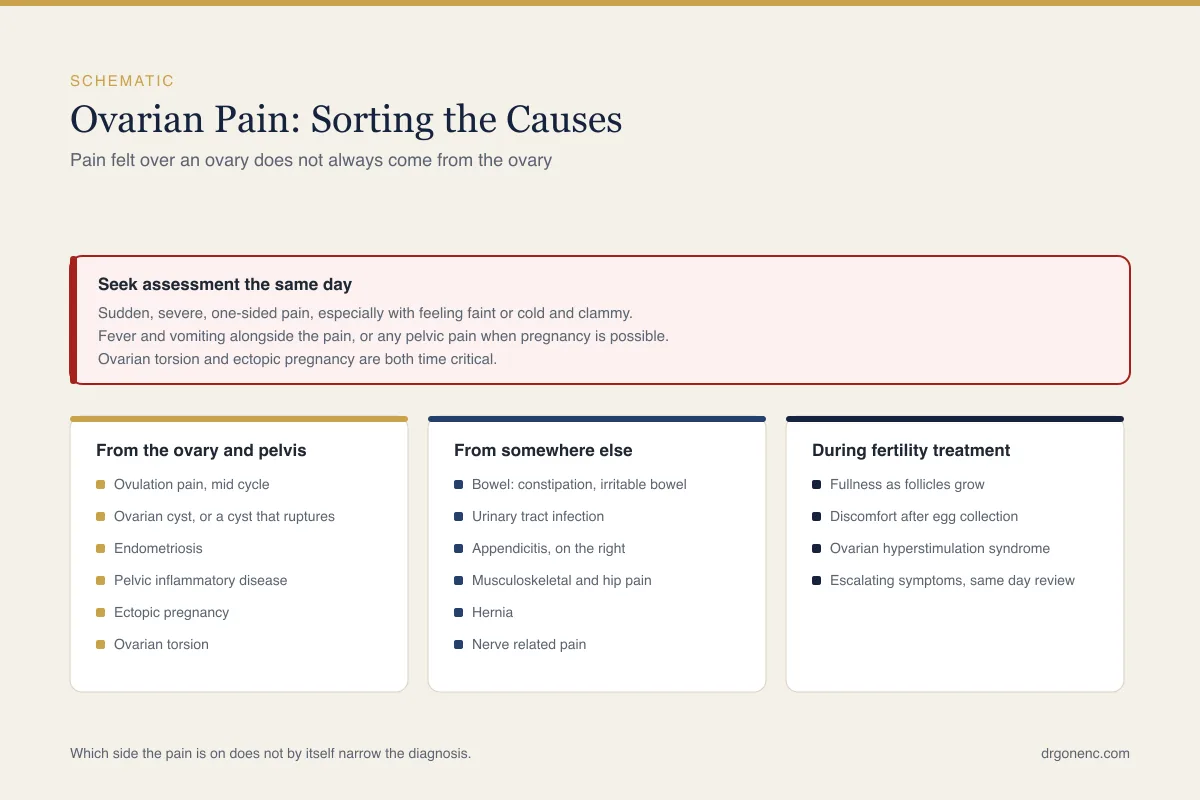
Pain felt low down on one side, over the place where you believe an ovary sits, is one of the most frequent reasons women are seen in a gynaecology clinic. It is also one of the easiest symptoms to misread, because the ovary is a small organ in a crowded part of the body. Bowel, bladder, appendix, ureter, pelvic floor muscles and the nerves of the abdominal wall all refer pain to the same patch of skin, and the nerves carrying sensation from the ovary itself are poor at telling the brain exactly where the signal started.
The useful question, then, is not only what is wrong with the ovary, but whether the ovary is involved at all. This article works through the gynaecological causes, from ovulation and cysts to endometriosis, pelvic infection and ectopic pregnancy, and then the fullness that comes with ovarian stimulation during fertility treatment. It also sets out separately the small group of features that mean today rather than next week. None of it replaces being examined: what is causing your own pain is a judgement for the doctor who assesses you.
Why pain over an ovary is often not coming from the ovary
Each ovary is roughly the size of an almond and lies against the side wall of the pelvis, low and deep, well behind the point most people press when they describe the pain. The sensory nerves from the ovary travel with the ovarian vessels and reach the spinal cord around the tenth thoracic level, which also serves the small bowel and the skin around the navel. Pain of this kind, called visceral pain, is characteristically dull, difficult to localise, and often accompanied by nausea rather than by a crisp sense of position.
Pointing at a spot is therefore weak evidence. A good deal of what patients describe as right ovary pain turns out to come from a loaded caecum, a hip joint, a hernia or a tender band of pelvic floor muscle. The reverse is equally true: a genuinely ovarian problem is often felt in the lower back, the groin, the inner thigh or even the rectum, because those regions share spinal segments with the pelvic organs and the brain cannot keep the sources apart.
- The caecum and appendix on the right, and the sigmoid colon on the left, both of which lie directly over the ovary
- The bladder and the lower ureter, which run close to the ovarian vessels as they cross the pelvic brim
- The fallopian tube, a separate structure from the ovary and a common source of one-sided pelvic pain
- The pelvic floor and lower abdominal wall muscles, and the sensory nerves passing through that wall
- The hip and the sacroiliac joint, which refer pain forwards into the groin and lower abdomen
None of this means the pain is imagined or unimportant. It means the diagnosis comes from the pattern rather than from the position: when it started and how quickly, what it relates to, what makes it better or worse, what else is happening at the same time, and what an examination and a scan show. A single symptom considered in isolation rarely identifies a cause, which is why a careful history still does more work than any one test.
Pain that needs assessment the same day
Two levels of urgency are used below. Call emergency services immediately, or have someone take you straight to an emergency department, if you feel faint or clammy, collapse, are bleeding heavily, or the pain is so severe you cannot move or stand. Everything else on the list below needs to be assessed the same day, which means an emergency department or an early pregnancy assessment service rather than the next free routine appointment.
Most ovarian pain is not an emergency. A small number of presentations are, and they belong near the beginning of this article rather than the end, because they are time critical rather than merely uncomfortable. Two diagnoses drive the list. In ovarian torsion the ovary twists on its own supporting ligaments and loses its blood supply. In ectopic pregnancy a pregnancy implants outside the uterine cavity, usually within a fallopian tube, and can bleed into the abdomen. In both, the interval between the pain starting and being assessed changes what can be done.
- Sudden severe pain on one side that arrived over minutes rather than days, especially with vomiting
- Any pelvic or lower abdominal pain when a pregnancy is possible, including before a test has been done
- Heavy vaginal bleeding alongside the pain, especially soaking a pad in an hour or passing large clots, whether or not a pregnancy is known about
- Feeling faint, light headed, clammy or collapsing, or any visible bleeding alongside the pain. This needs emergency services now (112 in Turkey, 999 in the UK, 911 in the US), not a same day appointment
- Fever with vomiting, or pain together with a temperature and an unusual vaginal discharge
- Pain at the tip of the shoulder, which can mean blood inside the abdomen irritating the diaphragm
- Abdominal swelling, breathlessness or a sharp fall in the amount of urine passed after fertility drug treatment
- Pain that is worsening hour by hour, or that simple pain relief no longer controls
- Pain that began around the navel and then moved and settled in the lower abdomen over several hours, with loss of appetite and nausea, which is how appendicitis typically behaves
Torsion becomes more likely once an ovary is enlarged, commonly by a cyst of around 50 mm or more, and it is seen more often in pregnancy and after ovarian stimulation, when the ovaries are both bigger and more mobile. The pain is typically sudden and severe, often with vomiting, and it can come and go if the ovary twists and partly untwists. Ultrasound with Doppler is used in assessment, but preserved blood flow does not exclude torsion, so a convincing history is acted upon. Where it is suspected, laparoscopy may be needed to untwist and preserve the ovary.
Ectopic pregnancy carries the same urgency, and it is the reason a pregnancy test comes before almost everything else in a woman of reproductive age with pelvic pain. Pain often precedes any bleeding, and a period that was late, light or unusual is easy to dismiss. Assessment combines a blood test for the pregnancy hormone hCG with a transvaginal ultrasound scan, sometimes repeated over several days while the picture declares itself. Many health systems run early pregnancy assessment services for precisely this situation, and attending one is not an overreaction. The NHS guidance on ectopic pregnancy sets out the same warning signs.
Ovulation pain and the mid-cycle ache
The commonest benign explanation for one-sided ovarian pain is ovulation itself. Over the first half of the cycle one follicle becomes dominant and grows to somewhere around 18 to 24 mm, stretching the capsule of the ovary and producing a dull, building ache. At rupture, follicular fluid and a small amount of blood escape into the peritoneal cavity, where the lining reacts sharply to blood and to prostaglandins, giving a briefer and sharper sensation. Smooth muscle in the ovary and tube contracts at the same time, adding a cramping quality. This pattern is discussed in detail in our article on ovulation pain.
Typical ovulation pain is one-sided, mild to moderate, and lasts from a few minutes to a few hours, with a minority noticing a low-grade ache for a day or two. It may switch sides between cycles, because the ovaries do not take strict turns. Timing is the most informative feature: it clusters roughly twelve to sixteen days before the next period starts, not on a fixed day fourteen. Tracking pain against the start of the following period is therefore more revealing than counting forward from the last one.
What argues against ovulation as the explanation is pain that is severe enough to stop you working, that lasts beyond two days, that appears at unpredictable points in the cycle, or that has recently changed in character or intensity. Fever, vomiting, fainting, heavy bleeding or shoulder tip pain take the problem out of this category altogether. A pain that reliably lands in the mid-cycle window over several cycles is behaving like ovulation pain; one that does not should be reassessed rather than labelled.
Ovarian cysts, and the pain when one ruptures or bleeds
Most ovarian cysts are functional, meaning they are part of the normal working of the ovary rather than a disease. A follicle that does not rupture can persist as a follicular cyst, and the corpus luteum left behind after ovulation can fill with fluid or blood. These are silent in most cycles and resolve over the following two or three. The RCOG patient information on cysts before the menopause reflects the usual approach, in which a simple cyst smaller than about 50 mm in a premenopausal woman generally needs no routine follow-up scan.
When a cyst does hurt, it usually does so by stretching the ovarian capsule or by pressing on neighbouring structures. Patients describe a heaviness or dragging sensation on one side, present for weeks rather than hours, sometimes with bloating, deep discomfort during intercourse, or a need to pass urine more often. Larger cysts, and the non-functional kinds such as a dermoid, an endometrioma or a cystadenoma, are more likely to produce this steady background ache because they do not come and go with the cycle.
Rupture is different in character. It produces sudden sharp pain on one side that then spreads across the lower abdomen over the next hour as fluid disperses and irritates the peritoneum, before settling over a day or so in most cases. Bleeding into a corpus luteum cyst, a haemorrhagic cyst, can be considerably more painful, and occasionally bleeds enough into the abdomen to need admission and observation. Anyone taking an anticoagulant, or with a bleeding disorder, is assessed with more caution for this reason.
Assessment of a cyst rests on ultrasound appearance, the symptoms it is causing, and age. A cyst with simple fluid, thin walls and no internal structures behaves differently from one with solid areas or increased blood flow, and a cyst found after the menopause is approached differently again, since functional cysts no longer form at that stage. Whether yours needs a repeat scan, a specialist opinion or nothing further is a decision for the doctor holding your scan report and your history together.
Endometriosis and pain that follows a pattern
In endometriosis, tissue resembling the lining of the uterus grows outside it, on the pelvic peritoneum, the ovaries, the bowel surface and the ligaments supporting the uterus. On the ovary it can form an endometrioma, a cyst filled with old blood. The pain usually begins as a cyclical problem, worst in the days around a period, and in some women becomes more constant over the years. Painful periods, deep pain during intercourse, pain on opening the bowels and a persistent one-sided ache are the descriptions that recur in clinic.
Delay in diagnosis remains the central problem, and much of it comes from normal test results being read as reassurance. NICE guideline NG73 is explicit that a normal examination, a normal ultrasound scan and even a normal MRI do not exclude endometriosis. Guidance has also shifted on timing rather than on the test itself. NICE now advises that investigation and referral proceed in parallel with starting treatment, so a woman is not left in pain while she waits for a scan or an operation, and it still recommends considering laparoscopy even when the ultrasound or MRI scan is normal. ESHRE has gone further and no longer treats laparoscopy as the only route to a diagnosis, accepting one made on symptoms and imaging. The practical consequence of both is the same: treatment does not have to wait for surgical confirmation. The relationship with conception is covered in our article on endometriosis and fertility.
An endometrioma deserves a separate mention, because it produces exactly the picture this article is about: steady one-sided ovarian pain, often with painful periods, in a woman whose scan shows a cyst that does not disappear. Large endometriomas also enlarge the ovary enough to matter for torsion. Management ranges from hormonal treatment that suppresses cyclical activity through to surgery, and because ovarian surgery has its own consequences for ovarian reserve, the balance is individual and belongs to the treating gynaecologist.
Pelvic inflammatory disease and the tube as the source
Pelvic inflammatory disease is infection that has ascended from the cervix into the uterus, the fallopian tubes and the surrounding tissue, most often caused by chlamydia or gonorrhoea. Because it travels along both tubes, the pain is more often felt on both sides than on one, although one side can dominate. The accompanying features are what identify it: an unusual vaginal discharge, bleeding between periods or after intercourse, deep pain during intercourse, pain low in the pelvis, and sometimes fever with feeling generally unwell.
Many episodes are mild and easily attributed to something else, which is the reason the condition causes lasting damage. On examination there is tenderness when the cervix is moved and over one or both adnexa. Swabs are taken for chlamydia and gonorrhoea, but antibiotic treatment is usually started on clinical grounds before the results return, because waiting adds to the scarring. Sexual partners need treatment as well, otherwise reinfection follows, and a repeat episode compounds the risk to the tubes.
Two complications change the urgency. A tubo-ovarian abscess produces a tender mass with fever and marked illness, and needs hospital assessment. Over the longer term, a scarred tube can fill with fluid and become a hydrosalpinx, which may cause ongoing discomfort and has recognised implications for later fertility treatment, covered in our article on hydrosalpinx and IVF. Chronic pelvic pain after a treated infection is also well recognised and should not be dismissed once the infection itself has cleared. ACOG's patient information on chronic pelvic pain covers that situation.
Other gynaecological causes felt in the same place
Uterine conditions frequently present as pain to one side. A fibroid growing out on a stalk towards the pelvic side wall can be felt exactly where an ovary would be, and a fibroid that outgrows its blood supply, which happens more often in pregnancy, causes acute localised pain with tenderness and sometimes a low temperature. Adenomyosis, where endometrial-type tissue sits within the muscle of the uterus, tends to produce heavy painful periods and a diffusely tender, bulky uterus rather than a single tender point.
Polycystic ovary syndrome is worth addressing directly, because the name misleads. The many small follicles that give the ovary its appearance on a scan are not cysts in the sense used elsewhere in this article, and they do not themselves cause pain. Ovaries in polycystic ovary syndrome are often slightly larger than average, which can contribute to a sense of fullness, and irregular or absent ovulation means that mid-cycle pain is less predictable or absent. But pain in a woman with polycystic ovary syndrome still needs its own explanation rather than being attributed to the diagnosis she already has. Our article on PCOS and getting pregnant covers the condition itself.
Adhesions after previous surgery or infection can tether an ovary to the pelvic wall or to bowel, giving pain that is provoked by movement, intercourse or a full bowel. Where an ovary has been removed, small amounts of remaining ovarian tissue occasionally continue to function and hurt. Dilated pelvic veins are another recognised cause of a dragging ache that is worse on standing and before periods. These are harder diagnoses, usually reached after the commoner explanations have been considered and excluded by the assessing doctor.
Ovarian pain during fertility treatment
During ovarian stimulation the ovaries are deliberately asked to do something they do not normally do. Instead of one dominant follicle, injectable gonadotrophins recruit a group of them, and each ovary grows from the dimensions of an almond to something appreciably larger. Most patients describe this as pressure and fullness rather than pain: a heaviness low in the abdomen on both sides, bloating, clothes feeling tighter, and discomfort on sudden movement. It builds towards the end of the stimulation phase and eases once the follicles have been emptied.
After egg collection, a fine needle has passed through the vaginal wall into each ovary several times, so cramping similar to a heavy period, together with light spotting, is expected for a day or two, as described in our article on egg retrieval. What is not expected is pain that increases after the second day, fever, heavy bleeding, faintness or progressive abdominal swelling. Any of those should prompt same day contact with the team running the cycle rather than waiting for the next scheduled appointment.
Ovarian hyperstimulation syndrome is the condition behind that advice. Vasoactive substances released by many stimulated follicles, amplified by hCG from the trigger injection or from an early pregnancy, make capillaries leak, so fluid shifts out of the circulation into the abdomen. The result is distension, nausea, breathlessness when lying flat and a noticeable reduction in urine passed. It is more likely where many follicles have developed, in polycystic ovary syndrome and in younger patients, and our article on ovarian hyperstimulation syndrome covers recognition and management. Two further symptoms matter because the same fluid shift thickens the blood and raises the risk of a clot: pain, swelling, warmth or redness in one calf or leg, and chest pain or sudden breathlessness. Either needs emergency assessment the same day, not a message to the clinic, and the risk persists for several weeks, including into an early pregnancy.
Two points follow for anyone in a treatment cycle. First, enlarged stimulated ovaries are more mobile and more prone to torsion, so sudden severe one-sided pain during or after stimulation is taken seriously rather than attributed to the fullness of treatment. Second, the strategies that reduce hyperstimulation, among them antagonist protocols, an agonist trigger, freezing all embryos and transferring in a later cycle, and adjusting the gonadotrophin dose, are decisions made in advance by the treating clinician according to the individual response.
Why left versus right does not by itself narrow the diagnosis
Patients reasonably expect the side to mean something, and for the gynaecological causes it means very little. The two ovaries are the same organ mirrored across the midline. Ovulation alternates irregularly rather than neatly, and functional cysts, endometriomas, torsion, tubal infection and ectopic pregnancy show no meaningful preference for one side. Knowing that the pain is on the left tells the examining doctor which adnexa to concentrate on during the scan, and almost nothing about which diagnosis sits at the top of the list.
Where side does carry some information is among the non-gynaecological neighbours, because they are not symmetrical. The appendix and caecum sit on the right, so appendicitis rises up the list for right-sided pain, and it is a same day problem rather than one to observe. Diverticular disease of the sigmoid colon sits on the left. Even there the signal is weak: the appendix can lie behind the caecum or be displaced upwards in pregnancy and present atypically, while constipation and trapped wind are felt anywhere across the lower abdomen on either side.
What does narrow the diagnosis is everything other than the side. How quickly the pain came on. Whether a pregnancy is possible. Where it falls in the cycle, and whether that is reproducible. Whether there is fever, vomiting, abnormal discharge, a change in bowel habit or urinary symptoms. What examination finds, and what the scan shows. Timing and the company the pain keeps are informative; left or right, on its own, mainly tells you where to put the probe.
Bowel, bladder and musculoskeletal pain felt over the ovary
Bowel conditions are probably the single largest group of pelvic pains that are initially assumed to be ovarian. Irritable bowel syndrome, simple constipation, diverticular disease, coeliac disease and inflammatory bowel disease all produce lower abdominal pain in the regions that overlie the ovaries. The clues lie in the relationships rather than the location: pain that changes with eating, that eases after opening the bowels or passing wind, that comes with bloating which varies through the day, or that accompanies a change in stool frequency or consistency. One pattern is the exception to all of this. Bloating or abdominal swelling that is persistent rather than fluctuating, present on most days for three weeks or more, together with pelvic pain, feeling full soon after starting to eat, or needing to pass urine more often, should be assessed rather than managed as irritable bowel syndrome. Ovarian cancer is an uncommon cause of this picture, but it is the reason guidance recommends examination, an ultrasound scan and a CA125 blood test for new persistent symptoms of this kind, particularly from the age of fifty onwards, when a first presentation of irritable bowel syndrome is unusual.
Urinary causes follow a different rhythm. A urinary tract infection gives burning on passing urine, urgency, frequency and sometimes low abdominal pain that can be felt to one side. Bladder pain syndrome produces pain that builds as the bladder fills and eases on emptying, with urgency and frequency but no infection on testing. A stone in the ureter causes severe pain radiating from the loin to the groin, often with blood visible in the urine, and is one of the more convincing imitators of ovarian pain.
Musculoskeletal and nerve causes are easily overlooked, partly because they are not what either patient or doctor is looking for when the pain sits over an ovary. Myofascial pain in the pelvic floor, the hip joint, the sacroiliac joint, an inguinal or femoral hernia, and entrapment of a sensory nerve in the abdominal wall all present as a persistent one-sided pelvic ache. They have a useful distinguishing feature: the pain can usually be reproduced by a specific movement, or by pressing a single point while the abdominal muscles are tensed, which is less typical of pain arising from inside the abdomen. It is a pointer rather than a test, and it does not rule out an internal cause: inflammation touching the inner lining of the abdominal wall can produce a tender point in the same way. It is an examination finding for a doctor to interpret alongside everything else, not something to rely on at home. Pelvic floor physiotherapy often has a real part to play here.
How the cause is worked out
The sequence is predictable. A pregnancy test comes first in anyone who could be pregnant, whatever they believe about their own cycle. Then the history: how the pain began, where it sits in the cycle, what provokes and relieves it, bowel and urinary symptoms, sexual history, previous pelvic surgery or infection, and any current fertility treatment. Abdominal and pelvic examination follows, then transvaginal ultrasound, which remains the main imaging test for the ovary. Blood tests, swabs and urine testing are added according to what the history suggests.
| Pattern of pain | Typical timing | Often comes with | Usual urgency |
|---|---|---|---|
| Dull ache or brief twinge on one side, lasting minutes to hours | Around mid-cycle, roughly twelve to sixteen days before the next period | Light mid-cycle spotting, a sense of pelvic fullness | Routine; worth tracking across a few cycles first |
| Heaviness or pressure on one side, present for weeks | Not tied to any particular point in the cycle | Bloating, deep discomfort with intercourse, urinary frequency | Routine assessment with an ultrasound scan |
| Pain building before and during periods, worsening across years | Cyclical at first, sometimes becoming constant | Painful periods, pain on intercourse, pain opening the bowels | Routine, but should not be left unexamined for years |
| Pain on both sides with an unusual discharge | Any time, often weeks after a change of partner | Bleeding between periods or after intercourse; fever means same day assessment | Prompt, within days, because tubal damage accumulates, but same day if there is fever, vomiting or feeling very unwell |
| Pain starting centrally, then moving and settling low on the right over hours | Any time, unrelated to the cycle | Loss of appetite, nausea, low fever, pain worse on movement or coughing | Same day emergency assessment |
| Sudden severe one-sided pain arriving over minutes | Any time | Vomiting, restlessness, no comfortable position | Same day emergency assessment |
| Any pelvic pain when a pregnancy is possible | Any time | Late or unusually light period, shoulder tip pain, faintness | Same day emergency assessment |
| Increasing distension and ache after fertility drug treatment | Days after the trigger injection or egg collection | Nausea, breathlessness, passing much less urine | Same day contact with the treating team; go to an emergency department the same day if breathless, barely passing urine, or with calf or chest pain |
A scan reporting normal ovaries is useful information rather than a dead end. It makes a cyst, an endometrioma, a tubo-ovarian abscess and most structural causes unlikely at that moment. Two things a normal scan does not do are exclude torsion, where blood flow can still look preserved, and exclude an early ectopic pregnancy, which may be too small to see. If the pain is severe, sudden, or getting worse, a normal scan is not a reason to stay at home. It is a reason to be reassessed. A normal scan redirects attention towards endometriosis without visible cysts, adhesions, bowel, bladder or musculoskeletal causes. Scanning at a different point in the cycle sometimes settles a question a single scan could not, since a functional cyst present one week may be gone three weeks later. Interpreting all of this together, rather than reacting to one line of a report, is the doctor's task.
- The date your last period started, and your usual cycle length
- Whether a pregnancy is possible, with the date and result of any test taken
- How the pain began: over minutes, over hours, or gradually across weeks
- What it relates to: the cycle, intercourse, opening the bowels, passing urine, eating or movement
- Any fever, vomiting, unusual discharge or bleeding outside your normal pattern
- Previous pelvic surgery, infection or imaging reports, and any fertility treatment under way
- What pain relief you have tried, and whether it made a difference
Evaluation is individual
The same symptom carries very different weight depending on who reports it. Pain over an ovary in a woman of twenty-five with regular cycles, in a woman mid-way through ovarian stimulation, and in a woman ten years past the menopause produces three different lists of likely causes and three different sets of tests. Guidance also differs honestly in places, for example on how far imaging alone can establish endometriosis, and on how closely a simple cyst needs to be followed, and where bodies differ that is a reason for a conversation rather than a rule.
This article is written to help you describe your own pattern accurately and to recognise the features that should not wait. It is not a substitute for assessment, and it cannot tell you which of the causes above applies to you. That judgement belongs to the physician who takes your history, examines you and reviews your imaging. The one part worth carrying away unchanged is the same day list: sudden severe one-sided pain, pain that is worsening hour by hour, feeling faint, fever with vomiting, heavy vaginal bleeding, pain at the tip of the shoulder, pain that began around the navel and settled low on the right over several hours, any pelvic pain where a pregnancy is possible, and, if you are in a fertility treatment cycle, increasing abdominal swelling, breathlessness or a clear drop in the amount of urine you are passing. Feeling faint, collapsing or bleeding heavily means emergency services rather than an appointment.
Related Reading
- Ovulation Pain (Mittelschmerz): Why Cramping During Ovulation Happens and When It Matters
- PCOS and Getting Pregnant: Symptoms, Diagnosis and Fertility Options
- Endometriosis and Fertility: Symptoms, Diagnosis and Getting Pregnant
- OHSS: Ovarian Hyperstimulation Syndrome Explained
- Egg Retrieval: What to Expect Before, During and After the Procedure
- Ovarian dermoid cyst explained: what it is, how it is found and when it needs treatment
- Cramps but no period: what causes it and when it needs assessing
Sources and references
This article is supported by the following independent, authoritative sources: