False positive pregnancy test: why it happens and what to do next

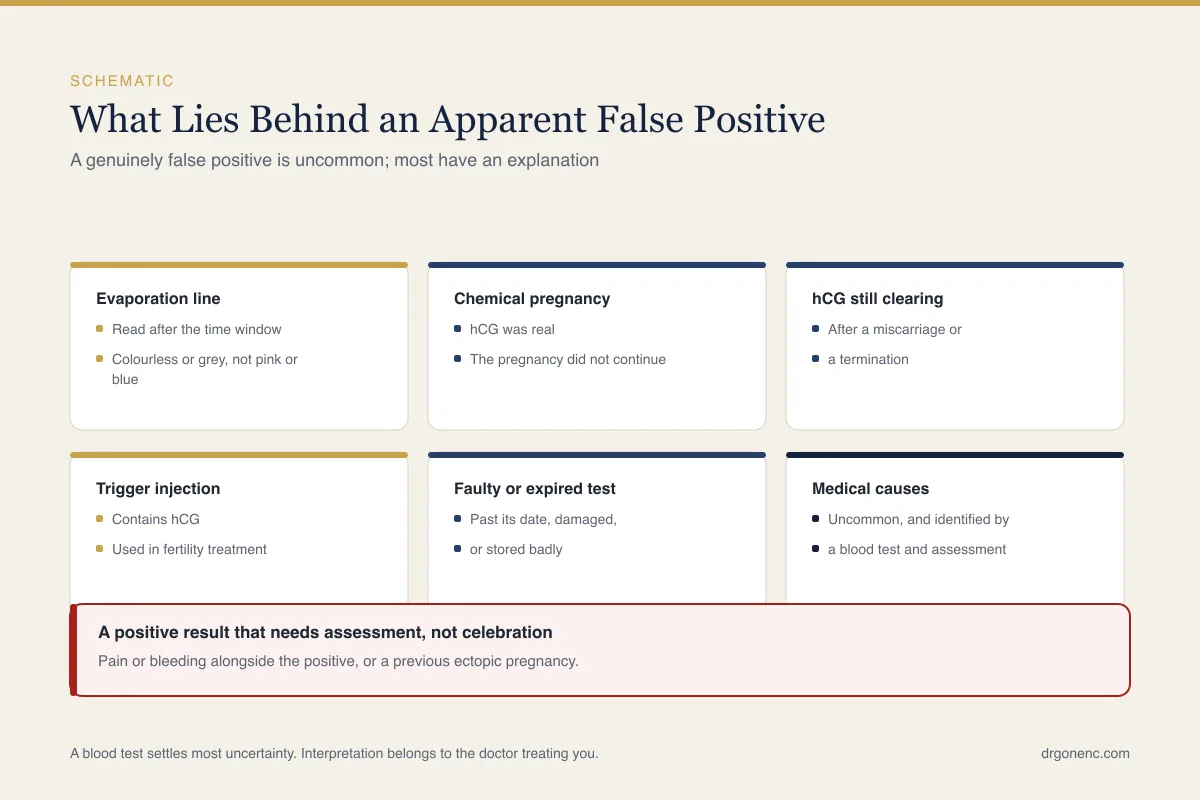
A home pregnancy test is built to answer one narrow question: is there human chorionic gonadotropin, the hormone of pregnancy, in this sample of urine. Modern tests do that job well, and a genuinely false positive, meaning a line that appears when no hormone was ever present, is uncommon. That is the honest starting point. What happens far more often is an apparent false positive: a result that was misread, read long after the stated time window, produced by hormone that really was there but came from a pregnancy that did not continue, or left over from recent treatment or a recent loss.
This article works through those explanations in turn, because each one carries a different next step. It covers evaporation lines and reading outside the time window, a chemical pregnancy, a recent miscarriage, termination or birth with hormone still clearing, a trigger injection used during fertility treatment, an expired or damaged test, and the uncommon medical conditions that genuinely raise the hormone. It then looks briefly at false negatives, which happen for quite different reasons, and at how to tell the two situations apart. All of this is general information; the person to interpret your own result, with your history and your dates in front of them, is your own doctor.
What a positive test actually means, and what it does not
A home test works by capturing hormone from the sample on an antibody line. When enough human chorionic gonadotropin is present, that line develops colour. Most kits state a sensitivity in milli international units per millilitre, often somewhere in the region of 10 to 25 mIU/mL, and a positive simply means the hormone reached that level in that sample at that moment. It says nothing about where the pregnancy sits, whether it is developing normally, or whether it will continue.
That distinction is where most confusion about false positives begins. Two quite different questions get asked in the same words. The first is whether the device malfunctioned and reported hormone that was never there, which is what a laboratory would call a true false positive. The second is whether the hormone was genuinely present but the pregnancy it came from has ended or was never going to continue. In the second case the test was correct when it was taken, and the thing that changed afterwards was the pregnancy, not the strip.
Separating the two matters practically. A misread strip is dealt with by repeating the test properly. A real but falling hormone level is dealt with by a conversation with a doctor and, usually, a blood test, because that pattern needs following rather than re-reading. If you take only one idea from this article, take that one: a positive line should prompt a question about the pregnancy, not only a question about the test.
Findings that need assessment the same day
Before any of the explanations below, one separation is worth making clearly. Whatever a test strip shows, certain symptoms matter more than the line does, and they should not wait for a repeat test in the morning. Anyone who could be pregnant, including someone whose test was negative, should treat the following as reasons for urgent assessment rather than for further testing at home.
- Severe lower abdominal pain, or pain concentrated on one side, particularly if it is building rather than settling
- Pain at the tip of the shoulder, pain on opening the bowels, dizziness, feeling faint, or collapse
- Heavy vaginal bleeding, for example soaking through a pad within an hour and continuing at that rate, or passing large clots
- A fever, with pelvic pain or an offensive vaginal discharge, or simply feeling unwell with a temperature
- Vomiting so severe that you cannot keep fluids down, or are passing very little urine
- Any of the above in someone who has had a previous ectopic pregnancy, tubal surgery or sterilisation, who has an intrauterine device in place, or who has conceived after fertility treatment
The reason for the warning is simple. A urine test cannot tell you where a pregnancy is, so a positive result does not rule out an ectopic pregnancy, and a negative result does not rule one out either. Both NICE and RCOG guidance treat pain and bleeding in early pregnancy as findings for prompt assessment. Attend an emergency department or your nearest maternity unit the same day, and call the emergency services rather than travelling yourself if you feel faint or collapse.
Evaporation lines, and reading the test outside its time window
This is the commonest reason a test is thought to have given a false positive. As the sample dries on the strip, a faint mark can appear where the test line would have formed. It happens as the urine dries and the proteins and salts left on the pad shrink back across the strip, leaving a mark that holds no dye at all, so it reads as colourless, grey or silvery rather than pink or blue. An evaporation line is not a reaction to hormone. It is a drying artefact, and it has nothing to do with whether you are pregnant.
Two features usually give it away. The first is colour: a true positive develops in the colour the kit uses, pink or blue, whereas an evaporation line tends to be grey, colourless or simply a change in texture. Our guide to reading a faint line on a pregnancy test works through the comparison in more detail. The second is timing. Every kit states a window within which the result must be read, often a few minutes up to about ten. A mark that was not there inside that window, and appeared when you looked again later, is not a result. The leaflet is explicit that a result read after the window is not valid.
An indent line is related and causes the same worry. It is the faint impression of the antibody line that is visible on some strips even before use, more noticeable in bright light or at an angle. Neither an indent nor an evaporation line gets stronger on a fresh test, which is the practical way to settle it. Retest with a new kit two to three days later on a first morning sample, read it once inside the stated window, in ordinary daylight, and do not go back to a used strip hours later or brighten a photograph of it. Waiting those few days matters, because a fresh test taken the same hour can read negative simply because the level, if there is one, is still at the limit of what the kit can see.
A chemical pregnancy: the hormone was real, the pregnancy did not continue
A chemical pregnancy is a pregnancy that was detected by hormone in blood or urine but ended very early, around the time the period was due and before anything could be seen on a scan. The phrase chemical pregnancy test is used loosely online; doctors are more likely to say biochemical pregnancy or very early pregnancy loss. The important point is that the hormone was genuinely produced. The test did not lie. The pregnancy implanted, released enough hormone to be detected, and then did not progress.
The pattern is recognisable. A positive appears around the expected period, sometimes faint. A repeat test a few days later is fainter rather than darker, or negative. Bleeding then arrives a little late and is sometimes heavier or more crampy than a usual period. Looked at afterwards, the sequence reads as a false positive, which is why so many people search for that term, but it was an early loss. Our article on a miscarriage found without the usual warning signs covers the related situation where the hormone does not fall as expected.
Very early losses of this kind have always happened. What changed is that sensitive home tests now detect pregnancies that would once have passed as a period arriving a few days late, so they are seen rather than created by testing. ACOG patient information is clear that early pregnancy loss is common, that a substantial share of early miscarriages follow an abnormal number of chromosomes in that particular pregnancy, and that in almost every case a miscarriage is not the woman's fault. Most people who have one go on to conceive again, and what to consider before trying again is a separate discussion to have with your own doctor.
A recent miscarriage, termination or birth, with hormone still clearing
Human chorionic gonadotropin does not disappear the moment a pregnancy ends. It falls gradually, and how long a urine test stays positive depends mainly on how high the level was to begin with. After a very early loss that may be a matter of days. After a loss later in the first trimester, after a termination, or after a birth, a urine test can remain positive for several weeks. A positive test in that window is usually residual hormone from the pregnancy that has ended, not a new pregnancy.
This is one place where a home test is genuinely the right tool, and the guidance is specific about it. RCOG patient information and NICE guidance both advise a home urine pregnancy test three weeks after a miscarriage, whichever way the loss was managed, and contacting your healthcare professional or early pregnancy unit if that test is still positive at three weeks. Quantitative blood measurements, repeated over time, belong to a different question, where what matters is the direction of travel rather than a single number, such as a pregnancy of unknown location. Your own team will tell you which applies to you, and you should contact them sooner than three weeks if you have severe pain, heavy bleeding, or feel unwell at any point, even if the test is negative.
There is one exception that should not be filed under reassurance. If the level stops falling, stays level or rises, that needs assessment rather than watchful waiting. The possibilities include retained pregnancy tissue, persistent trophoblastic tissue, a pregnancy of unknown location and, occasionally, a new pregnancy. None of those is something to work out from strips at home. If you have had a recent pregnancy loss and a test is still positive beyond the interval your team gave you, contact them.
A trigger injection containing hCG during fertility treatment
In fertility treatment, the final maturation of the eggs before collection is often prompted by an injection, and one of the preparations used for that purpose is human chorionic gonadotropin itself. A home test cannot distinguish hormone that came from an injection from hormone made by a pregnancy, because the molecule it detects is the same. A test taken too soon after a trigger injection can therefore be positive when there is no pregnancy, and this is one of the few genuinely predictable causes of a misleading positive.
Injected hormone clears over a number of days, commonly up to about ten and sometimes longer after a higher dose, and how quickly depends on the dose and preparation used and on the individual. This is precisely why units set a specific date for the pregnancy test rather than leaving it to the patient, and why testing early in a treatment cycle so often creates distress in both directions. Follow the date your own unit gives you. What the different injections in a cycle do, and why their timing is fixed, is covered in our guide to the medications used in an IVF cycle.
Not every trigger contains this hormone. Some cycles are triggered with a gonadotropin releasing hormone agonist instead, which is a different class of medicine and does not register on a pregnancy test at all. Which one was used in your cycle, and what it means for the timing of your test, is information your own clinician holds. If a test is positive and you are unsure which trigger you were given, ask the unit that treated you rather than working the answer out from further strips at home.
An expired, damaged or badly stored test
A pregnancy test contains biological reagents, and they degrade. Past the expiry date, after storage in a hot car or a damp bathroom cupboard, or once the foil wrapper has been torn and the strip has sat in the air, a kit may no longer behave as designed. In most cases a degraded test fails visibly, which is useful, because the failure shows up as a missing control line rather than as a convincing positive. The control line is the part of the strip that proves the test ran.
That gives a rule worth remembering: if the control line has not appeared, the result is void whatever else is in the window, and the test should be repeated with a fresh kit. Handling matters too. Too little urine, too much urine, dipping a strip past the maximum line, or holding a cassette upright while the sample runs can all produce marks in the test region that are artefacts rather than results.
The practical answer is undramatic. Check the expiry date before using a kit, keep it sealed until the moment of use, store it somewhere cool and dry, follow the leaflet for how much sample and for how long to wait, and read the window once at the stated time. If a result still looks ambiguous, repeat it with a kit from a different batch on a first morning sample. NHS guidance notes that a test can be done on urine collected at any time of day; the time of day only begins to matter when the expected hormone level is low, which is exactly the situation an ambiguous result describes.
Medical causes that genuinely raise hCG
A small group of conditions produces this hormone outside a normal pregnancy, and in those situations the test is working correctly. The most important is gestational trophoblastic disease, in which placental tissue grows abnormally. A molar pregnancy is the commonest form. It gives a positive test, often with a strikingly high blood level, and tends to declare itself with irregular bleeding in early pregnancy, severe sickness, or a uterus that feels larger than the dates suggest. Any of those findings is a reason to be seen promptly, and vomiting severe enough that you cannot keep fluids down is a reason to be seen the same day, rather than to repeat a home test. Cancer Research UK patient information describes how it is diagnosed and followed.
Beyond that, certain germ cell tumours of the ovary or testis and a few other tumours can produce the hormone, which is one reason it is used as a tumour marker in those settings. Low levels can also arise from the pituitary gland around and after the menopause. On the laboratory side, kidney failure and interfering antibodies in the blood can both distort an assay result, and laboratories have ways of checking a value that does not fit the clinical picture.
None of this is a reason to read a positive test with alarm. These causes are uncommon, and the overwhelming majority of unexpected positives are explained by the far more ordinary reasons set out above. The reason to mention them is that they are the situations in which a positive test genuinely needs a doctor rather than a second strip. A result that does not fit your dates, your symptoms or your circumstances is a reason to be assessed, not a puzzle to solve at home.
Can a pregnancy test be wrong the other way? False negatives
For contrast, it is worth knowing that a negative result is wrong more often than a positive one. The main reason is simply testing too early. Hormone cannot appear before the embryo has implanted and begun to produce it, and the level then takes several days to climb to where a urine test will see it. A test taken before the period is due can be negative in a pregnancy that is progressing perfectly well, which is why NHS guidance anchors testing to the day the period was due, and how soon a test can be taken sets out the timing.
The other reasons are mostly about the sample and the cycle. Very dilute urine, after drinking a large volume of fluid or late in the day, can carry the hormone below what the kit can detect. Irregular cycles make the expected period a poor anchor, so what feels like a late test may be an early one, and how long implantation itself takes after intercourse explains why the clock does not start on the day of sex. Reading the window too soon, before the reaction has run, has the same effect.
Rarely, a very high hormone level can saturate the antibodies on the strip and prevent a line forming, which is known as the hook effect. It is described with the very high levels of a molar pregnancy or a multiple pregnancy, and with later pregnancy, rather than with the levels of an ordinary first few weeks. The clinically important point stands whatever the mechanism: a negative test in someone whose period has not arrived, or who has pain or bleeding, is not an all clear, and should lead to assessment rather than to another kit.
Telling the two situations apart
In practice the explanation is usually suggested by the sequence of events rather than by the strip itself: when the line appeared relative to the reading window, what a repeat test did, and what was happening in the weeks beforehand. The comparison below sets out the patterns that come up most often in clinic, and what each one usually points to. It is a guide to the conversation you will have, not a substitute for it.
| What you are seeing | Typical pattern | Usual explanation | Sensible next step |
|---|---|---|---|
| A faint mark that was not there earlier | Grey or colourless, seen only after the reading window had closed | Evaporation or indent line | Retest with a fresh kit on a first morning sample and read it once, inside the window |
| A clear positive that fades | Fainter on repeat, then negative, with bleeding arriving a few days late | Very early pregnancy loss | Contact your doctor rather than continuing to test |
| Positive soon after a trigger injection | Test taken before the date the unit gave | Injected hormone still present | Wait for the clinic test date and ask which trigger was used |
| Still positive after a loss or a birth | Blood values falling steadily on repeat testing | Hormone still clearing | Follow the follow up plan your team set; report a level that stops falling |
| Positive that does not fit the dates | Unusually high blood value, irregular bleeding, marked sickness | A cause that genuinely raises the hormone, including trophoblastic disease | See a doctor promptly for blood tests and a scan |
| Negative with no period | A repeat a few days later turns positive | Tested too early, or a dilute sample | Repeat on a first morning sample; see your doctor if the period stays away |
| Negative with pain or bleeding | Symptoms persist or worsen regardless of the result | A negative test does not exclude an ectopic pregnancy | Same day assessment |
One pattern deserves emphasis because it is so often misfiled. A positive that becomes a negative, followed by a late period, is the signature of an early loss rather than of a faulty test. People who conclude that the kit was defective sometimes never mention the episode at a later appointment, and it is information a doctor would want, particularly if it happens more than once.
What a blood test adds to a urine result
A urine test gives a yes or no. A blood test measures the hormone and reports a figure in mIU/mL, which is a different kind of information. Laboratories commonly treat a value below about 5 mIU/mL as not indicating pregnancy, with an indeterminate band above that, often quoted up to around 25 mIU/mL, which is resolved by repeating rather than by interpreting; a value inside that band can belong to a normal early pregnancy. MedlinePlus gives under 5 mIU/mL as the non-pregnant range, sets out how the quantitative test is used, and notes that reference ranges vary slightly between laboratories.
The real value is in the sequence. A single figure early on says remarkably little, because the same number can belong to very different situations depending on how many days have passed. What informs the picture is the change across an interval, usually about forty eight hours: a level that climbs as expected, one that plateaus, and one that falls each point in a different direction. Our article on how these values are read in early pregnancy and after treatment goes into the detail.
It is worth being clear about the limits as well. A blood test cannot say where a pregnancy is sitting any more than a urine test can. Location is a question for ultrasound, once the dates and the hormone level make a scan informative, and sometimes for repeated scans. A blood test also cannot promise that a pregnancy will continue. It narrows the possibilities and sets the pace of follow up, which is a genuinely useful thing for it to do.
A positive result that needs assessment rather than celebration
For most people a positive test is the beginning of ordinary antenatal care, and the next step is registering with a midwife or doctor in the usual way. For a smaller group it is the moment at which an appointment matters before anything else. That group includes anyone with pain or bleeding alongside the positive test, anyone who has had an ectopic pregnancy before, anyone who has had surgery on the tubes or a sterilisation, anyone who conceives with an intrauterine device in place, and anyone who conceives after fertility treatment.
The reason in each case is the same: these are the circumstances in which the chance of a pregnancy sitting outside the uterus is higher than usual, and an ectopic pregnancy is dangerous when it is found late rather than when it is found early. Guidance differs a little in how it is organised. In the United Kingdom NICE describes early pregnancy assessment services, which accept self-referral from women who have had a previous ectopic or molar pregnancy or recurrent miscarriage, while in many other health systems, including Turkey, the route is through your own doctor or the nearest emergency department. The principle is the same everywhere: be seen early rather than wait and see.
If you are going to be assessed, a few minutes of preparation makes the appointment more useful. Take the date your last period started and your usual cycle length, the dates of every test you have done and what each one showed, details of any fertility treatment including which trigger was used, and a note of any previous pregnancies, losses or tubal surgery. Say plainly what has worried you. The judgement about what the result means belongs with the clinician who can examine you and arrange a scan.
Related Reading
- hCG Levels in Early Pregnancy and After IVF: What the Numbers Mean
- Missed (Silent) Miscarriage: Diagnosis, Symptoms, Causes and Management
- IVF Injections and Medications: The Process, Side Effects and Common Questions
- Trying Again After Miscarriage: When and How
- How long after sex does implantation occur, and what happens in between
- Faint line on a pregnancy test: is it positive, and what to do next
- How soon can you take a pregnancy test? The timeline, day by day
Sources and references
This article is supported by the following independent, authoritative sources: