Faint line on a pregnancy test: is it positive, and what to do next

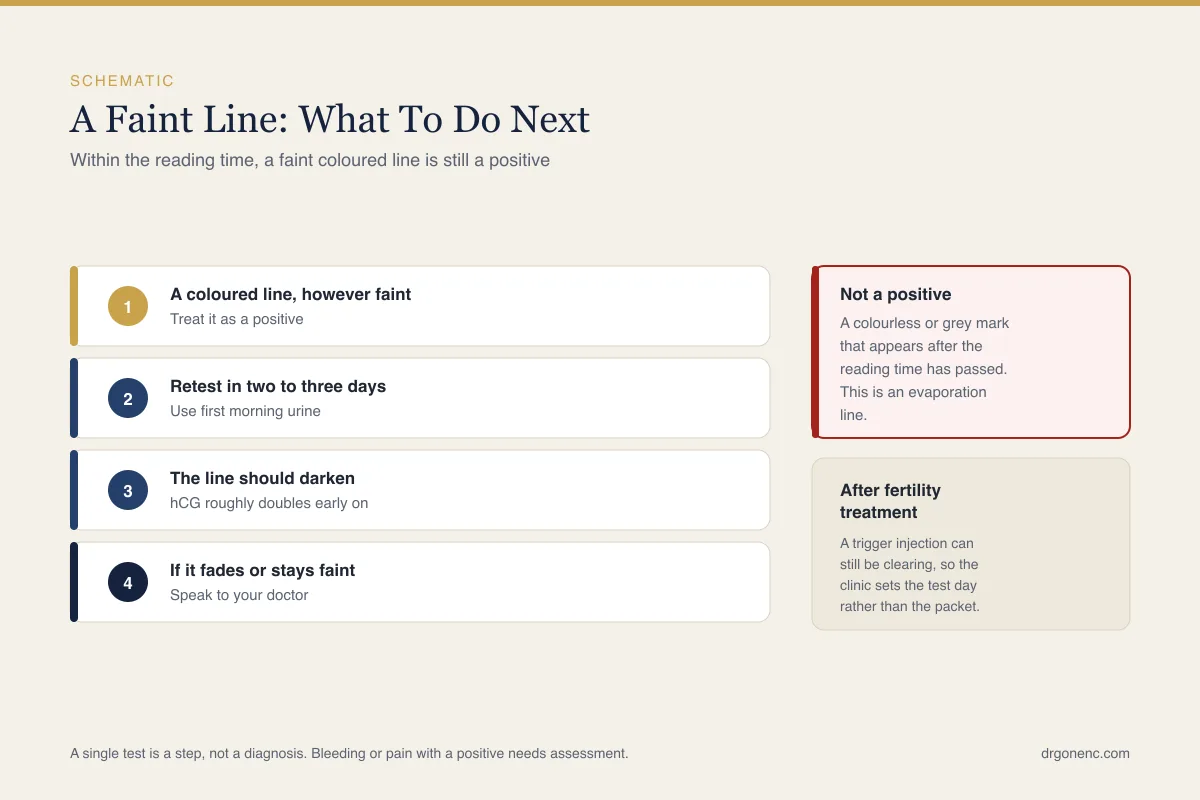
A second line that is barely there, visible only when the stick is tilted towards the light, is one of the most unsettling results a home test can give. The short answer is the one worth having first. A line that appears in the test window inside the time stated in the instructions, in any shade of the dye the device uses, pink or blue, is a positive result, as long as the control line has appeared too. Test instructions set a reading time and require the control line to appear; they do not set a minimum darkness for the test line. The antibodies on the strip bind human chorionic gonadotropin, the hormone a developing pregnancy produces, and very little else, so a coloured line means that hormone was detected in that sample.
What a faint line does not tell you is how the pregnancy is progressing. Faintness reflects how much hormone happened to be in that particular sample of urine, which depends on how early you tested, how dilute the urine was and the threshold of the device. It is not a grade. This article explains why a true positive reads faint, how to read the window properly, the one result that is genuinely not a positive, how and when to retest, what a line that fades can mean, how a trigger injection complicates testing after IVF, and the findings that need assessment the same day rather than another test.
A faint line in the test window is still a positive
Home pregnancy tests work by sandwiching hCG between two antibodies, one fixed to the strip and one carrying a coloured label. When enough hormone passes through the pad, the labelled antibody is trapped at the test position and a line develops. The depth of that line depends on how many sandwiches formed, which in turn depends on how much hormone was present. Below the device threshold nothing appears at all. Just above it, a small number of sandwiches forms, and the line is faint. The chemistry does not produce pale lines out of nothing.
This is why there is no such thing as a slightly positive test. The device gives a yes or no answer about one hormone, and a faint line is a yes recorded close to the limit of what that device can see. On its own it does not mean an early or fragile pregnancy, and it does not mean a strong one either. Where a pregnancy is progressing, a line that is pale today is usually unmistakable a few days later, simply because the hormone will have risen while the test threshold has not moved. A line that stays faint across two or three tests taken several days apart, or one that fades, is a different matter, and is dealt with further down.
Treat a faint line in the reading window as a positive result and tell your own doctor or midwife, who will decide what confirmation and what dating you need. If you are under the care of a fertility unit, tell the unit rather than acting on the result yourself, because they will have their own testing schedule and their own interpretation of an early result.
Before you retest, check this: if a positive or faint positive test comes with pain low down on one side, any bleeding, shoulder tip pain, a temperature or chills, or you feel faint, dizzy or unwell, do not wait two to three days to repeat the test. Contact your doctor or an early pregnancy assessment service the same day, and call your local emergency number for severe abdominal pain, shoulder tip pain, collapse or feeling faint. The findings that need same day assessment are listed in full below.
Why a positive line can be faint
The commonest reason is simply that it is early. hCG becomes detectable in urine only after implantation, and the amount then rises steeply, roughly doubling every two to three days in the first few weeks before the rate slows. Pregnancies vary, and a rise that is slower than doubling can still be entirely normal, which is why a trend interpreted by your doctor means more than any single value. Home tests are sold with detection thresholds that typically sit somewhere between about 10 and 25 mIU/mL. Some packs and leaflets state the figure and many do not, so if yours does not, keep the packet and use the identical test again rather than trying to match numbers. If you test on the first day you possibly can, the hormone is only just above that threshold, and a pale line is exactly what the chemistry should produce. Further detail on how the hormone behaves is set out in our article on hCG levels in early pregnancy and after IVF.
The second reason is dilution. A urine test measures concentration, not total output, so the same pregnancy can produce a clear line in the morning and a barely visible one that afternoon. Drinking a large volume of water, tea or anything else in the hours before testing lowers the concentration of every solute in the sample, hCG included. This is why first morning urine, after several hours without passing water and without loading up on fluids, gives the most informative result when the expected level is low. NHS advice is that a test can be done on urine collected at any time of day, and that holds once levels are comfortably above the threshold. It is the borderline sample, the one producing a faint line, where concentration still makes a visible difference.
Device factors matter too. Thresholds differ between formats, and so does the amount of dye the strip carries, which is why the same urine can give a crisp line on one brand and a whisper on another. A kit stored in a hot bathroom, kept past its expiry date, or opened and left out before use may also underperform. None of these explanations is reassuring or worrying in itself. They simply mean that one pale line on one morning is a single data point.
Reading the test window correctly
Every test states a reading window, commonly from about three minutes to ten minutes after the sample is applied, and that instruction is the single most useful thing in the leaflet. Read the window at the stated time, in ordinary daylight or good room lighting, held flat against a pale background. Do not angle the device under a lamp looking for something you did not see when you first looked, and do not keep checking it through the evening. A result that was not there inside the window is not a result.
Check the control line first. It confirms that enough sample travelled through the strip and that the reagents were still active. If the control line is absent or incomplete, the test is invalid no matter how convincing anything else on the strip looks, and the result should be discarded and repeated with a new device. A test that was flooded with urine, or that had too little applied, often fails in exactly this way.
Photographing a test and raising the contrast, inverting the colours or asking strangers online to read it is understandable and is also a poor substitute for the only thing that settles whether a line was real, which is a second test a few days later. Image processing can make a dye-free indentation look like a line and can make a real faint line look like an artefact. If you are not sure what you saw, write down the time you read it, keep the packet so you know the threshold, and retest.
Evaporation lines and indent lines: what is not a positive
There is one appearance that is genuinely not a positive, and it accounts for a large share of the lines people agonise over. An evaporation line appears after the reading window has closed, as the urine dries and the proteins and salts left on the pad shrink back across the strip. It has no dye in it, so it reads as colourless, grey or silvery, like a shadow or a watermark rather than a pink or blue bar. It often spans the whole width of the strip and may look thinner at one edge.
The related indent line is not a reaction at all. On many cassette tests the test position is a slight groove where the antibody was printed, and in raking light that groove can be visible as a dry, colourless mark on a completely negative test. Tilting the device makes it come and go, which is the clue. A real faint positive stays in the same place and keeps its colour when you move the test, because it is dye held on the strip.
| Feature | Faint positive | Evaporation line | Indent line |
|---|---|---|---|
| When it appears | Inside the stated reading window | After the window, as the strip dries | Visible at any time, including before use |
| Colour | Pale version of the test dye, pink or blue | Colourless, grey or silvery | Colourless, the shade of the strip itself |
| Appearance | A defined band of even colour | Shadow or watermark, often full width | A dry groove or dent in the strip |
| Effect of tilting | Stays visible and keeps its colour | Comes and goes with the angle | Comes and goes with the angle |
| What it means | hCG detected in that sample | Nothing about the result | Nothing about the result |
| What to do | Treat as positive and tell your doctor; same day if there is pain or bleeding | Discard and, if you have no pain or bleeding, retest in two to three days | Discard and, if you have no pain or bleeding, retest in two to three days |
The practical rule that saves most of the distress is to decide at the stated time and then put the test away. Nothing you see on a dried strip hours later changes what the device reported, and keeping it on the windowsill to study again tomorrow reliably produces an evaporation line that will have to be explained to someone.
What to do next after a faint positive
If you have pain, bleeding, or any of the findings listed in the same day assessment section below, stop here and arrange assessment today rather than retesting. Where none of those apply, the next step is a repeat test, not a repeat reading of the same one. Leave two to three days, because that is the interval over which the hormone changes enough for the difference to show on a strip. Testing again the same evening, or the next morning, often produces a line that looks no darker, and that tells you almost nothing while costing a great deal of worry. Use the same brand and the same format, so that you are comparing like with like.
- If you have no pain and no bleeding, wait two to three days rather than retesting the same day, so the hormone has time to rise; with pain or bleeding, do not retest, and seek assessment the same day as set out below.
- Use first morning urine, after a few hours without passing water, and do not drink large volumes beforehand.
- Use the same brand and format as the first test, so the detection threshold is the same and the comparison means something.
- Read at the time the leaflet states, in good light, and record what you saw and when.
- Do not line the new test up against the old strip. After two or three days of drying it will have developed marks that mean nothing; compare the new result against what you wrote down at the time instead.
- If the second line is clearly darker, you have the trend you were looking for, and the next step is a conversation with your doctor rather than more strips.
Where the answer genuinely matters sooner, for example if you have pain, bleeding, a history of ectopic pregnancy or recurrent loss, or you are in a treatment programme, a quantitative hCG measured on a blood sample gives a number in mIU/mL and can be repeated after about forty eight hours to show the direction of travel. That test is arranged by a doctor and interpreted alongside your dates and, where appropriate, a scan. It is not something to organise on the basis of a home strip alone, which is precisely why the conversation comes first.
Digital tests compared with line tests
A digital test runs the same antibody reaction on a strip hidden inside the casing and then has an optical reader decide whether a line formed, displaying words instead. That removes the judgement, which is its real appeal when you are looking at something ambiguous. It does not remove the threshold. A sample that produces a faint line on a strip test sits close to the limit of detection, and the reader in a digital device may call that same sample negative, because it is applying a fixed cut-off rather than straining to see a shadow.
This is why a faint line on a strip followed by a negative digital result a few minutes later is a common and confusing sequence, and why it is not evidence that the faint line was false. The two devices answered slightly different questions. If you want the reassurance of words rather than shades, the useful approach is to retest digitally after two to three days rather than immediately, by which point the hormone should be comfortably above either threshold.
Some digital formats also estimate how many weeks have passed since conception from the strength of the reaction. Treat that display as a rough indicator only. Hormone levels vary widely between pregnancies at the same stage, so the estimate can be out by more than a week in either direction, and your doctor will date the pregnancy from an ultrasound measurement rather than from a test window. Where a dating estimate and your own records disagree, the scan is what guides care.
A faint line that fades or disappears on retest
Sometimes the second test is paler than the first, or negative. When a test was genuinely positive and then becomes negative, with bleeding arriving at or shortly after the expected date of the period, the usual explanation is a very early pregnancy loss, sometimes called a biochemical or chemical pregnancy. The hormone rose far enough to be detected and then fell. It is not the only explanation, and a falling result says nothing about where the pregnancy was: an ectopic pregnancy can also present with hCG that falls and with bleeding around the date the period was due. A fading line with pain low down on one side, shoulder tip pain, feeling faint, or bleeding that is more than light needs the same day assessment set out below, and the distinction is made by your doctor with a blood test and a scan, not at home. Losses this early are counted within early miscarriage: ACOG defines early pregnancy loss as the loss of a pregnancy before 13 completed weeks, and the RCOG notes that many early miscarriages happen before a period has been missed or before the pregnancy has been confirmed by a positive test. The category has become visible mainly because sensitive tests are now used before a period is even late.
It is worth saying plainly that nothing you did caused it, and that an isolated very early loss does not predict what happens next. Guidance does differ on when to investigate. ACOG's patient guidance says that when two or more miscarriages happen, testing can be done to try to find a cause, and that a first-trimester loss is usually a one-time event. The RCOG's early miscarriage information sets a higher bar for genetic testing, suggesting it after three or more miscarriages, and covers investigation more fully in its separate recurrent miscarriage information. Some units will look sooner if there are other features in your history, so ask your own doctor what applies to you rather than assume either answer. Bleeding that is lighter than a period and arrives around the expected date is covered further in our articles on implantation bleeding and on missed miscarriage.
Report a fading line to your doctor even if the bleeding seems to have settled matters, and report it to your fertility unit promptly if you are in treatment, because they will usually want blood samples to confirm that the hormone has cleared. A line that fades while bleeding stays light, or while pain develops on one side, is a different situation and belongs in the section on same day assessment below.
A faint line after IVF, and the trigger injection
Testing at home after an embryo transfer can carry one extra complication, depending on how your cycle was run. Where a fresh cycle used an injection of human chorionic gonadotropin to trigger final egg maturation, that injection contains the very hormone the test detects, and it clears gradually, over something like ten to fourteen days depending on the dose and preparation given and on individual clearance. A faint line taken inside that window may therefore be residual trigger rather than an implanting pregnancy, and cannot be interpreted on its own. This does not apply to every transfer: a frozen embryo transfer cycle, and a cycle triggered with a GnRH agonist rather than hCG, involve no hCG injection, so there is no trigger left to explain a line away. Ask your unit which applies to you rather than assuming an early line is the injection.
This is the reason units set a specific test date rather than leaving it to you, and the reason they generally prefer a quantitative blood hCG on that date to a urine strip. A single number can be compared against what would be expected for the day after transfer, and a second sample a couple of days later shows whether it is rising or falling, which residual trigger does not do. Follow the date your own unit gives you, and tell them what you have tested if you have already done so.
Two further points come up constantly. Progesterone and oestrogen used for luteal support do not make a pregnancy test positive, because the test does not detect them, so a faint line is not caused by the pessaries or injections used for that support. And never stop, start or change any supporting medication on the basis of a home test result, whatever it shows. That decision belongs to the clinician prescribing it. The symptoms people try to read alongside the test are discussed in our article on implantation symptoms after embryo transfer.
Bleeding or pain with a faint positive: findings that need same day assessment
A positive test means hCG was detected, and outside the window after a trigger injection that nearly always means a pregnancy. What it does not tell you is where that pregnancy is, and that is what matters here. An ectopic pregnancy, one implanted outside the cavity of the uterus and usually in a fallopian tube, can produce hCG that rises more slowly than expected or plateaus, but it can also rise normally, and it can fall. No pattern on a urine strip rules it in or out, and the shade of the line is not the thing to watch: an ectopic pregnancy can sit behind a faint line, a clear one or a dark one. What matters is the symptoms. Any positive or faint positive test combined with any of the findings below needs assessment the same day.
- Pain low down on one side, whether constant or coming in waves, with a positive or faint positive test.
- Bleeding with pain, or bleeding heavy enough to soak a pad in an hour or less, or passing clots, after any positive test.
- A temperature, shivering or chills, or a change in vaginal discharge, alongside bleeding or pain after a positive test, because infection in early pregnancy needs assessing the same day.
- Pain in the tip of the shoulder, which can mean bleeding inside the abdomen.
- Feeling faint, dizzy or clammy, collapsing, or a racing pulse.
- Pain on opening the bowels or passing urine alongside a positive test.
- Severe or rapidly worsening abdominal pain, or vomiting with abdominal pain.
Do not retest to decide whether to seek help. A second urine strip cannot tell you where a pregnancy has implanted, and waiting two to three days for a comparison is exactly the delay that must not happen here. Contact your doctor or an early pregnancy assessment service the same day, and go to an emergency department or call the local emergency number straight away for shoulder tip pain, faintness, collapse or severe abdominal pain. NHS information on ectopic pregnancy makes the same point, that this combination of symptoms needs advice straight away even if you have not had a positive pregnancy test. A negative test, or a line so faint you are unsure, does not rule an ectopic pregnancy out and is never a reason to wait and test again.
The hook effect: a faint line later in pregnancy
There is one situation in which a faint or even negative line reflects too much hormone rather than too little. Where hCG is extremely high, the hormone saturates both the capture antibody on the strip and the labelled antibody in the pad separately, so the two never bridge the same molecule and the sandwich that produces colour cannot form. The result is a line that is paler than the hormone level deserves, and occasionally no line at all. Laboratories call this high-dose hook effect, and it is why a laboratory will repeat an implausible result on a diluted sample.
It is not something to look for in the first days after a missed period, when hormone levels are nowhere near that range. It becomes relevant later in the first trimester, and in the particular situations where hCG can run very high, including a multiple pregnancy and a molar pregnancy. If you have a faint or negative home test alongside symptoms and signs of an established pregnancy, say so to your doctor explicitly rather than trusting the strip. NHS guidance lists the usual early signs as a missed period, tender breasts, tiredness and needing to pass urine more often, and those signs continuing while a test reads faint or negative is worth reporting. If it comes with bleeding, or with a uterus that feels larger than expected, treat it as one of the findings in the section above and seek assessment the same day. A laboratory hCG on a diluted sample and a scan settle it.
When to call your doctor rather than retest another strip
Retesting is the right response to uncertainty about whether a line was real. It is the wrong response to several other situations, where another strip simply delays the person who can actually help. The dividing line is whether a second result would change what happens next. Where your history, your symptoms or your treatment already determine the plan, the call comes first.
- Any pain or bleeding with a positive test, which needs same day assessment as set out above.
- A previous ectopic pregnancy, tubal surgery, or a coil in place. A positive test with a coil in situ carries a raised chance of the pregnancy sitting outside the uterus, so where it has implanted needs establishing without delay rather than at a routine appointment.
- Recurrent miscarriage, or a condition such as diabetes, thyroid disease, epilepsy, lupus or a clotting disorder, and any long term medication, because some prescriptions need reviewing promptly in pregnancy.
- A faint line after an embryo transfer, or during any fertility treatment, which belongs with your unit and not with another strip.
- A line that has stayed faint across two or three tests taken several days apart.
- Any test result you cannot reconcile with your dates, your symptoms or a previous result.
Everything in this article describes how a device behaves and how results are usually read, and none of it replaces an assessment of your own situation. Your doctor has your history, your dates and the ability to measure the hormone in a blood sample and to look with a scan, and those three together answer questions that no home test is designed to answer. If a faint line has left you uncertain, that uncertainty is itself a reason to speak to your own doctor rather than to buy more tests.
Related Reading
- hCG Levels in Early Pregnancy and After IVF: What the Numbers Mean
- Implantation Bleeding: What It Looks Like, Timing, Cramps and When to Test
- How long after sex does implantation occur, and what happens in between
- Missed (Silent) Miscarriage: Diagnosis, Symptoms, Causes and Management
- After Embryo Transfer: Implantation Symptoms and What to Expect
- How soon can you take a pregnancy test? The timeline, day by day
- False positive pregnancy test: why it happens and what to do next
Sources and references
This article is supported by the following independent, authoritative sources: