Tubal ligation reversal and IVF: the two routes after sterilisation

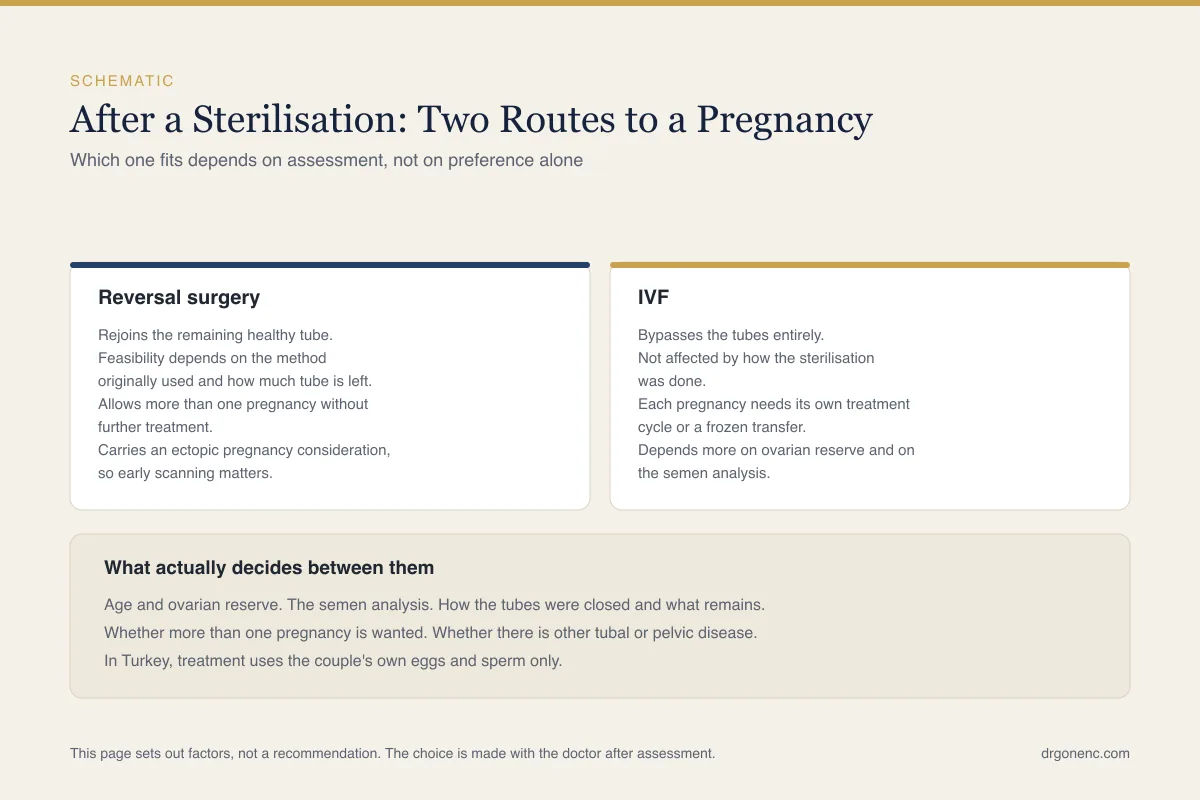
A sterilisation is chosen as a permanent decision, and most people who have one never revisit it. A smaller number do, usually because a relationship has changed, because a child has died, or because a certainty that felt complete at the time no longer fits the life around it. Wanting a pregnancy after your tubes were tied is neither unusual nor a failure of judgement. What it does mean is that you now face a choice between two quite different routes: an operation to rejoin the tubes and restore the natural pathway, or in vitro fertilisation, which leaves the tubes as they are and works around them entirely.
This article sets out what each route involves, what makes a reversal feasible or not, and the factors that genuinely move the decision one way or the other. It describes likelihood in words rather than quoting published averages, because the findings that matter in your case are the ones your own assessment produces. It also covers the safety point that applies specifically after a reversal, the raised possibility of a pregnancy implanting inside the tube, and what that means for early scanning. The decision itself belongs to you and the doctor who has examined you and read your records.
What a sterilisation did, and why that matters now
Female sterilisation works by interrupting the fallopian tube so that an egg released from the ovary cannot meet sperm travelling up from the uterus. Several ways of doing that have been used over the years. A clip or a silicone ring can be applied to compress a short segment. The tube can be cut and the ends tied or buried. A length can be destroyed with diathermy. For a period, small devices were also placed inside the tubes through the cervix, without any incision, under the names Essure and Adiana; these were withdrawn from the market in 2017 and 2018. Increasingly, both tubes are removed altogether, an operation called bilateral salpingectomy. Whichever method was used, what matters for the question you are asking now is how much tube was left behind.
What none of these methods do is stop the ovaries working. Hormone production continues, periods continue, and an egg is still released each cycle. That egg normally has nowhere to go, and is reabsorbed. Sterilisation is very reliable but it is not absolute, and in the uncommon event that a pregnancy does begin while the tubes are still interrupted it is more likely than usual to be sitting in the tube, so a positive test in that situation needs an early scan. This is why a sterilisation does not bring menopause forward, and why the question you are asking now is a mechanical one rather than a hormonal one: the pathway is interrupted, and either it can be reopened or it has to be bypassed.
Because the method used is what decides feasibility, the single most useful document you can bring to an assessment is the operation note from the sterilisation itself, together with any histology report if tissue was sent to the laboratory. Many people have never seen either. It is worth requesting them from the hospital where the procedure was done before any appointment, because without them a surgeon is guessing at what remains.
The two routes in outline
A tubal ligation reversal, properly called tubal reanastomosis, is microsurgery. The blocked or damaged segment is excised and the two healthy ends are rejoined under magnification with very fine sutures. If the join stays open and the tube still functions, conception afterwards happens in the ordinary way, in your own time, without further treatment and without anyone counting cycles for you.
IVF takes a different approach. The ovaries are stimulated, eggs are collected directly from the ovary with a needle guided by ultrasound, fertilisation happens in the laboratory, and an embryo is placed into the uterine cavity through the cervix. The tube is not used at any stage, so its condition becomes irrelevant. The sequence is set out in more detail in our article on how IVF works step by step.
The difference in character matters as much as the difference in technique. One is a single operation followed by an open ended period of trying. The other is a treatment cycle, repeatable, with defined steps and a defined answer at the end of each attempt. Neither is inherently the right answer, and the assessment exists to work out which one your particular situation points towards.
Symptoms that need urgent assessment
Most of what follows in this article can be considered at leisure. The following cannot, and it is set out here rather than at the end so that nobody reads past it. If any of these applies, do not wait for a scheduled appointment. Call the emergency services or go straight to an emergency department now if you feel faint, collapse, have shoulder tip pain, or are bleeding heavily; for the others, contact a doctor or an early pregnancy unit the same day.
- A positive pregnancy test when your tubes are still tied or clipped. Sterilisation occasionally fails, and when a pregnancy does occur afterwards it is more likely than usual to be in the tube, so ask for an early scan to confirm where it is sitting
- Pain low down on one side, with or without light bleeding, in anyone who could be pregnant and especially after a tubal reversal, because of the possibility of an ectopic pregnancy
- Shoulder tip pain, feeling faint or lightheaded, collapse, or pain on opening the bowels alongside a positive or possible pregnancy test. Call the emergency services and do not travel alone
- Sudden severe abdominal pain after any tubal or pelvic operation, or after an egg collection
- Fever, offensive vaginal discharge or increasing pelvic pain in the days after tubal surgery, which can indicate infection
- Rapidly increasing abdominal swelling, breathlessness, or passing much less urine than usual after ovarian stimulation
- Heavy vaginal bleeding soaking through a pad within an hour, with dizziness or breathlessness. Call the emergency services
The reason for naming these separately is that the dangerous presentations here are not the dramatic ones. An ectopic pregnancy very often announces itself with a few days of light bleeding and some one sided discomfort rather than with collapse, and the window in which it can be managed straightforwardly is counted in days. Nothing in this article should lead anyone to wait and see.
Whether a reversal is feasible: the method originally used
Feasibility is decided almost entirely by what is left. Clips and rings compress a short segment and tend to leave the greatest length of healthy tube on either side, which is why they are a favourable starting point for a surgeon. Cutting and tying removes or devitalises more. Diathermy destroys a longer stretch, and the damage often extends beyond what is visible. Where a hysteroscopic device such as Essure was used, the blockage sits at the narrow inner end of the tube and the device itself has to be removed before any repair is attempted, so IVF is more often the route offered. If the tubes were removed, there is no tube to rejoin and a reversal is simply not possible.
Length and site then decide the rest. A surgeon is looking for enough healthy tube on each side to make a join that will stay open and still carry an egg, commonly described as somewhere around 4 cm or more, with the two ends of reasonably similar calibre. A join between the narrow inner portions behaves differently from one between a narrow and a wide segment, and both differ from a repair out at the far end.
The outer end deserves particular attention. Where the fimbriae are still present but scarred or stuck together, a surgeon can sometimes free or reopen them, operations called fimbrioplasty and neosalpingostomy. What cannot be done is to recreate fimbriae that were removed. If the far end and its fimbriae were removed, rejoining the remaining tube to the uterus restores a channel without restoring the function that collects the egg in the first place, which is a different proposition altogether.
- Which method was used: clip, ring, cutting and tying, diathermy, a hysteroscopic device such as Essure or Adiana, or removal of the tube
- Whether the procedure was done at caesarean section, at laparoscopy, or through an open incision
- How much tube was removed or destroyed, and on which side
- Whether the fimbrial end of each tube was left intact
- Any histology report, which confirms what tissue was actually taken away
- Any note of endometriosis, adhesions or infection found at the time
How likely a reversal is to work, and what that cannot tell you
Published series of microsurgical, laparoscopic and robotic reanastomosis describe pregnancy following in a substantial proportion of carefully selected women, with age the single strongest influence on that: more favourable in the twenties, lower through the thirties, and lower again past forty. The three surgical approaches are reported as broadly comparable to one another, so the choice between them is a practical one rather than a question of which is likelier to work. A pregnancy implanting in the tube rather than the uterus is reported appreciably more often after a reversal than after IVF, which is the reason for the early scanning described below.
Two cautions belong with any of that. These are averages drawn from selected surgical series in centres with a particular interest in the operation, so they describe groups of women who were judged suitable for surgery rather than everyone who asks about it. And an average is not a forecast: your own operation note, how much healthy tube remains, your age, your ovarian reserve and your partner's semen analysis are what narrow a general expectation into a realistic one. That is why the assessment comes before the choice, and why a figure quoted to you before anyone has read your records is not telling you about your own position.
What tubal reversal surgery involves
The operation is done under general anaesthetic, either laparoscopically or through a small incision just above the pubic bone, and in some centres with robotic assistance. The surgeon inspects both tubes, excises the interrupted segment, and brings the healthy ends together in layers with sutures finer than a hair, sometimes over a temporary stent. Patency is usually checked at the end by passing dye through the uterus and watching it emerge from the tube.
Part of the assessment can only be done once the abdomen is open or the laparoscope is in. A surgeon may plan a reversal, find on inspection that too little usable tube remains or that adhesions have fixed everything in place, and have to stop. This possibility should be discussed before the operation, including what you would want done instead, so that the conversation does not have to happen in a recovery room.
Most reversals are now done by minimally invasive routes, including outpatient minilaparotomy, laparoscopy and robotic assistance, so many people go home the same day or after one night, followed by a few weeks before normal activity. Conception is attempted naturally from then on, and most teams advise a period of trying before reinvestigating, which is one of the reasons age weighs so heavily in this choice. The risks are those of any pelvic operation: bleeding, infection, injury to nearby bowel, bladder or vessels, anaesthetic risks, new adhesions, and the possibility that a join narrows and closes again.
What IVF offers instead, and why it bypasses the tubes
In an IVF cycle, the egg never has to travel along the tube and the embryo never has to travel back. Eggs are taken directly from the ovary through the vaginal wall, fertilisation happens in a dish, and the embryo is placed where it needs to implant. The entire function that a sterilisation removed is replaced by the laboratory and the transfer catheter. This is why the state of the tubes does not determine whether an embryo reaches the uterus.
That is also why IVF becomes the available route rather than one of two routes in several common situations: when the tubes were removed, when a surgeon judges too little healthy tube remains, when a previous reversal has not led to a pregnancy, or when something else in the couple's assessment also needs bypassing. A significant sperm problem is the clearest example, because intracytoplasmic sperm injection can be used within the same cycle.
IVF carries its own burden, and it is not a lighter option simply because it avoids an operation. It involves daily injections, monitoring scans and blood tests, an egg collection under sedation, and the possibility of ovarian hyperstimulation, which is why response is watched closely. Where several embryos are created, freezing the surplus allows later attempts without repeating stimulation. Intrauterine insemination, which couples sometimes ask about as a gentler first step, has no role while the tubes are interrupted or absent, because it still relies on sperm and egg meeting inside a tube. It can be considered after a successful reversal if the tubes are shown to be open. The difference between the two is set out in our article on IUI vs IVF.
Ectopic pregnancy after a reversal, and early scanning
A rejoined tube is not a normal tube. There is scar tissue at the join, the internal lining and its hair like cilia have been disturbed, and the gentle muscular wave that moves an embryo towards the uterus may be interrupted at exactly the point where it was repaired. The consequence is that a pregnancy conceived in a reversed tube is more likely than usual to implant inside the tube rather than reaching the cavity. Anyone considering a reversal should understand this before consenting, not afterwards.
The practical response is simple, and it is worth knowing before you start trying. As soon as a pregnancy test is positive, tell whoever is looking after you that you have had a tubal reversal, and ask for an early scan to confirm the pregnancy is sitting inside the uterus. Do not wait for a routine first appointment at eight or ten weeks, and do not assume that an absence of pain means all is well.
IVF reduces this consideration but does not remove it, because an embryo placed in the cavity can still migrate into a tube that remains in place. Early scanning is arranged after a transfer in any case. Where a tube is diseased rather than merely interrupted, the question of whether it should be removed before treatment is a separate discussion for the treating team.
Age and ovarian reserve
Of all the factors in this decision, age is the one that most often settles it. A reversal restores a pathway. It does not restore eggs, and it does nothing about egg quality, which declines with age in a way that no surgery addresses. The arithmetic still matters: a few weeks of recovery, then a period of trying, with tubal patency usually reassessed if there is no pregnancy by about six months, and a move to IVF after that if the tube is not working. For someone in their early thirties that sequence is affordable. In the late thirties or forties it may consume the time that mattered, which is why the interval your team would allow is a question to ask before you consent.
Ovarian reserve is assessed with anti-Mullerian hormone, reported in ng/mL or pmol/L depending on the laboratory, together with an antral follicle count on transvaginal ultrasound, and sometimes early cycle FSH in mIU/mL with oestradiol. These tests describe how many eggs are likely to be available for collection. They say little about quality and they predict natural conception poorly, so they inform the choice without deciding it. Interpretation is covered in our article on low AMH and diminished ovarian reserve.
The two factors interact rather than add. A younger woman with reassuring reserve and a favourable operation note has room to let a reversal play out. An older woman with reduced reserve usually does not, and in that situation many teams will discuss moving directly to IVF, where the response to stimulation itself gives information within a single cycle. Guidance differs in emphasis rather than in substance: NICE now covers both access criteria for IVF and tubal surgery in the same guideline, while committee opinions from reproductive surgery go into more detail on which tubes are worth repairing, so the weighting you meet may depend on where you are assessed.
The partner's semen analysis, and when it settles the question
A reversal restores a route for sperm that must then complete the rest of the journey unassisted. That only makes sense if the sperm can do it. A semen analysis is therefore part of the assessment before any decision about tubal surgery, not something to be arranged afterwards, and a reversal planned without one is planned on an assumption.
Concentration, total and progressive motility, and morphology are each read against the reference limits the laboratory uses, and a single sample is not enough because values vary considerably from one collection to the next. Repeat testing after an interval is usual before conclusions are drawn. A result within reference limits does not by itself confirm fertility, and a result below them does not by itself exclude a natural conception. What the numbers mean is discussed in semen analysis results explained.
Where concentration or motility is markedly reduced, where there are very few normal forms, or where sperm have to be retrieved surgically, the calculation changes shape. Rejoining the tubes would address one obstacle and leave the other untouched, whereas IVF with intracytoplasmic sperm injection addresses both within a single treatment. For many couples this single test is what moves the discussion decisively towards one route.
More than one pregnancy, and other pelvic disease
How many children you hope for belongs in this decision and is often left out of it. A tube that works keeps the option of a further pregnancy open indefinitely, with nothing more to arrange and nothing more to attend. With IVF, each attempt is a cycle in its own right, although embryos frozen from a first collection soften that considerably and can be transferred later without repeating stimulation. A couple wanting one more child and a couple hoping for two or three are not weighing the same choice.
The rest of the pelvis matters too. Endometriosis, a history of pelvic infection, previous abdominal surgery, adhesions and fibroids all affect both routes, and a tube that is diseased as well as interrupted is a poor candidate for repair. Fluid trapped in a blocked tube is its own problem, discussed in our article on hydrosalpinx and IVF, because it can affect the uterine environment whichever route is chosen.
The uterine cavity, the cervix and your own cycle history are assessed alongside all of this. It is also worth knowing that the two routes are not mutually exclusive over time. A reversal that does not lead to a pregnancy does not close the door to IVF, since the tubes play no part in it. What a reversal does spend is time, recovery and one operation, and whether that is a reasonable thing to spend depends on everything above.
The two routes side by side
Set out together, the factors that usually decide between reversal and IVF become easier to hold in mind. The table below describes direction of travel only. It is a summary of considerations, not a scoring system, and in most real assessments two or three rows point one way while another points the other.
| Factor | Tubal ligation reversal | IVF |
|---|---|---|
| Tubes removed at sterilisation | Not possible, there is no tube to rejoin | Unaffected, the tubes play no part |
| Clip or ring used, healthy tube on both sides | Usually a favourable starting point for repair | Also available, and may still be preferred for other reasons |
| Diathermy or a long segment removed | Often not feasible, and judged at operation | The usual route in this situation |
| Fimbrial end removed | A channel can be restored but egg collection cannot | Egg collection is done directly from the ovary |
| Age in the late thirties or forties | Recovery, then a period of trying, with patency usually reassessed by about six months | Shorter interval to a definite answer |
| Reduced ovarian reserve | Pathway restored, egg numbers unchanged | Response to stimulation gives information within one cycle |
| Semen analysis below reference limits | Leaves the sperm factor unaddressed | Sperm injection can be used in the same cycle |
| More than one pregnancy hoped for | One operation, then an open ended window | Each attempt is a cycle, frozen embryos can be used later |
| Hydrosalpinx or other tubal disease | A tube that is diseased as well as interrupted is a poor candidate for rejoining, though mild disease is sometimes treated surgically in its own right | Usually planned once the affected tube has been dealt with |
| Pregnancy implanting in the tube | Raised, so every positive test needs an early scan | Possible but less likely, early scan arranged in any case |
| What each attempt involves afterwards | No further treatment, but an early scan with every positive test and a patency check if no pregnancy follows | Stimulation, monitoring, collection and transfer |
Note also that the published literature on tubal surgery and the published literature on assisted reproduction are not written by the same groups, and the emphasis differs between reproductive surgeons and assisted conception units. Where you ask will colour the answer you get, which is an argument for an assessment that looks at both routes rather than one that starts from a preference.
Who decides, and the legal position in Turkey
No article can tell you which route to take, and this one has deliberately not tried. The choice rests with the doctor who has examined you, read your operation note, seen your scan and your partner's semen analysis, and discussed with you what you are prepared to go through and over what timescale. Bring questions to that appointment, including what the surgeon would do if the tubes look worse than expected.
There is one framework point specific to treatment in Turkey that is worth stating plainly, because it is sometimes assumed otherwise. Assisted reproduction here is carried out using the couple's own eggs and sperm only. Donor eggs, donor sperm and surrogacy are not permitted under the Turkish regulation governing assisted reproduction centres, so any plan that would depend on them is not an option in this country. Regulations change, so confirm the current position with your clinic. For someone whose ovarian reserve is very low, that fact belongs in the conversation from the outset rather than being discovered partway through.
- The operation note and any histology report from your sterilisation
- Dates and details of any other abdominal or pelvic surgery
- A recent semen analysis, with a repeat if the first was abnormal
- Any previous fertility investigations, scans or imaging of the tubes
- A record of your cycle pattern over recent months
- A note of how many children you hope for, and the timescale you have in mind
Finally, treat any proposal that skips the assessment with caution. A route recommended before your operation note has been read, or before a semen analysis exists, has been recommended without the information that decides it. Ask what in your own findings supports the suggestion, and ask what the alternative would be, because a reasoned answer to both of those questions is the mark of an assessment worth acting on.
Related Reading
- IUI vs IVF: Differences and How to Choose
- How Is IVF Done? A Step-by-Step Guide to the IVF Process
- Low AMH & Diminished Ovarian Reserve
- Semen Analysis Results Explained
- Hydrosalpinx and IVF: What It Means
Sources and references
This article is supported by the following independent, authoritative sources: